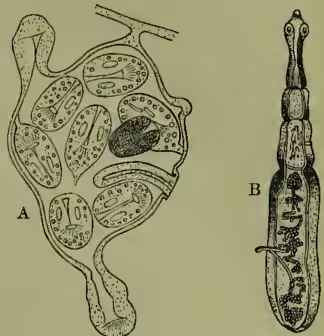
Hydatid (from the Greek hydatis, 'a watery vesicle'), a term applied to the bladder-worm (scolex) stage of certain tapeworms, but particularly to that of Tenia echinococcus, found especially in man and monkeys, ox and swine, in liver, lungs, or almost any organ. The bladder-worm (Echinococcus veterinorum) is often very conspicuous, from the size of a pea to that of a child's head, weighing in some cases 12 to 30 lb., and notable among bladder-worms for its prolific asexual multiplication. From the inner surface, in numerous special brood-capsules of the size of millet-seed, sometimes hundreds of 'heads' are budded off; while daughter-bladders may also be produced externally.
The adult tapeworm is small, and lives socially in the intestines of dog, jackal, or wolf. It is from the dog being kept too much about the house or person that the eggs which give rise to the dreadful Echinococcus find their way to man. The disease is known in most countries of Europe, but is commonest in Iceland. The term hydatid is sometimes extended to other bladder-worms—e.g. the 'stagger-worm' (T. canurus) of the sheep, or in medicine to serous cysts which have nothing at all to do with parasites. See TAPEWORM; and for a very full discussion of Echinococcus, see Leuckart's Parasites of Man (trans. by W. E. Hoyle, vol. i. Edin. 1886).
Hyde, an important manufacturing town of Cheshire, 7 miles ESE. of Manchester, and 5 NE. of Stockport. Standing in a coalfield, and enjoying ample facilities of communication by road, rail, and canal, it has risen from a mere village to a considerable town, which in 1881 was incorporated as a municipal borough. Cotton is of course the staple manufacture; then come the felt-hat industry, engineering, boiler-making, &c. The town-hall is a handsome building. Pop. (1811) 1806; (1861) 13,722; (1891) 30,670.