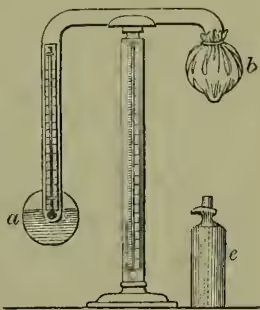
Hygrometer (Gr. hygros, 'moist,' metron, 'measure'), an instrument for measuring the quantity of moisture in the atmosphere. The earlier forms of hygrometer depended upon the property possessed by some substances of readily absorbing moisture from the air, and being thereby changed in dimensions or in weight. Of this kind was the hair hygrometer of Saussure, in which a hair, which expands and contracts in length according as the air is more or less moist, was made to move an index; a similar instrument was the whalebone hygrometer of Deluc; but as other causes as well as moisture affect such instruments they afford no accurate indications. The most perfect hygrometer, theoretically, is that of J. F. Daniell (q.v.). It consists of two bulbs connected by a bent tube, as represented in the figure, and enclosing a thermometer, together with some ether and vapour of ether, the air having been expelled. The bulb b is covered with muslin, and a is either blackened or coated with metal. The observer's hand is placed for a short time on b, to drive the ether into a, leaving b and the tube filled with vapour of ether. A little ether is then dropped from a flask, of the form e, on the muslin-covered bulb; evaporation instantly takes place and produces a cooling of b, which condenses the vapour inside; a fresh evaporation from a fills the vacuum, which is again condensed by dropping ether on b, and the process is repeated till the temperature of a is so reduced by successive evaporations (see EVAPORATION) that dew begins to be formed on the outside of the bulb. At the instant this occurs the height of the mercury in the two thermometers is accurately noted, the one giving the dew-point temperature, and the other the temperature of the air. The actual quantity of moisture contained in a cubic foot of air can now be readily found from the following empirical formula: weight of moisture in grains = ; where t is the temperature of the air at the time of observation, and p (found from tables) the elasticity of vapour at the temperature of the dew-point. The evident defects of this instrument are, first, its rapidity of operation, so that no time is allowed for the glass, ether, and thermometer to come to the same temperature, and in consequence the dew-point is given higher than it actually is; secondly, its costliness, owing to the great consumption of ether; and, thirdly, its uselessness in tropical countries, owing to the difficulty of preserving the ether in a fluid state. Daniell's hygrometer was used at the Royal Observatory, Greenwich, from 1840—the commencement of meteorological observations—till 1847, when it was superseded by the more convenient instrument, the Wet and Dry Bulb Thermometers. This instrument consists of two ordinary thermometers: one has its bulb bare, and thus shows the temperature of the air; the other has its bulb covered with muslin, which is kept wet by a cotton wick dipping into water. The evaporation from the muslin, and consequent cooling of the bulb, being in proportion to the dryness of the air, the difference between the readings of the two thermometers is greatest when the air is driest, and zero when it is completely saturated. The readings of the thermometers being taken, the elastic force of vapour at the dew-point is calculated by the formula of Dr Apjohn:
the first formula to be used when the wet thermometer is above, and the second when it is below the freezing-point (). In these formulae is the elastic force of vapour at the dew-point, which has been determined for different temperatures by Regnault from carefully conducted experiments; , the elastic force at the temperature of evaporation (or reading of wet bulb); , the difference between the dry and wet bulbs; and , the height of the barometer. From this the quantity of moisture in a cubic foot of air, &c. can be found as before. To dispense with these troublesome calculations the Hygrometric Tables of Mr Glaisher may be used, except in very dry states of the atmosphere, such as occasionally occur on Ben Nevis and very dry climates, when Dr Apjohn's formula must be used.