Hyperbola. If two similar cones be placed apex to apex, and with the lines joining the apex and centre of base in each, in a straight line; then if a plane which does not pass through the apex be made to cut both cones, each of the two sections will be a hyperbola, as PBN, P'AN'.
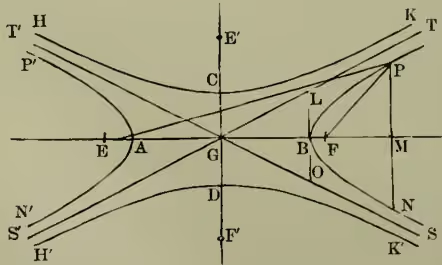
It is, viewed analytically, the locus of the point to which the straight lines EP, FP differing by a constant quantity are drawn from two given points, E and F. These given points are called the foci, one being situated in each hyperbola. The point G, midway between the two foci, is called the centre, and the line EF the transverse axis of the hyperbola. A line through G perpendicular to the transverse axis is called the conjugate axis; and a circle described from centre B, with a radius equal to FG, will cut the conjugate axis in C and D. If G be taken for the origin of co-ordinates, and EM and E'T' for the axes, the hyperbola is expressed by the equation . (, ). The hyperbola is the only conic section which has Asymptotes (q.v.); in the figure these are GT, GT', GS, GS'. It also appears that, if the axes of co-ordinates be turned at right angles to their former position, two additional curves, HCK, H'DK', will be formed, whose equation is . These two are called conjugate hyperbolas, and have the same asymptotes as the original hyperbolas. These asymptotes have the following remarkable property: If (starting from G) the asymptotes be divided in continued proportion, and from the points of section lines be drawn parallel to the other asymptote, the areas contained by two adjacent parallels and the corresponding parts of the asymptote and curve are equal; also, lines drawn from the centre to two adjacent points of section of the curve enclose equal areas. The equation to the hyperbola when referred to the asymptotes is ; which shows that as the ordinates decrease in geometrical progression the abscissæ increase in the same ratio.