Hyrax, a genus of mammals representing a distinct order, the affinities of which are very obscure, and unilluminated by the discovery of any fossil forms. 'Feeble folk' as the species of hyrax (so-called 'cony') are, they find, according to many, their nearest allies in the huge elephants or in the ungulates proper. In size they are like rabbits; but the name 'cony,' which really belongs to the rabbit, is not very appropriate; in appearance they rather suggest marmots. They are natives of
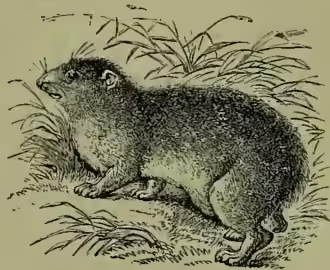
Africa and Syria, and live among the rocks, in stony deserts, or on trees. The plump body, thick head, small ears, short slender limbs, rudimentary tail, soft yellowish-gray or brownish fur are obvious external characteristics. Closer examination shows many peculiarities. The snout, which has a cleft upper lip, is somewhat rodent-like, and so are the rootless, persistently growing curved upper incisors, except that they have a prismatic shape and a sharp point instead of the chisel edge of rodents. The entire dentition is expressed in the formula , and the back teeth are in pattern distinctly like those of the rhinoceros and some other ungulates. There are four toes on the anterior limbs, three on the hind, all with short broad nails except the inner toe of the hind-foot, which bears a curved claw. The feet strikingly suggest those of rhinoceros or tapir, and are interesting in the further peculiarity that the naked sole is furrowed in such a way that the hyrax can in gecko-like fashion cling to the vertical sides of rocks and trees. Among the many characteristics of the skeleton may be noticed the large number (28-30) of back and loin (dorso-lumbar) vertebrae. The brain and skull most resemble those of ungulates; the stomach recalls that of horse or rhinoceros; the placenta is zonary as in elephants and carnivores.
There are numerous species, sometimes referred to two genera, Hyrax and Dendrohyrax. The former is represented by H. capensis, the Cape Daman, Klippdass, or Rock-badger; H. syriacus, the Shaphan—mistranslated 'cony'—of Scripture; and H. habesiniensis, the Ashtok of the Abyssinians. These live in companies, usually in holes among the rocks, and feed on shoots, grass, flowers, and the like. In reference to the Scripture account it may be noted that the hyrax does not chew the cud, though it moves its jaws very constantly. Though only two are born at a birth, the rate of multiplication is very rapid, keeping pace with ravages of carnivores, which are very deadly in spite of the caution and even sentinels of the hyraxes. Of different habitat, and sometimes referred to the second genus, Dendrohyrax, are certain hyraxes which, in West and South Africa, live in trees—e.g. D. arboreus and D. dorsalis. The members of this order, so puzzling zoologically, are playful, good-humoured, and wary.
Their flesh is sometimes eaten, and is said to resemble rabbit's.—Hyraceum, a supposed medicine for certain nervous diseases, was made from the mixed urine and feces of the Cape Hyrax.