Hysteria (Gr. hystera, 'the womb') derives its name from an ancient but erroneous notion that it is specially connected with disorders of the womb. It is a disease which exhibits itself under so many aspects that to describe all the varied forms which it may assume would be to give an epitome of the symptoms of nervous diseases in general, for there is hardly one of these which the mimicry of hysteria may not reproduce. In dealing with the condition two things must be kept in mind—the tendency or temperament which predisposes to it, and the exciting cause which determines the actual attack. Among savages it is scarcely ever met with. Among civilised races it is unequally distributed, the French, for example, being more hysterical than the English, while in every country the female sex, especially at or before the age of puberty, is far more liable to it than the male. Among boys, however, it is not uncommon. The tendency seems sometimes to be due to hereditary influence, sometimes to injudicious training in childhood.
The exciting cause which develops the hysterical tendency into actual hysteria is generally some severe emotional shock—a fright, an unhappy love affair, or a sudden reverse of fortune. But many general diseases occasionally carry hysteria in their train; and in 1889 a volume of nearly 400 pages appeared (The Exciting Causes of Hysteria, by Georges Guinon) dealing solely with the enumeration and discussion of the exciting causes of this Protean malady.
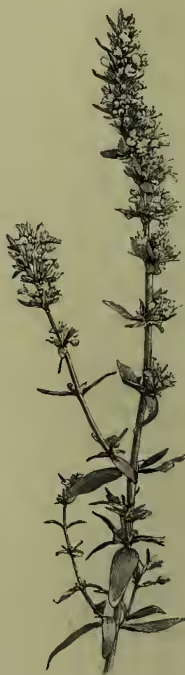
(Hyssopus officinalis).
In the developed disease some of the symptoms are continuous, others occasional or paroxysmal. The will is weakened, and the patient is a prey to unregulated whims and impulses. The temper is often irritable, and every petty annoyance is exaggerated into a serious trouble. There is a morbid craving for sympathy, which leads to the most outrageous acts. Blood has been swallowed by a hysterical girl in order that she might vomit it again. Porter has been mixed with urine, and the mixture palmed off upon the medical man as an abnormal discharge. The most elaborate lies have been concocted; innocent people have been accused of imaginary crimes; every inconvenience has been suffered and every artifice exhausted in order to play upon the credulity or the pity of friends and attendants.
This moral perversion has its counterpart in the disorder of the sensory and motor mechanism. Sensibility to impressions of various kinds may be exalted, lessened, or abolished. A touch may give rise to all the symptoms of severe pain; and, on the other hand, the prick of a pin, or even the contact of a hot iron, may not be felt. Paralysis of the legs, arms, or face, or of one side of the body, or of special muscles or groups of muscles, is a very common symptom. Laryngeal paralysis may reduce the voice to a whisper. Speech or motor power may often return suddenly, especially under the influence of strong emotion; and there is no doubt that 'miraculous' cures are sometimes of this nature. A hysterical paralytic, for instance, will generally run out of a burning house. Digestive disorders are common in hysteria, and, aided sometimes by fraud, give rise to 'fasting girls' and other newspaper marvels. Palpitation, great rapidity of breathing, giddiness, and flushing of the face are also of frequent occurrence.
But besides these more or less continuous symptoms, there are the occasional paroxysms or 'fits' which in the popular mind are chiefly associated with the name of hysteria. These emotional storms or crises vary much in frequency and severity. In the mildest form there is no loss of consciousness, but the arms, legs, and head are tossed about, and there is great mental excitement. In severer cases, perhaps after some premonitory symptoms, such as the sense of constriction in the throat known as the globus hystericus, the patient falls to the ground, sometimes with a scream, her features twitching, her back arched, and her legs and arms moving convulsively. She may snap like a dog at the hands of those who approach her, or at her own, occasionally inflicting serious injuries; but she rarely hurts herself in falling, as often happens in an epileptic fit. The seizure may last only a fraction of a minute, or as long as three or four hours.
The treatment of hysteria must be directed both to the removal or alleviation of the symptoms and to the cure of the condition which gives rise to them. The first object can generally be attained, the second more rarely. The treatment must be both moral and physical, and the former is the more important of the two. In the more severe cases complete change of scene and surroundings is required. The patient should be placed among strangers, and away from the sympathising friends whose well-meant 'coddling' and condolence are often the chief hindrances to recovery. The nurse must be kind but firm; and while the morbid tendencies of the patient are repressed, she must not be laughed at but understood, and encouraged to make essays in self-control. As an alternative to sending the patient away from home, the Weir-Mitchell treatment has met with much success. The patient is kept in bed, isolated except from the attendant, and fed with abundance of easily-digested food, electricity and massage being applied daily.
Particular symptoms must be treated on general principles. Forced feeding by means of a stomach- tube may be required if the appetite is gone or the patient refuses food. A mixture of milk, eggs, meat, and the flour of lentils has been used for this purpose with success. Of late hypnotism has been much employed in France for the treatment of hysterical affections; but this is a method which should be used with caution, for it sometimes aggravates the condition which it is intended to cure.
For prevention of the 'fits' the most useful drugs are valerianate of zinc, iron, morphia, and turpentine. Slight attacks may be warded off by an antispasmodic like ether, or by inhaling nitrite of amyl. To cut short an attack after it has begun a copious douche of cold water to the head is an old and approved plan. A still more effectual proceeding is to close the mouth and nose with a towel for fifteen or twenty seconds. A little cold water poured into the mouth often acts at once. When everything else fails, th to th of a grain of apomorphine, injected under the skin, will end the fit (Gowers).
People with a tendency to hysteria should be encouraged to substitute some rational and regular work for the aimless life of alternate excitement and lassitude which so many of the women of the upper and middle classes lead.