Ibis, a genus of birds related to the Spoonbills, and, more remotely, to the Storks and Herons. It comprises about twenty-five species, of which the bulk belong to the Old World, though the genus is nearly cosmopolitan. The bill is long, slender, curved, thick at the base, the point rather obtuse, the upper mandible deeply grooved throughout its length. The face, and generally the greater part of the head, and sometimes even the neck, are destitute of feathers, at least in adult birds. The plumage is mainly white, with black primary feathers and plumes on the wings. The neck is long. The legs are rather long, naked above the tarsal joint, with three partially united toes in front, and one behind; the wings are moderately long; the tail is very short. The Sacred Ibis, or Egyptian Ibis (I. aethiopica; formerly known as I. religiosa), is an African bird, 2 feet 6 inches in length, although the body is little larger than that of a common fowl. The Glossy Ibis (I. or Plegadis falcinellus) is a smaller species, also African, but migrating northwards into continental Europe, and occasionally seen in Britain. It is also a North
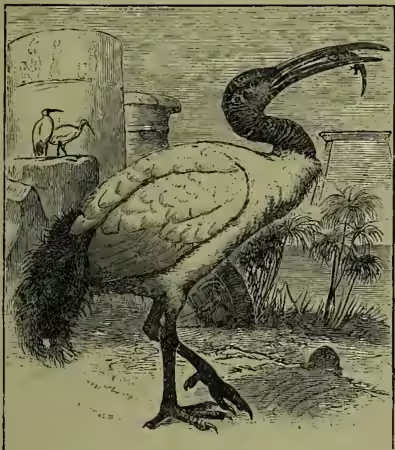
American bird. Its habits resemble those of the sacred ibis. Its colour is black, varied with reddish-brown, and exhibiting fine purple and green reflections. It has no loose pendent feathers. The White Ibis (I. or Eudocimus alba), a species with pure white plumage, abounds on the coasts of Florida. The Scarlet Ibis (I. or Eudocimus ruber) is a tropical American species, remarkable for its brilliant plumage, which is scarlet, with a few patches of glossy black. The Straw-necked Ibis (I. or Carphibis spinicollis) is a large Australian bird of fine plumage, remarkable for stiff naked yellow feather-shafts on the neck and throat.
The Sacred Ibis, one of the birds worshipped by the ancient Egyptians, and called by them Hab or Hib, was supposed, from the colour of its feathers, to symbolise the light and shade of the moon. It was the avatar of the god Thoth or Hermes, who escaped in that shape the pursuit of Typhon. Its feathers were supposed to scare, and even kill, the crocodile. It appeared in Egypt at the rise and disappeared at the inundation of the Nile, and was said to deliver Egypt from the winged and other serpents which came from Arabia. As it did not make its nest in Egypt it was believed to be self-engendering, and to lay eggs for a lunar month. It was celebrated for its purity, and only drank from the purest water; besides which, it was fabled to entertain the most invincible love of Egypt, and to die of self-starvation if transported elsewhere. Its flesh was thought to be incorruptible after death, and to kill it was punishable with death. Ibises were kept in the temples, and unmolested in the neighbourhood of cities. After death they were mummied, and there is no animal of which so many remains have been found at Thebes, Memphis, and some other places. They were prepared as other mummies, and wrapped up in linen bandages, which are sometimes plaited in patterns exter- nally. See Wilkinson, Manners and Customs; and Renouf's Hibbert Lectures (1880).