Induction, in Electricity and Magnetism, is a term of various application. In every case, however, there is a certain idea present—the idea, namely, of an effect produced at an apparent distance from the producing cause, the effect being essentially a reproduction of the cause. More accurately stated, induction is the name of a method or mode by or in which a particular electric or magnetic condition is made to pass from one material system to another without the intervention of any obvious material connection. Thus, in static electricity a metallic body or other conductor brought into the neighbourhood of an electrified body becomes itself electrified by induction. Similarly, a piece of iron or other magnetisable metal, when brought near a magnet, or, more generally, when brought into a magnetic field, becomes itself magnetised by induction. Indeed, according to Faraday's view, induction is the essential feature in all electric and magnetic interaction. These two fundamental cases of induction will be found treated in full under ELECTRICITY and MAGNETISM.
There is, however, a third and very important group of electric and magnetic phenomena to which the name induction belongs. These were discovered by Faraday, and will be treated in a general way under MAGNETISM. The essential peculiarity of this class of induction phenomena is the production of electric currents in conductors or circuits in which there exists no source of electrical energy. These induced electric currents are in all cases the result of some magnetic change in the region occupied by the conductor. This magnetic change may be produced by the approach or withdrawal of a magnet; or it may be produced by the motion of the conductor in a constant magnetic field; or it may be due to variations of primary currents in neighbouring conductors, or even in the conductor itself. In this last case the variations of these primary currents cause corresponding variations in the magnetic fields existing with them, so that the induced current can always be explained in terms of a magnetic change. According to Ohm's Law (see ELECTRICITY), the strength of a current flowing through a given circuit depends on the electromotive force which excites the current, and on the resistance of the circuit through which the current is made to flow. In the case of induction of currents the electromotive force is directly due to, and is measured in terms of, the rate of change of the number of lines of magnetic force embraced by the circuit; and this rate of change depends on the geometrical form of the circuit and on its space relations to the magnetic field surrounding it. Thus the induced current depends on three things—viz. the form of the circuit, the varying space relations of the circuit and the magnetic field, and the ordinary ohmic resistance of the circuit.
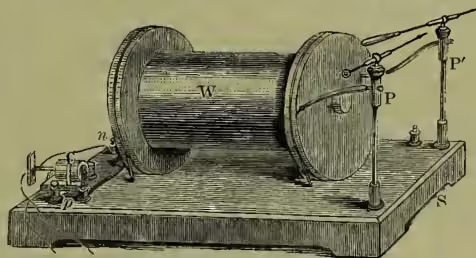
One of the readiest ways of producing induced currents is to have two coils of wire, one placed inside the other, and to pass through the inner or primary coil a current of varying strength. At every variation of the primary current a current is induced in the outer or secondary circuit. The direction of the secondary current depends on the manner of change of the primary. If the primary current is decreasing in strength, the induced current in the secondary circuit flows in the same direction as the primary in its circuit; but if the primary current is increasing, the secondary current flows in the reverse direction. The best effects are produced at the 'making' and the 'breaking' of the primary circuit; for by these operations the primary current is made to have its greatest variations. This is the principle of action of the Ruhmkorff Induction Coil, one of the many forms of which is shown in the figure. The coils are wound, the primary inside the secondary, on the portion marked W. The battery wires, attached to the binding screws, p, n, are brought into connection with the terminals of the primary coil by means of the commutator, C. The terminals of the secondary coil are fixed to the brass heads of the glass pillars, P, P', which are furnished with pointed rods capable of universal motion. The true way of looking at the action of this instrument is to regard the primary current as the source of a magnetic field within and around the coils. To intensify the magnetic field it is usual to introduce a soft iron core into the centre of the coils. In virtue of magnetic induction this iron core, under the influence of the magnetic force due to the primary current, becomes powerfully magnetised, and the magnetic field within the coil greatly increased. When the primary current is interrupted the iron core loses nearly all its magnetism, and accompanying this great decrease in the strength of the magnetic field an intense induced current flows in the secondary circuit. Now it is only when the magnetic field is varying that the induced electromotive force exists; and, since in a given secondary circuit the total current induced is proportional to the total change in the magnetic field, it follows that the more abrupt this change the more concentrated will be the flow of the secondary current.
In the induction coil matters are so arranged that the induced current is sufficiently concentrated to pass across a considerable air-space, which really forms part of the secondary circuit. By taking the terminals of the secondary circuit in our hands we may make ourselves part of this circuit, and experience the curious throbbing sensation of a galvanic shock. Or we may attach the terminals to the platinum wires of a Geissler tube, and produce the beautiful effects of electric discharge through gases in a state of great rarity. In most forms of induction coil the primary current is broken and made automatically, the varying magnetic strength of the iron core being used for this purpose. When the primary current passes, the iron core becomes a powerful magnet, and attracts a small iron disc set opposite one end. By means of a simple form of lever attachment this disc when so moved interrupts the primary circuit. The current then ceases to flow, the iron core loses most of its magnetism, and the small iron disc thus freed returns to its original position. With this return of the disc the primary circuit is again completed, the current flows as before, and the same order of effects is repeated, and so on indefinitely. In the secondary coil there is, of course, a possible induced current at make as well as at break. But, as in such instruments the corresponding magnetic change is not nearly so rapid at make as at break, the induced current is not so concentrated. Hence, practically, in working with an induction coil we have to do only with the induced current due to the interruption of the primary circuit.
The Telephone (q.v.) is an instrument whose action depends largely upon the laws of electromagnetic induction; and in the same category we may include the induction balance of Professor Hughes, which illustrates in a marvellous way the sensitiveness of a variable current flowing in a circuit to the presence of a small piece of metal or other conducting material.