Insectivorous Plants. There are several hundred species of Dicotyledons which in some way or other catch insects and use them for food, either digesting their bodies or simply absorbing the products of their decomposition. They are remarkable for the adaptations of structure and function by which the insects or other small animals are secured, and for their obvious approach to the animal mode of nutrition. For it is a familiar fact that all typical plants feed at what may be called a very low chemical level, obtaining the required carbon from the carbonic acid gas of the air, and the equally essential nitrogen from ammonia, nitrates, and the like in rain-water and soil; while animals, on the other hand, do not derive their carbon from simpler substances than starch, sugar, and fat, nor their nitrogen from a lower source than the albumens manufactured by other animals or by plants. The insectivorous forms, however, break down the distinction in so far as they feed like animals on substances at a high chemical level; and the unity becomes more striking as we recognise that many of the insectivorous plants exhibit marked sensitiveness, mobility, and digestive power.
Altogether there are nearly five hundred species of insectivorous plants, referable to about twelve genera, and to half a dozen Dicotyledonous orders. They are represented in every great geographical region, perhaps with the exception of the African wastes and the Argentine pampas. For convenience of treatment we follow Kerner in recognising three sets: (1) those with pits or cavities, into which small animals enter, but from which they are unable to return—e.g. Bladderworts and Pitcher-plants; (2) those in which the insect-catching depends wholly on the viscidness of the leaves—e.g. Drosophyllum; (3) those which exhibit distinct movements which help to secure the insects—e.g. Sundew and Fly-trap.
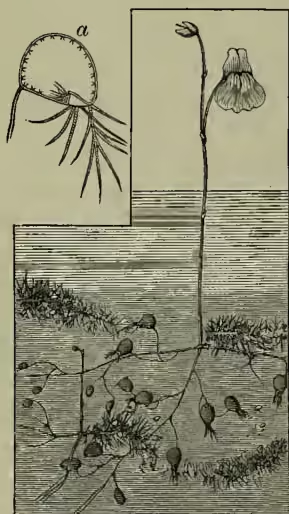
1. With Pit-like Traps.—The Common Bladderwort (Utricularia vulgaris, ord. Lentibulariaceæ or Utriculariaceæ) is a rootless floating water-plant, not uncommon on tarps and marshy lochs, but by no means conspicuous except in summer, when its handsome golden blossoms are raised on a flower-stalk about six inches above the water. Among the slender leaves borne on the straggling floating stem are numerous bladders, to which the plant owes its name. They are much modified dimpled leaf-organs, and form a simple but effective trap. As the figure shows, they are hollow chambers, entered by a door or valve which opens inwards only, and allows of no egress. Tiny crustaceans, known as water-fleas, whether chased by their enemies, attracted by a slight mucilage, or prompted by fatal curiosity, clamber on the antenna-like bristles which project from and perhaps protect the bladders. So far they are safe enough, but if they push their way through the narrow door, they find within the bladder a prison and a tomb. Escape is impossible, death ensues, and the products of decomposition are absorbed by suck- ing cells (fourfold hairs) on the walls of the bladder. Towards the end of summer, when the water no longer swarms with crustaceans, the Utricularia begins to die off, the life is concentrated in terminal buds, the bladders fill with water, and the plant sinks to the bottom. Thence it rises again in spring with a fresh equipment of buoyant bladders. There are numerous species of Utricularia, of which several are aquatic like the above; while others, especially in the tropics, are terrestrial. The booty of course changes with the situation, but the general habit seems to be the same throughout. We can only mention an allied genus, Genlisea, which has traps of a different pattern, approaching those of the pitcher-plants.
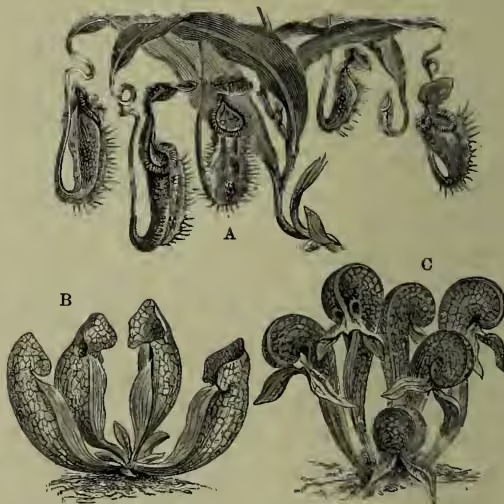
A, Nepenthes Phyllamphora; B, Sarracenia purpurea;
C, Darlingtonia californica.
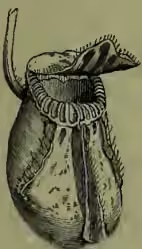
Among the pitcher-plants, the most familiar belong to the genus Nepenthes (ord. Nepenthaceæ), which includes nearly forty species, widely distributed by swamps and jungle pools, 'from New Caledonia and New Guinea over tropical Australia to the Seychelles and Madagascar, over the Sunda Islands and Philippines to Ceylon, Bengal, and Cochin-China.' The young plant has a rosette of half-prostrate leaves, quite unlike those of the adult, with a terminal hooked crest overhanging a slightly hollowed broad lower portion. A stem shoots up, however, bearing other leaves, broad and spatulate in form, ending in a cylindrical tendril, which twists round adjacent branches and develops terminally into a large cavity or pitcher. The tendrils gradually lift the stem, and over the pool there eventually hang dozens of pitchers. These vary in size from a couple of inches to about a foot, are usually brightly coloured with red, yellow, and purplish blotches, and bear two lateral flanges and a terminal lid, which opens when the pitcher attains its full size. Partly by the colour and partly by the honey glands of the lid and pitcher margin, insects are attracted; they sip the sweet secretion and venture farther down, only to land on an exceedingly smooth, waxed, slippery 'conducting surface,' whence they fall into the lower third or half of the pitcher, which contains water and digestive secretion. When an insect falls, the secretion is stimulated and becomes acid. As analysis has shown the presence not only of various acids (malic, citronic, formic) but also of a peptic ferment, the fluid is exactly like that of an animal stomach, and the result is the same.
Another well-known pitcher-plant is Sarracenia purpurea (ord. Sarraceniaceæ), widely distributed in swampy regions of eastern North America from Hudson Bay to Florida. A rosette of half prostrate hollow leaves surrounds an erect flower-stalk. The pitchers are topped by a crest, which is decorated with reddish streaks, and disposed so that it catches rain-drops and lets them slide into the pitcher. Insects are attracted by the sweet secretion of glandular hairs on the lid or crest, wander farther down on a so-called 'conducting surface,' covered with downward-pointed hairs which forbid return, and eventually fall hopelessly into the water occupying the lower part of the pitcher. There they are decomposed and absorbed. Several inches of half-rotten insects are found at the base, rendering the water brown and putrid, and emitting a disagreeable smell. That digestion does not occur seems certain, and the fact is confirmed by Riley's observation that two insects—a fly (Sarcophaga sarracenia) and one of the Lepidoptera (Xanthoptera semicrocca)—brave the horrors of the trap in safety, and utilise the dungheap of rotten insects as a suitable place wherein to deposit eggs. The grubs, which would perish if digestion occurred, thrive well and eventually bore their way through the sides of the leaf. Birds occasionally discover the store of insects and rifle the pitchers with their beaks. While all the species of Sarracenia probably agree in being non-digestive, they present considerable differences of structure, which we cannot here describe. Beside the above species—S. purpurea—may be ranked Heliamphora nutans (from Mount Roraima in British Guiana). In S. variolaris and in Darlingtonia californica (from the Sierra Nevada) the pitcher is capped by a helmet, so that no water can enter; the contained liquid must therefore be wholly a secretion, though still only putrefactive. Finally, S. drummondii and S. undulata are in external form almost nearer to Nepenthes and Cephalotus than to the other species of Sarracenia.
In the two species of Sarracenia last mentioned only some of the leaves are modified into pitchers, the others remaining green, lance-shaped, and unhollowed. So is it with Cephalotus follicularis
(Cephalotaceæ, near ord. Ribesiaceæ), which is restricted to a limited area near Albany in Western Australia. Here in the usual basal rosette only the lower leaves are pitchers, two inches or so in height, best adapted for catching ants and ground-loving insects. The outer surface bears ridges which help the insects up, and there are the usual attractions of bright colour and sweet secretion. Intoxicated, it may be, with the honey, or merely inquisitive and unwary, the visitors pass from the sides or from the half-open lid to the slippery though corrugated margin, and thence fall into the liquid which fills half the pitcher. Endeavours to return are balked by a projecting shelf, by an area beset with stiff downward-pointed papillæ, and by sharp spines round about the inturned margin of the collar. As the glandular secretion has an acid reaction and a solvent power, Cephalotus is also to be credited with true digestion.
In regard to the morphology of the pitchers, we shall simply cite the recent conclusions of Macfarlane: (1) The leaf in Nepenthes, Heliamphora, Sarracenia, and Darlingtonia is compound, and consists of from two to five pairs of leaflets; (2) there is a marked tendency to dorsal fusion of the leaflets from apex to base; (3) such fused leaflets are seen in the broad basal part of Nepenthes leaf, and in the flaps and lids of the various pitchers; (4) the pitcher itself is a deep dorsal involution of the midrib just above the termination of the fused upper pair of leaflets, except in Cephalotus, where, as Dickson clearly showed, it is an involution of the leaf-blade.
Very different from the pitcher-plants, and with appliances less involved for insect-catching, is the Toothwort (Lathræa squamaria, ord. Scrophulariaceæ), a pale, chlorophyll-less parasite found in British woods, battening on the roots of trees and shrubs. Excepting the flower-stalk, the stem is virtually underground; it bears suctorial roots and tooth-like leaves. The latter are hollow, and are entered through a narrow aperture by many kinds of small animals. These seem to be entangled in protoplasmic exudations within the leaf-cavity, find exit impossible, die, decompose, and are absorbed. Along with the toothwort ought also to be ranked Bartsia alpina, whose underground buds show a somewhat similar structure and carnivorous habit.
2. Plants which catch Insects by Viscid Secretion without Pits or Movement.—The best representative of this set is Drosophyllum lusitanicum (ord. Droseraceæ), a native of Portugal and Morocco, growing with luxuriance in sandy or rocky places, to a height of about a span. The long linear leaves are richly beset with glands, many borne on long stalks, red in colour, and copious in an acid, viscid, dewdrop-like secretion, the others invisible to the naked eye, without stalks, colourless, and with an acid, dissolvent secretion, which is only exuded in response to the stimulus of some nitrogenous substance. Insects of various kinds alight on the long leaves, knock off the drops from the stalked glands, move anxiously about knocking off more and more until they are thoroughly besmeared, and their tracheæ choked. Giving up the struggle, they sink on to the surface of the leaf, where the sessile glands begin the dissolvent and absorbent process. Kerner notes that the insect-catching is so effective that the peasants about Oporto use the Drosophyllum in their dwellings as a convenient substitute for fly-paper.
3. Plants which exhibit Distinct Movements in their Insect-catching.—The Common Butterwort (Pinguicula vulgaris), belonging to the same order as Utricularia, is a widely distributed representative of a genus including about forty species, all growing on more or less marshy ground (see fig. at BUTTERWORT). From a rosette of plump glistening leaves there rises for several inches an upright stalk, bearing a beautiful two-lipped, spurred flower of a violet colour. The leaves have a distinct fungus-like odour, doubtless attractive, and are covered with glands, some stalked like miniature mushrooms, others almost sessile, both with a copious, viscid, acid secretion. This serves as 'insect-lime,' but, besides retaining the unwary midges, it finally digests them. Drops of rain may fall on the leaves, or pebbles may land there, but without noteworthy effect; a small insect, however, stimulates a copious flow of the fatal secretion. But there is also movement; for, when an insect is caught, the margins of the leaves slowly curl inwards for an hour or two, thus surrounding the booty, or shifting it nearer the centre, in any case exposing it to more glands. After digestion, the results and the surplus exudation are absorbed, leaving finally the undigested skin of the insect on the more or less dry leaf surface. More than 150 years ago Linnæus noted how the Lapps used the butterwort for curdling milk, a property due to a rennet-like ferment which the plant has in addition to the digestive or peptic. The antiseptic qualities of the ferments perhaps justify another old custom of applying the leaves to the sores of cattle.
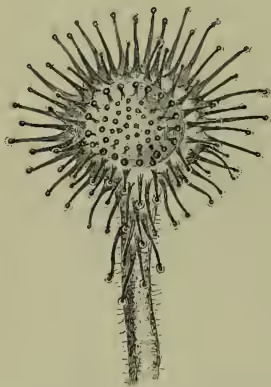
Beside the butterwort on the marshy moor we are likely to find Drosera rotundifolia (ord. Droseraceæ) or some other species of sundew. Again, we have a rosette of prostrate leaves, from amid which rises a stalk with inconspicuous whitish flowers. Very striking, and constant in the forty or so species, are the red glandular 'hairs,' 'tentacles,' or processes which grow at different lengths from the upper surface and margins of the leaf. These are complex little structures with a head of glandular cells, supplied by numerous water-pipes (wood-cells or tracheides), and surrounded externally by a drop of viscid secretion. These tentacles are sensitive, mobile, secretory, digestive, and absorptive. To drops of rain they are indifferent, to irritant particles they may respond by increased secretion; but when a midge or a small particle of nitrogenous food is placed upon them, they become marvellously though by no means rapidly active. A living midge, which mistakes the secretion drops for nectar, lights on the leaf, and is forthwith entangled; as it struggles it becomes more hopelessly besmeared, and meanwhile the secretion becomes cent leaves. The sensitiveness is finer than our most delicate nerves or balances, for a sundew hair will respond to a millionth of a grain of stimulating nitrogenous matter. The response is marked by the increased secretion and by the bending, while internal changes are traceable under the microscope passing from one cell to another down the tentacle. As one leaf may be seen with the remains of a dozen insects, and as there are half a dozen or so well-formed leaves, the carnivorous diet of the sundew is often considerable, and it has been demonstrated that the yield of seeds is better in those which are able to gratify their natural appetite.
Venus's Fly-trap (Dionaea muscipula), which Linnaeus called the miracle of nature, is in several ways a more elaborate insectivorous plant than any of the above, and is the climax of the order Droseraceæ. A native of the east of North America, with very local distribution, from Long Island to Florida, it grows on moorland, with a circle of more or less prostrate leaves round the base of a many-flowered stalk, which rises 4-6 inches from the ground. The leaves, about 4 inches in length, consist of a spatulate stalk, which is constricted to the midrib at its junction with the broad blade. The halves of the blade are movable on one another along the midrib, and close together as this volume would do if fitted with an automatic closing spring. Round each margin are twelve to twenty long teeth, which interlock in rat-trap fashion with those of the opposite side; the centre of the leaf bears numerous rosy digestive glands; and there are on each half of the blade three sensitive hairs, which rise obliquely, but bend flat on a basal joint when the leaf closes. The blade shuts up in 8 to 10 seconds when one of the sensitive hairs is stimulated, and if an insect is caught in the trap a profuse secretion is exuded from the glands. Digestion goes on for a week or a fortnight according to the size of the booty; finally the digested material and the secretion are absorbed, and the leaf then reopens. There is evidently division of labour to a greater extent than in the sundew, for the marginal teeth, the sensitive hairs, and digestive glands have separate functions. The delicacy of sensitiveness, the rapidity of movement, and the copiousness of the digestive secretion are noteworthy, while it is also significant that Burdon Sanderson has detected electric currents similar to those observed in the neuro-muscular activity of animals.
Superficially somewhat like the bladderwort, in its leaf-structure very like Dionaea, is an aquatic plant, Aldrovanda vesiculosa (ord. Droseraceæ), at home in south and central Europe, flourishing in ponds and pools where clear water is warmed by the summer sun. A thin rootless floating stem bears whorls of peculiarly modified leaves, dies away at one end as it grows on the other, forms in autumn a concentrated terminal tuft, which sinks to the mud at bottom and hibernates. Thence it rises again in spring lightened of its stores of starch and with buoyant air-spaces. The leaves consist of a spatulate stalk and a broad blade, which folds along the midrib like that of the fly-trap. The margin is firm, with small teeth, which meet those of the opposite side when the leaf is closed; externally a few long bristles project; the surface bears numerous longish hairs and also small stellate structures; there are large and small glands. When the water-fleas, insect-larvæ, or even diatoms rest on the surface of the leaf, the half-blades close quickly as in the fly-trap, the victims are imprisoned, and, though they may remain alive for some days, there seems no doubt of their final absorption. Other species of Aldrovanda from Australia and Bengal seem to have the same habit.
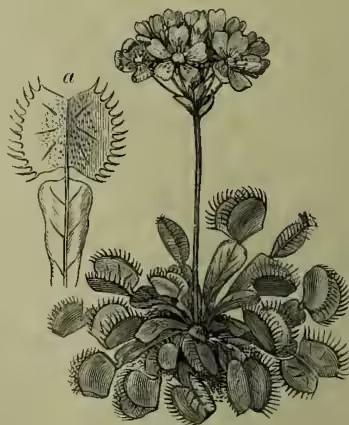
a, leaf.
Besides the true insect-catchers noted above, there are not a few plants—e.g. among the Saxifragæ, Sedunæ, and Primulæ, on the glandular surfaces of which insects are often entangled. These plants suggest how the insectivorous habit might begin, and there are two species in the sundew order, Roridula dentata and Byblis gigantea, in which the insect-catching seems to be more than incipient. Among the possibly insectivorous forms we must also include a Brazilian fern, Elaphoglossum glutinosum, and several liverworts—e.g. Anomocladus mucosa and Physiotum cochleariforme. Zopf has recently described an interesting fungus (Arthro- botrys oligospora) which catches small threadworms in great numbers in its nooses, riddles their bodies with a growth of fine threads (hyphæ), and absorbs the tissues.
Utility.—The adaptations for catching and utilising insects are so numerous and effective, that we are apt to conclude too readily that the insectivorous habit is not only advantageous but necessary for the health of the plants. There are, however, several facts which suggest caution. Thus it has often been noticed that a leaf of sundew or fly-trap may suffer, and even die, from the effects of too big a meal, a serious enough objection to utility were the casualty not as rare in nature as it is common in experiment. More important is the difficulty raised by cultivators, who point to all sorts of insectivorous plants flourishing perfectly without any insect food. To this it can be retorted that the natural conditions of scanty nitrogenous supply are probably not observed in the greenhouse, but the facts force us to abandon belief in the necessity of the insectivorous habit. We can only maintain that it is normally advantageous, a conclusion confirmed in some cases by the decrease in the quantity and quality of the seeds when no insects are available. From this, however, we need not conclude that the insectivorous function is the complete or even the original function of any of the curious leaf-structures above described.
Physiological Summary.—(1) It is a familiar fact that sundew and butterwort generally grow among bog-moss on the moors, hardly rooted in the soil, and therefore less adapted than ordinary plants to suck up the all-important nitrogenous compounds. The same relative scantiness in nitrogenous supplies is more or less marked in the habitats of other insectivorous plants, and doubtless renders them more dependent on their peculiar animal diet. All are said to be averse to the presence of much lime. (2) The diet is to some extent a matter of chance; both creeping and flying insects, small flies and even large moths, besides spiders, and centipedes are caught by the terrestrial and pendent traps. The aquatic bladderwort's most frequent victims are the small crustaceans known as Cyprids; while the subterranean Lathraea's prisoners vary from the rank of mites down to infusorians. (3) The attractions of insectivorous plants are manifold; a mushroom-like odour in the butterwort lures insects which frequent fungi, and some of the others also appeal to the sense of smell; the 'dew-drops' of Drosera, the rosy patch on the fly-trap, the bright colours of many pitchers are obvious enough charms; while the frequent exudation of honey is the most direct lure of all. (4) In Nepenthes and Cephalotus, Drosera and Drosophyllum, Dionæa and Pinguicula, the bodies of the insects caught are digested, that is to say, chemically altered into soluble substances, which are absorbed by the cells of the leaf. The process agrees with animal digestion in the net result, and in the presence of a peptonising ferment and an acid. Too little is known about the ferment or ferments, and also about the various acids present; but there is no doubt in regard to their digestive activity. It is very important, however, to recognise, with Morren and others, that in plants digestion and the activity of ferments are by no means confined to the insectivorous forms. Thus the diastase which in germinating seeds, &c. turns starchy material into sugar is virtually the same as the ferment in the saliva, &c. of animals; similarly in both plants and animals there is an inverting ferment which turns cane-sugar into grape-sugar; there is also an emulsifying or saponifying ferment in plants, acting on fats and oils in a manner comparable to part of the rôle of the pancreatic juice. J. R. Green has described a rennet-forming ferment, comparable to that of the calf's stomach, not only in Pinguicula, but in the flowers of Gallium verum, in the stem of Clematis vitalba, in the petals of the artichoke, &c.; finally, a peptonising ferment has been detected not only in insectivorous plants, but in such diverse situations as the latex of Carica papaya and the seeds of Vicia. The protoplasmic changes of plants are comparable to those of animals not only fundamentally, but also in many details, and the insectivorous plants are not unique, but simply conspicuous illustrations of vegetable digestion. (5) There is no doubt that both the products of digestion and the results of decomposition are absorbed by the insectivorous plants. Large stomata, protruding papillæ, suctorial 'hairs,' and other structures in the different plants are sometimes credited with this function, about which little definite information is yet forthcoming. An interesting, if hardly conclusive, corroboration of the absorbent activity is given by Clark, who fed Drosera with flies saturated in citrate of lithium, and some days later detected with the spectroscope the presence of the metal throughout the whole plant, in fact even in the flower. (6) The sensitiveness so marked in sundew and fly-trap is not of course unique, but is illustrated in the leaves, tendrils, stamens, stigmas, &c. of many plants, and may be compared—though we cannot go much further—with that of animals. Both Drosera and Dionæa respond to various kinds of stimuli, but usually and most readily to that of nitrogenous substances. Darwin gives numerous illustrations of the sundew's sensitiveness to extremely homœopathic doses ('000095 of a milligramme) of nitrate of ammonia and the like. In the fly-trap the sensitiveness, as we have seen, is definitely localised in the six jointed hairs. (7) The movements of sundew, fly-trap, and Aldrovanda, like those in the leaves of the sensitive plant or the stem of the hop, the stamens of the barberry or the stigma of Mimulus, are associated with changes in the cells of the plant. It is easy enough to compare the movements with those of contracting muscles; but we are still far from being able to work out the comparison or determine the divergence. Four points may be noticed: (a) In the tentacles of Drosera the movement is associated with a visible change in the contents of the cells. Darwin described this, perhaps mistakenly, as 'aggregation of the protoplasm,' and compared it with analogous changes seen elsewhere. From what we know of movement in other plants, it is likely that the activity of the insect-catchers is connected with a change in the water tension or turgidity of the cells. (b) In the movement of Dionæa Darwin detected a measurable contraction or alteration of form; the same has been seen by Cohn, Haeckel, and others in the mobile organs of other plants, and at once suggests the change of form in muscle-fibres. (c) Though there is no trace of anything like the nerves of animals, there is no doubt that a stimulus provoking motion passes from cell to cell and from part to part in both sundew and fly-trap. (d) Finally, Burdon Sanderson has described a resting and an action current of electricity in Dionæa, and concludes that 'the property by virtue of which the excitable structures of the leaf respond to stimulation is of the same nature as that possessed by the similarly endowed structures of animals.'
Although our knowledge of insectivorous plants dates from 1768, when Ellis sent to Linnæus a description of the fly-trap and its habits, structural investigations prevailed until Darwin in 1860 began the thorough experimental study of insectivorous plants, comparing their sensitiveness, mobility, and digestive powers with those of animals. Since then the physiological interest of these plants has been kept steadily in view, our analysis of their vital processes becoming with each year more complete. At the same time, the morphology, especially of the pitcher-plants, has been studied with great success. The most difficult question concerning the origin and evolution of the insect-catching structures and functions is still a problem of the future.
See the following general works from which a guide to the vast literature will be obtained: C. Darwin, Insectivorous Plants (1875); O. Drude, in Schenk's Handbuch der Botanik (vol. i, 1881); P. Geddes, article 'Insectivorous Plants,' Encyclo. Brit.; A. Kerner von Mariann, Pflanzenleben (vol. i, 1887); J. Sachs, Physiology of Plants, trans. by Marshall Ward (1887); S. H. Vines, Physiology of Plants (1886).