Izard, the Pyrenean Ibex. See GOAT.
J
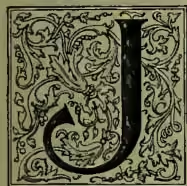
is the latest addition to our alphabet, and has been inserted, as the tenth letter, after i, from which it was developed, just as v and w follow u, out of which they arose. In the 14th century it became the fashion, in Provençal and Catalan MSS., to lengthen the letter i into the form j, with a tail turned to the left, as a sort of ornamental initial at the beginning of words. The consonantal sound usually occurring at the beginning, and the vowel-sound in the middle or at the end of words, the initial form j after a while became conveniently but undesignedly specialised to denote the consonantal sound, the medial form i being retained for the vowel-sound. In the 15th century this usage, which never reached Italy, spread to France and England, but it was not before the middle of the 17th century that it became universal in English books, as is shown by the fact that in King James's Bible of 1611 the words Jesus and judge are printed Iesus and iudge.
The dot over the j is a curious survival. It is unnecessary as a diacritical mark, which it originally was (see I), as there is no danger, in its present form, of confusion with any other letters. The dot remains as a witness not only that j was developed out of i, but also of the fact that the evolution of j was later than the practice of dotting the i.
In English the symbol j is used to denote the sound of dzh, as in journal; in French of zh, as in four; in Spanish it represents the hard ch, heard in the Scotch loch, as in Jerez; in German it retains the original y sound of the Latin consonantal i, as in Jahr. Thus, while German geographers write Jenissei and Jakut, English maps have Yenissei and Yakut.
The consonantal sound of the English j is frequently expressed by g, as in gem or gin, or by ge, as in knowledge. The sound did not exist in Early English, but was introduced from France after the Norman Conquest. Hence in Middle English, before the symbol was invented, we find the sound represented by other devices. Thus, we have Gives for Jesus, gecte for jest, chaw for jaw, and cham for jam. Chaucer has gailer where the Bible has jailor. The use of j is still extending, and we find jibe, jaul, and Jeffrey occasionally used, instead of the more correct forms gibe, gaol, and Goffrey.
We have unfortunately introduced our acquired French sound of j into Latin words which had the consonantal i, which the Romans pronounced as y; and we say jam, jugum, juvenis, Jupiter, juncus, jacio, hujus, and major, where the Romans said yam, yugum, yjuvenis, Yupiter, yuncus, yakio, hujus, and major. In some inscriptions of the early imperial age the consonantal sound of i is denoted either by doubling the letter or writing it as a capital; 'huius,' or 'huIus,' representing the older spelling huus. In inscriptions of the later empire we find Giove for Jove, a usage adopted in modern Italian, in which we have Gesu, Giovanni, Giuseppe, and maggiore, from Jesus, Johannes, Josephus, and major, the use of the new letter j being evaded in the same manner as in Middle English.