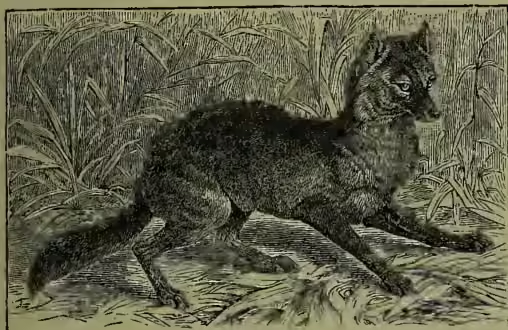
Jackal (Persian shaghāl, Fr. chacal), the name of a number of species of the genus Canis (see DOG), which are in many respects intermediate between the wolves and foxes. Canis aureus, being the most typical and widespread form, sometimes goes under the name of the Common Jackal. It measures about 3 feet in length, one-third of which is occupied by the tail, whilst the height is about 18 inches. The animal's build is strong, the muzzle is more acute than that of the wolf, blunter than that of the fox, and the bushy tail hangs down as far as the heel. The ears are short, less than one-fourth the length of the head, and far apart; the pupil of the eye is round. The colour is difficult to define: its ground-tint is a dirty fawn or grayish-yellow, becoming blacker on the back and sides; the under surface is white, reddish-yellow, or gray, and there are not unfrequently ill-defined dark bands on the shoulders and hind-quarters. The home of this species is the southern part of Asia, from India (including Ceylon) over Persia, Arabia, Palestine, and Asia Minor. Hence it has spread, perhaps following the track of armies, to North Africa, the Morea, and Dalmatia. In its habits as well as in its structure it exhibits characters intermediate between the wolves and foxes; like the former it hunts in packs, like the latter it is nocturnal. When on the chase these animals howl most dismally, and make the night hideous in regions where they abound. The singularly appropriate Arabic name Deeb ('howler') has reference to this habit. So far from avoiding the proximity of man, they penetrate into villages in search of offal and carrion, and they will also enter yards, houses, or tents in the most shameless manner, and carry off whatever takes their fancy, sometimes articles absolutely uneatable. They render a certain amount of service as scavengers and by killing vermin, such as mice, but this is by no means an equivalent for the damage they cause by their depredations in sheepfolds and poultry-yards, as well as orchards and vineyards. In many districts they constitute a veritable scourge, and can only be held in check by their congeners the dogs. They follow the larger carnivores to feed upon their leavings, a habit which has given them the reputation of being 'the lion's providers.' They are extremely cunning, and in oriental fable and proverb take the place of our Reynard in this respect. The word 'fox' in the Old Testament probably refers in many cases to them. According to Sir Emerson Tennent, they habitually hide their booty, and if observed will seize some indifferent article and make off with it, as though that were the object of their solicitude, returning to their real spoil at the first convenient opportunity. The skull of certain jackals has a horny outgrowth some half-inch in length, eagerly sought for as a charm. Jackals are readily tamed, and the likelihood that they have given rise to some of the domestic dogs has already been alluded to (see DOG). The
Striped Jackal (Canis lateralis, C. adastus) is a connecting link between the wolf and jackal. The extreme length is a little over a yard, and the height rather less than half this; the pupil of the eye is somewhat elliptical and oblique, the ears widely separated. The species is rather rare, but has a wide distribution in Africa south of the Sahara. The Jackal-wolf (Canis anthus) is even more wolf-like than the last, and has been classed by different authors among the wolves or jackals. It is much smaller than the wolf, and inhabits Northern Africa. The Black-backed Jackal (Canis mesomelas) is somewhat more fox-like than the others, especially in the form of the head. The general build is low. The ears are large and close together, recalling those of the Fennec (see FOX). The area of distribution of this species extends from Middle Nubia down the east side of the continent to the Cape, and perhaps across to the west coast also.