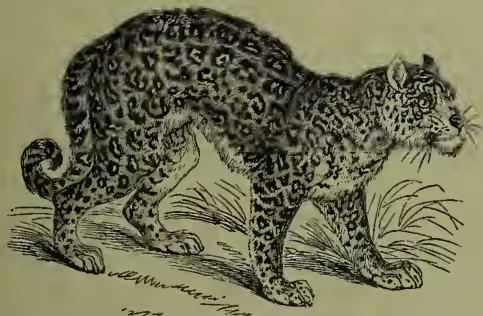
Jaguar (Felis onca), one of the largest and most beautiful of the Felidae, and by far the strongest and fiercest of the American beasts of prey. The jaguar is nearly equal to the tiger in size, but is less massive, and has shorter legs. The soft, rich fur varies in colour from yellowish-white to very dark brown or black; the sides, shoulders, and thighs are marked with dark ring-like spots, larger, and arranged in more regular patterns than those of the leopard. Each ring usually encloses several small black points. The black-furred jaguar is sometimes regarded as a different species, but the characteristic markings can be seen in certain lights, and the ground-colour varies greatly even in members of the same litter. The jaguar is found all over South America except in some parts of Patagonia, and in North America as far north as the borders of Texas and South California, inhabiting chiefly the outskirts of forests and the shady banks of rivers and lakes. The food of the jaguar is very varied. Wild horses and mules are his favourite prey, but birds, turtles, and fish are readily eaten, while he is often forced to depend for subsistence on the timid, stupid capybaras. The flesh of the peccary, too, is a dainty which he exercises all his ingenuity to procure, for even a jaguar dare not openly attack a herd of these courageous little pigs. His method, it is said, is to conceal himself in a tree till a herd passes, drop down on one and kill it, then spring into the tree again and wait patiently until the angry herd is a safe distance off. The jaguar is hunted sometimes with the lasso, but most frequently with dogs and poisoned arrows, and the skins are imported into Europe in large numbers.