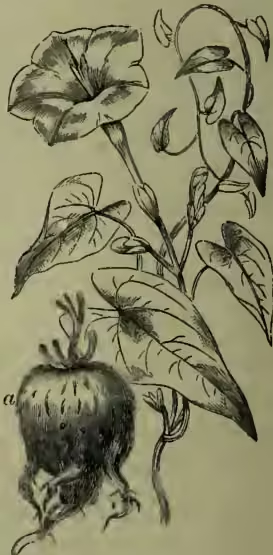
a, the root.
Jalap, a well-known purgative medicine, is the root of Ipomœa purga, a plant of the natural order Convolvulaceæ. It is a native of the eastern slopes of the Mexican sierras, growing at an elevation of about 6000 feet. Named from the town of Jalapa, it is a perennial twining plant, with large flowers and a turnip-like root, varying from the size of a hazel-nut to that of a man's fist. The roots when fresh are white and fleshy, and abound in a milky juice. They are dug up at all seasons of the year, and hence one great cause of their variation in size and activity. After being dried the roots are brown and wrinkled externally, of a deep yellowish-gray colour internally, and have the consistence of wood. Their odour is faint and disagreeable, and the taste is nauseous. For use in medicine the roots are finely powdered. Jalap-root contains starch, sugar, lignin, and other ingredients, but the active principle is a resin which is official under the name of Jalapae Resina. The amount of this resin varies from 12 to 21 per cent. It is extracted from the root by means of dilute alcohol, and consists chiefly of a body called convolvulin. Jalap is a hydragogue cathartic, and may be given alone or in combination with calomel or cream of tartar. It and its preparations are used in constipation, renal disease, and cerebral affections. Its action is limited to the production of severe purgation. Jalap was first used in England about the beginning of the 17th century. The ordinary dose of powdered jalap for an adult varies from ten to thirty grains, a scruple generally acting smartly and safely; for children under a year old the dose is from two to five grains. The dose of the compound powder is double that of the ordinary powder.