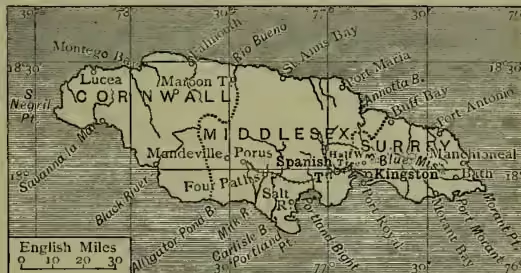
Jamaica, aboriginally Xaymaca ('Land of Springs'), one of the West India Islands, and by far the most important of those belonging to Great Britain, is about 90 miles to the south of Cuba, and stretches between 17° 43' and 18° 32' N. lat., and between 76° 11' and 78° 20' W. long. It is divided into three counties, Surrey in the east, Middlesex in the middle, and Cornwall in the west; its area is 4193 sq. mi., or a little more than the three English counties of the same names with Hampshire thrown in. The greatest length is 144 miles; the greatest breadth, 50 miles. Turk's and Caicos Islands, as well as the three Cayman Islands, are dependencies of Jamaica. The island is traversed from east to west by the Blue Mountains, which rise to 7400 feet. From this range nearly 120 streams descend to the coasts, but owing to the shortness and steepness of their courses they are not navigable, with the exception of Black River, which affords, for small craft, a passage into the interior for 30 miles. Excellent harbours are everywhere to be found. Incomparably the best of these is Kingston (q.v.) harbour, a deep and capacious basin in the south-east quarter of the island. Jamaica is believed to be rich in mineral wealth, but no minerals are extracted. The chief towns are Kingston (pop. 46,542), the capital, and Spanish Town, formerly the seat of the government (pop. 5019), on the south-east of the island; and Montego Bay (pop. 4863), Savanna-la-Mar (2952), on the south-west, and Falmouth (pop. 2517). Port Royal, situated at the western extremity of the spit of sand that shuts in the harbour of Kingston on the south, which, previous to the great earthquake of 1692, was one of the chief cities in the West Indies, is now a place of only 1200 inhabitants, though still a naval station.
The climate varies considerably, falling on an average 1° for every 300 feet in altitude. At Kingston, on the coast, the thermometer is nearly all the year round at 70° during the night and 90° during the day, the mean thus being 80° or 81°; but the heat is tempered by the sea-breezes. A corresponding regularity is observable in the upland regions. On the whole, the island is very healthy; invalids even come from the United States to enjoy the benefit of the salubrious air of the interior.
There are two rainy seasons, one in the middle of spring and the other towards the middle and end of summer. In the latter the rains are exceptionally heavy; violent thunderstorms are frequent, and hurricanes sometimes occur. A cyclone in 1880 did damage to the extent of more than a million sterling.
The vegetation is very luxuriant. The primeval woods are rapidly disappearing; yet there are still many valuable trees, such as balata, mahogany, logwood, lignum vitae, fustic, ebony, pimento, cocoa-nut and other palms, cactuses, &c. Tropical fruits are grown in great variety, also many of the fruits of more temperate climes. Fruits were exported to the value of £347,652 in 1888 (£39,451 in 1878). Spices, dye-woods, medicinal plants, and food plants, such as ginger, cochineal, castor-oil, arrowroot, maize, vanilla, pimento (allspice), &c., are extensively grown. A large extent of the cultivated area (one-fifth) is devoted to the growing of Guinea grass. This and pasture land occupy the greater portion of the north and west of the island. In the south and east the principal crops are sugar (33,600 acres in 1888, 12,800 less than in 1878), coffee, vegetables, and fruits. A little cinchona and cacao are also grown. The mongoose, imported to prey on the rats that infested the sugar estates, has, after exterminating the rats, become a plague, and has nearly extirpated lizards, harmless snakes, and small birds, so that insect pests (especially the troublesome ticks) abound. The negroes, who are mostly small holders, are the chief growers of fruit. The exports, which consist chiefly of dye-woods, fruits (oranges, lemons, bananas, pine-apples, &c.), sugar and rum, coffee, ginger, allspice, and cocoa, average fully 1½ million annually; whilst the imports, consisting of food-stuffs, clothing, hardware, liquors, coals, building materials, &c., reach pretty nearly the same value. About 40 per cent. of the trade is with the United Kingdom, and the share with the United States 43 per cent.
During the past thirty years the white inhabitants have increased far less rapidly in numbers than the black and coloured population. In 1861 the total population was 441,255 (13,816 white and 427,439 black and coloured); in 1871 the figures were respectively 506,154 (13,101 and 493,053); and in 1881, 580,804 (14,432 and 554,132, besides
Chinese and others, and 11,016 immigrant coolies). In 1891 the population had increased to 639,491. By religion 32,300 belong to the Church of England, 30,000 are Baptists, 22,000 Methodists, 10,800 Presbyterians, 9290 Roman Catholics, 16,000 of the Moravian Church, and 9900 of other churches—children being excluded. In 1895 there were 924 government schools, with 98,359 pupils; besides two government training colleges for teachers. Secondary education is left to private initiative. Jamaica has 185 miles of railway and 950 miles of telegraph. The total exports in 1896 had a value of £1,470,241; the imports of £1,856,378. The defences of the island include a British garrison (the West India regiments) of more than 1000 men, a volunteer force of 600, and numerous coast batteries. There is also a semi-military police force of about 700 men. The public debt of the island amounted to £2,220,089 in 1896. The government is in the hands of a governor appointed by the Queen, assisted by a privy-council (which fulfils the offices of an executive) and a legislative council, both partly elective, partly nominated by the Queen or the governor.
Jamaica was discovered by Columbus in 1494, and definitely taken possession of by the Spaniards in 1509. The original inhabitants were peace-loving Indians (not Caribs); but they were practically extinct in 1655, when the island was conquered by the English, an expedition having been sent out for that purpose by Oliver Cromwell, under Admiral Penn and Venables. Jamaica was formally ceded to England by the treaty of Madrid in 1670. The place of the native Indians was taken by negro slaves, imported by the Spaniards, and by Irish and colonial immigrants, who arrived soon after the capture of the island. During the 18th century more than half a million slaves were brought over from Africa. Under English rule the chief events in the history of Jamaica were frequent rebellions of the Maroons, a community of runaway slaves, who had obtained a tract of land on the north side of the island; in 1831–32, a negro insurrection; and on August 1, 1834, the emancipation of the slaves, Jamaica receiving £6,161,927 as her share of the compensation money. The chief result of this last event was to ruin the sugar-growing of Jamaica, principally owing to the difficulty of procuring labour. The negroes refused to work, now they were free. The liberation was followed by concessions of representative and constitutional rights to the newly-liberated slaves. But the experiment proved a failure. The negroes considered it a grievance that offices in the magistracy were not more frequently conferred on them. They wished to suppress coolie immigration, which tended to keep down wages. They sought to obtain land without rent. The more violent even suggested the expulsion of the whole white population of the island. In 1865 the discontent was at its height. In October of that year the negroes rose in revolt and massacred twenty-three whites. Martial law was proclaimed by Governor Eyre, who suppressed the rising with resolute vigour, though the punishments inflicted on the rioters were in some cases perhaps unnecessarily severe. For the course he had taken Governor Eyre was thanked by the Jamaica Assembly; but in England a different view was taken of his conduct (see EYRE). He was recalled, and the representative constitution was suspended. A new constitution was framed in 1866, under which the island is now governed like an ordinary crown colony. There seems to be good authority for the statement that from the catastrophe of 1865 a new life has sprung. Crime has diminished; and education has everywhere advanced among the black population. A collection of Jamaica products was exhibited with very satisfactory results at the Philadelphia Exhibition of 1876; and an exhibition in Jamaica of native products was opened in the autumn of 1890. New roads have been formed, harbours are being constructed, and the Rio Cobre irrigation canal, begun in 1872, will give fertility to 50,000 acres of the plain between Spanish Town and Kingston. Thanks to the Cuban refugees who have taken several of the long-forsaken sugar estates, property is looking up, and the official statements show that the export trade is increasing, though slowly. Although Jamaica has not recovered its former commercial prosperity, the negroes cannot now be described as idle. They cultivate their provision grounds with care, and are especially active in developing the fruit trade. Extreme poverty is unknown among them, and they are described as a law-abiding and inoffensive community. See the Jamaica Handbook, issued at the government printing-office, Kingston; and Harper's Magazine, 1890.