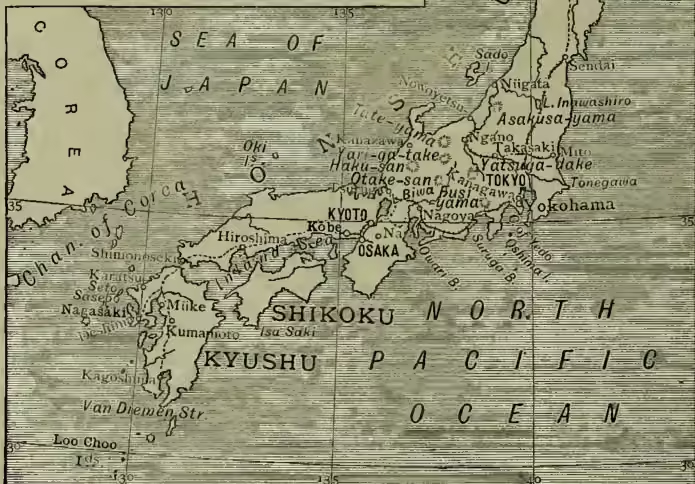
Japan, a corruption of Marco Polo's Zipangu, itself a corruption of the Chinese pronunciation of the native name Nihon. Nihon, or Nippon, means 'Land of the Rising Sun.' Dai, 'Great,' is sometimes prefixed. Japan Proper comprehends four large islands—viz. Honshū (the Japanese mainland), Shikoku, Kyūshū, and Yezo—and extends from 26° 59' to 45° 30' N. lat. Formerly the southern portion of Saghalien belonged to Japan, but this was ceded to Russia in 1875, certain of the Kurile island group being granted in return. The empire of Japan—the area of which has been estimated at 155,000 sq. m., or 34,000 miles larger than the United Kingdom—includes, in addition to the above, nearly 4000 small islands, among which are the Liu Kiu ('Loo Choo') and Kurile groups, and is situated between 24° 6'—50° 56' N. lat., and 122° 45'—156° 32' E. long. It is bounded on the N. by the Sea of Okhotsk, on the E. by the North Pacific Ocean, on the S. by the eastern Sea of China, and on the W. by the Sea of Japan. On the 1st January 1891 the population of Japan was 40,453,461, an increase of nearly 2 millions in 5 years; in 1894 it was 41,390,000. The population is distributed as follows: Honshū, 31,722,674; Shikoku, 2,907,280; Kyūshū, 6,379,262; Yezo, 379,097. Formosa and the Pescadores, ceded by China in 1895, are now Japanese.
Physical Features.—The islands of Japan appear to be the highest portions of a huge chain of mountains which rises from a deep ocean bed; they are the advanced frontier of the Asiatic continent. This chain, though dotted with volcanoes, is not therefore itself of volcanic origin. Earthquakes occur very frequently in Japan, although the western slope, facing the Asiatic continent, is exempt. Japan is one of the most mountainous countries in the world. Its plains and valleys, with their foliage surpassing in richness that of any other extra-tropical region, its arcadian hillslopes and forest-clad heights, its alpine peaks towering in weird grandeur above ravines noisy with waterfalls, its lines of foam-fringed headlands, with a thousand other charms, give it a claim to be considered one of the fairest portions of the earth. The sublime cone of the sacred Fuji-san (Fusiyama, Aino, 'Fire-goddess Mountain'), an extinct or rather dormant volcano, rises from the sea to a height of 12,365 feet. Ontaké-san and Yari-ga-také (each 10,000 feet), Taté-yama (9500), Yatsuga-daké (9000), Haku-san (8590), Asama-yama (active volcano, 8260), with many other scarcely lower peaks, rise in Honshū. The eruption on July 15, 1888, of Bandaisan (6037 feet), near Lake Inawashiro, was due to imprisoned steam; 1600 feet was blown off the top of the hill, and 27 sq. m. of country covered with debris. The three other large islands also abound in mountains, though of less elevation. Yezo has no fewer than eight active volcanoes. Throughout the empire there are many solfataras, and sulphurous springs well up from hundreds of volcanic valleys. The plains, most of the valleys, and many of the lower hills are highly cultivated. Lakes are not very numerous, the only two of any size being Biwa, near Kyōto, and Inawashiro, midway between Tōkyō and Sendai; but there are countless rivers, most of which, however, are too impetuous to admit of navigation. The harbours are spacious and deep, but not numerous, considering the great length of the coast-line.
Climate.—The different parts of Japan vary widely in climatic conditions. Leaving out the northern and southern extremes, at Tōkyō (Yedo) we find the annual average temperature to be 57.7° F., while in winter the mercury occasionally falls to 16.2°, and in summer it may rise to 96°; at Nagasaki the lowest winter temperature is 23.2°; at Hakodaté the annual extremes are 2° and 84°. The normal hot weather begins only about the beginning of July, and terminates usually in the middle of September. The late autumn is the driest and most agreeable season. The ocean current known as the Kuroshiwo ('Black Stream') considerably modifies the climate of the south-east coast; thus, while snow seldom lies more than 5 inches deep at Tōkyō, in the upper valleys of Kaga, near the west coast, less than 1° farther north, 18 and 20 feet are common. The east coast of Yezo is visited by a cold current from the Kuriles, which renders the climate foggy in summer and retards cultivation. The rainfall, which varies much in different years, is on an average 145 inches. No month passes without rain; but it is most plentiful in summer, especially at the beginning and the close of the hot seasons, when inundations frequently occur. North and west winds prevail in winter, and south and east in summer. The violent circular storms called typhoons are liable to occur during summer, but are more destructive in the autumn. August and October are the pleasantest months for travelling. Thunderstorms are neither common nor violent, and autumn fogs are equally rare. The climate, though somewhat relaxing to Europeans and having a tendency to produce anaemia and troubles of the head, is fairly salubrious, highly so in the mountains.
Vegetable Productions.—In Hodgson's Japan will be found a systematic catalogue of Japanese flora by Sir Joseph Hooker. Chestnut, oak (both deciduous and evergreen), pine, beech, elm, cherry, dwarf-oak, elder, sycamore, maple, cypress, and many other trees of familiar name abound. The grandest forests of pine and oaks of great size grow in Yezo; but the Rhus vernicifera or lacquer-tree, the Laurus camphora or camphor-tree, the Broussonetia papyrifera or paper-mulberry—the bark and young twigs of which are manufactured by the Japanese into paper—and the Rhus succedanea or vegetable wax tree of Japan, are among the remarkable and characteristic trees of the country. Bamboos, palms, including sago-palms, and 150 species of evergreen trees likewise flourish. Thus the vegetation of the tropics is strangely intermingled with that of the temperate or frigid zone; the tree-fern, bamboo, banana, and palm grow side by side with the pine, the oak, and the beech, and conifers in great variety. The camellia, the Paulownia, and the chrysanthemum are conspicuous amongst the indigenous plants. The azalea blooms in May, and a red variety is found in the mountains as late as the beginning of July. The splendid Lilium auratum covers the hillsides in July; and these are also bright during the same month with the pink berries of the Coriaria japonica, the same plant from which comes the arrow poison of the New Zealanders. Nymphæas and parnassia fill the lakes and morasses. The tobacco-plant, the tea-shrub, different varieties of the potato, rice, wheat, barley, buckwheat, and maize are all cultivated. The flora of Japan bears a remarkable resemblance to the flora of that part of the North American continent lying between the Lower Mississippi and the Atlantic.
Zoology.—Wild animals are not numerous in Japan. No true wolf exists, the Japanese yamainu ('wild few merits, and in most provinces is a miserable animal. The province of Shimōsa, east of the capital, is now largely devoted to horse-breeding, stallions having been brought from San Francisco for the purpose of improving the breed. Draught oxen are common on the main island, but milk-cows are of quite recent introduction. Donkeys are seldom or never seen. Pork is rapidly becoming a favourite food, and horseflesh is prepared at some of the restaurants of the capital. Goats are practically unknown, and the sheep does not thrive. The domestic dog is a wolf-like, ill-conditioned animal, while the domestic cat is remarkable in having a mere stump of a tail; foreign varieties of these animals are being rapidly introduced. There are numerous water-birds—cranes, storks, herons, coots, moorhens, snipe, wild geese, ducks; and cormorants trained to fish, the dog') being a poor imitation of the fierce European animal. The black bear peculiar to the country is found in the mountains north of Tōkyō, and is dreaded in Yezo. Wild boar's flesh is often seen for sale in the capital, as also monkey's flesh, an animal remarkable in Japan for its bright crimson face. Wild deer, protected by law in one or two places, are freely hunted elsewhere. A factory for tinning venison was established in Yezo, at Bibi. A clumsy species of antelope inhabits the mountains. The fox, a small-sized breed, plays an important part in the folklore, as the embodiment of craft and as a kind of magician. A variety of the stoat, known as the itachi, wages war on rats and on poultry. A badger resembling the American species is trained for fortune-telling. There are two species of squirrel, also two flying squirrels, various kinds of rat—powerful pests—but no true house mice. The hare is a small species resembling a rabbit. There is a single species of otter, and there are several varieties of the seal and the whale. Of the various varieties of snake only one, the small mamushi, is poisonous. Of domestic animals there are few. The native horse, introduced according to tradition in the 3d century, is really a mere pony, and has practice dating back at least 1100 years. Land-birds are less numerous, the voracious and powerful crow, sometimes mistaken for a raven, reigning supreme, and acting as a general scavenger. There are two magnificent species of pheasant, pigeons, quail, hazel grouse, and ptarmigan. The goshawk was much used for hawking in feudal times. Various owls abound. Song-birds are not specially numerous, the bullfinch and two varieties of uguisu ('Japan nightingale') being best known. Swallows, swifts, sparrows, goat-suckers, and woodpeckers all abound, and there is a fine species of Japanese jay. Of all Japanese birds the Icteria princeps, a fly-catcher, is the most beautiful. Bird-catching is commonly practised, decoy-birds being cruelly blinded for the purpose; and the European market is now largely supplied with skins from Japan. One lark is found, besides twelve buntings, eleven thrushes, three robins, a wren, a tit, and various other small birds. There are many varieties of the ordinary fowl, these birds being kept in nearly every house, almost solely for their eggs. The larger breeds known as Shamo and Kukin are, as their names imply, of foreign origin, the ordinary breed resembling a pheasant in size and shape. The fresh-water fish of Japan are mostly of European genera. The rivers of Yezo swarm with salmon, which, when salted, supply the southern market. Carp are kept in garden ponds, and goldfish are reared extensively. Of salt-water fish the red-fleshed maguro and the taï are eaten raw under the name of sashimi. Oysters abound, Akkeshi in Yezo being noted for its beds; the lobster, an emblem of longevity, is highly prized for the table. Insect life is specially abundant; butterflies, moths, dragon-flies, and beetles exist in astonishing variety. And yet Japan is comparatively free from insect pests. Mosquitoes and gnats are troublesome; wasps are rare; honey-bees are scarce, and the native honey is an insipid substance.
Agriculture is the chief occupation of the Japanese, and they are very careful farmers, thoroughly understanding cropping and the rotation of crops. The soil is not naturally very fertile, being mostly volcanic or derived from igneous rocks, but it is made productive by careful manuring, especially with night-soil from the villages and towns. Rice is the staple production, while barley, wheat, millet, buckwheat, maize, and many varieties of bean and pea are also everywhere produced. The rice harvest commences in September; wheat is sown in drills in November and December, and is reaped in May and June. Of vegetables the staple is the large white radish or daikon. Of Japanese fruits the persimmon and orange are alone worthy to be classed as really good fruits. The plums, peaches, and cherries are very poor, the trees being reared for their blossoms. The culture of tea, introduced from China in 770, is universal in the middle and south; the whole production amounts to about 22,000,000 lb. annually. Sericulture is on the increase, and cotton and hemp are also widely grown. Of sugar a total of over 90,000,000 lb. was produced in 1895; much tobacco is also raised—an inferior kind, remarkable for its mildness and dryness. There are two agricultural colleges, with foreign professors on their staffs, one in Tôkyô, the other at Sapporo in Yezo.
Mineralogy.—The mineral resources of Japan are considerable, and the government during the sixteen years preceding 1884 spent largely upon mining. Since then it has allowed private enterprise to step in. Gold, silver, copper, iron, lead, antimony, tin, sulphur, coal, basalt, felspar, greenstones, granites (red and gray), rock-crystal, agate, carnelian, amber, scoriæ and pumice-stone, talc, alum, &c. are found in greater or less quantities. Gold is principally worked in the island of Sado; silver on the main island. Coal-beds extend from Nagasaki to Yezo, the principal mines being Takashima, Miike, and Karatsu in Kyûshû, and Poronai, near Sapporo, in Yezo. Petroleum is found in small quantities near Niigata and in Yezo. The supply of sulphur is almost inexhaustible, and of wonderful purity. Good building-stone is scarce.
History.—The reputed founder of the present dynasty was Jimmu Tennô, who ascended the throne in 660 B.C. The legendary epoch continues for more than 1000 years, and all Japanese history before 500 A.D. is to be classed as legendary. In 201 A.D. the Empress Jingô is said to have invaded and conquered Corea, and this expedition was followed by the introduction of Korean civilisation, the sacred Chinese books Rongo and Senjimon arriving from Corea in 285. In 552 Buddhism was introduced from Corea, and became, forty years later, the established religion. In 624 a Buddhist hierarchy was established by government. Shortly before this direct relations had been entered upon with China, and Chinese civilisation was thereafter rapidly assimilated. The system of periods com- menced in 646, and from this time onward the national history is clearly traced. During the five centuries which ensue the people made immense strides in civilisation. A complete system of officialdom was organised, under the rule of the Fujiwara family, whose members filled all the chief posts under government, and gave a succession of consorts to the imperial house.
The decadence of this family and the growing weakness of the government favoured the rise of the hitherto subordinate military class, which, in the person of Yoritomo, created Shôgun or Generalissimo in 1192, seized the reins of power. The usurpation of supreme authority by this officer, long known to Europe by the Chinese name of Tycoon, led to the erroneous but natural belief that, down to 1868, there were two emperors in Japan—one, a Mikado or 'spiritual emperor' who reigned but did not govern, and the Shôgun, who really governed though he paid homage to the Mikado. The next four centuries until 1603 were a period of bloodshed, marked by all the untold miseries of civil strife. The military fiefs organised by Yoritomo raised up a feudal baronage, who succeeded in making themselves virtually independent of the central power. Even the Buddhist monasteries in many cases became military centres. At one time (1333-92) two puppet dynasties held sway, the north and the south, to one or other of which the feudal barons rallied. The Shôgunate, made powerful by Yoritomo, itself fell into abeyance, but the military genius and astute policy of Hideyoshi, who died in 1598, prepared the way for its revival in 1603 by Tokugawa Ieyasu, the illustrious general and statesman who gave a lasting peace to Japan. In 1592 Hideyoshi had directed an expedition against Corea, inflicting a blow on the prosperity of that country from which it has not since recovered. Ieyasu, victorious over a combination of southern barons at Sekigahara near Lake Biwa in 1600, fixed his seat of government at Yedo, the 'port' situated at the head of the Gulf of Yedo, and near the embouchure of the rivers which drain the largest plain in Japan. Backed principally by the northern clans, he was able to consolidate his power and to found a permanent succession, his descendants reigning at Yedo till 1868. From being a collection of small scattered villages this place soon became one of the most populous cities in the world. His system was perfected by Iyémitsu, the third Shôgun of the Tokugawa dynasty.
It was his policy 'to preserve unchanged the condition of the native intelligence,' and 'to prevent the introduction of new ideas;' and to effect this he not only banished foreigners, interdicted all intercourse with them, and extirpated Christianity, but introduced that 'most rigid and cunningly-devised system of espionage' which was in full activity at the time of the Earl of Elgin's mission, as amusingly described by Laurence Oliphant. 'This espionage,' says a recent Japanese writer, 'held every one in the community in dread and suspicion; not only the most powerful daimyo felt its insidious influence, but the meanest retainer was subject to its sway; and the ignoble quality of deception, developing rapidly to a large extent, became at this time a national characteristic. The daimyos, who at first enjoyed an honourable position as guests at the court of Yedo, were reduced to vassalage, and their families retained as hostages for the rendition of a biennial ceremonial of homage to the Shôgun. Restrictions surrounded personages of this rank until, without special permission, they were not allowed to meet each other alone.' The Portuguese, who first landed in Japan in the year 1543, carried on a lucrative trade; but by-and-by the ruling powers took alarm, ordered away all foreigners, and interdicted Christianity (1624), believing that foreigners impoverished the country, while their religion struck at the root of the political and religious systems of Japan. The converts to Catholicism were found to have pledged their allegiance to a foreign power, while their conduct is said to have been offensive towards the Shintō and Buddhist temples; so that in time they came to be regarded as a dangerous and anti-national class whose extirpation was essential to the well-being of the nation and to the success of the political system being organised or perfected by Iyémitsu. The Portuguese continued to frequent Japan till 1638, when they and their religion were finally expelled. From this date the Japanese government maintained the most rigid policy of isolation. No foreign vessels might touch at Japanese ports under any pretence. Japanese sailors wrecked on any foreign shore were with difficulty permitted to return home; while the Dutch, locked up in their factory at Deshima, were allowed to hold no communication with the mainland; and the people lived 'like frogs in a well,' as the Japanese proverb has it, till 1853, when they were rudely awakened from their dream of peace and security by Commodore Perry steaming into the harbour of Uraga with a squadron of United States war-vessels. He extorted a treaty from the frightened Shōgun, 31st March 1854, and Japan, after a withdrawal of 216 years, entered once more the family of nations. Other countries slowly followed the example of the United States until sixteen in all had obtained the same privileges.
Five ports, Kanagawa (Yokohama), Kōbe (Hyōgo), Nagasaki, Niigata, and Hakodate, were opened to foreign commerce, 'settlements' or foreign quarters in these being set apart for the residence of foreigners under the jurisdiction of their own consuls. A limit of travel, extending to a radius of twenty-five miles round these ports, was granted. Foreign settlements were also established in Yedo (Tōkyō) and Ōsaka, these settlements being within the prescribed twenty-five miles' limit of Yokohama and Kōbe. Obstructions being placed in the way of foreign merchants settling at Kanagawa, the question was quickly solved by their crossing the narrow bay, now filled up, and erecting their 'hongs' at Yokohama, a few miles farther from the capital. With the opening of these ports commenced the extra-territoriality system under which Japan has shown herself so restive.
The fall of feudalism was merely accelerated by the arrival of foreigners. For long not a few of the most powerful clans, chiefly Satsuma and Chōshū, had been dissatisfied with the Shōgun's position, and these gladly availed themselves of the pretext now furnished for opposing him. All possible means were taken to involve him in complications with the ambassadors at his court; and to this motive rather than to any hatred of foreigners are to be ascribed the numerous assassinations which darkened the period immediately prior to 1868. Every weakening of his power was a step gained towards his overthrow and the longed-for unification of the empire in the hands of the Mikado (emperor). At length the Shōgun resigned; but it was only after a sharp civil war in the winter of 1867-68 that the power of his adherents was completely crushed. At the outset of the struggle the imperial party were decidedly retrogressive in their political ideas; but before its close various circumstances convinced them that without intercourse with foreign nations the greatness which they desired for their country could not be achieved; and when they got into power they astonished the world by the thorough- ness with which they broke loose from the old traditions and entered on a course of enlightened reformation. Recognising Yedo as really the centre of the nation's life, they resolved to make it the capital; but the name Yedo being distasteful through its associations with the Shōgunate, they renamed the city Tōkyō or Tōkei—i.e. 'eastern capital.' Here the emperor established his court, abandoning for ever that life of seclusion which had surrounded his ancestors with a halo of semi-divinity, but deprived them of all real power. The venerable city of Kyōto, which had remained the capital since 794, was at the same time renamed Saikyō or Saikei—i.e. 'western capital.' The daimyos, very few of whom were more than mere weaklings under the direction of strong-willed retainers, resigned their fiefs, and were pensioned by the government. Since 1868 the leading men of Satsuma and Chōshū, forming what is called the Sat-chō combination, have held the important portfolios of state. The new period, commencing with the Emperor Mutsuhito's accession, has been named Meiji, 'enlightened peace.'
Japan has during the Meiji period striven to make her influence felt as a powerful factor in Asiatic politics. Her expedition to Formosa in 1874 to punish piracy, her annexation in 1879 of the Loo Choo Islands, notwithstanding China's remonstrances and threats, her spirited policy in Corea in 1873 and again in 1882, her conscription law of 1883 and subsequent army reorganisation, her development of a strong navy, her coast-defence scheme of 1887, subscribed to liberally by wealthy private individuals, prove her assertive spirit. A rebellion in 1877 of the fiercer Satsma men under General Saigō was promptly crushed.
In 1887 the negotiations for a revision of the treaties were broken off, owing to an outbreak of popular dissatisfaction with the guarantees demanded by the seventeen foreign powers acting in concert. This breakdown was followed by a distinct conservative reaction in the nation, in no way seriously affecting the steady progress of western institutions, but marking a more cautious attitude and a more critical spirit. In the spring of 1889 the combination of treaty powers was broken through by the action first of the United States and then of Germany and Russia, who formed treaties on their own account, abolishing extra-territoriality and sanctioning mixed residence under certain mild restrictions. These treaties were to come into force in 1890. Mexico, not a treaty power, had also arranged an independent treaty in November 1888. Other powers prepared to follow. But a strong opposition having sprung up, the Kuroda cabinet found itself unable to carry out the scheme, and treaty revision was once more shelved. This is the close of the first epoch in the modern history of Japan, following on the heels of the promulgation of a popular constitution, February 11, 1889.
The position in which Japan has been placed during the past few decades is so exceptional that outsiders find great difficulty in forming a correct judgment of her political situation. Instability is supposed where it is really absent, the fact being that no nation's history has been more consistent than Japan's. The sudden change of front in 1868 was deliberate and final, one end having been kept in view all through—the independence and glory of Dai Nippon. So hurried an assimilation as was made necessary by her complete previous isolation was naturally accompanied by numerous minor imprudences and extravagances, the result of ignorance. But the thoroughly patriotic spirit of the nation has triumphed, and her administration is now in a highly satisfactory condition.
The assassination in 1877 of Ōkubo, chief of the party whose reforms gave rise to the Satsuma rebellion, was followed twelve years later by the assassination of Viscount Mori, a cabinet minister. This last was not, like the former, a political event, but merely an unfortunate isolated incident, the work of a religious fanatic, a Shintoist. Political assassination is not, however, dead, and is a peculiar danger in Japan, where its perpetrators seem wholly regardless of their own lives.
During the past few years, especially since the reconstruction of the cabinet and the administration in 1886, the court has emerged entirely from its seclusion. The emperor and empress have visited all the chief institutions, and are present at public spectacles. The crown-prince, Haru, was the first in the long dynasty to be educated at a public school. A new nobility was created in 1884, drawn partly from the old feudal baronage and partly from the new men of 1868. It consists of five orders, princes or dukes (11), marquises (28), counts (85), viscounts (355), and barons (102), who send representatives to the newly-created Upper Chamber. The nation is itself divided into three classes, Kwazoku ('nobility'), Shizoku ('gentry'), and Heimin ('commonalty'). Officials are of four classes, shinnin, chokunin, sōnin, and hannin. Officials constitute the flower of the nation; class jealousy is absent, careers being open to the poorest. The main events of the triumphant war with China in 1894-95, the acquisition of Formosa, as also the Chinese campaign of 1900, have been noted at CHINA, Vol. III. p. 194. Japan was visited by a terrible earthquake in 1892; and in June 1896 an earthquake wave cost 10,000 lives.
Inhabitants.—With the exception of the wilds of Yezo, peopled by 12,000 Ainos, the Japanese islands are inhabited by a single race speaking various dialects of the same tongue. Probably, but this is merely a conjecture, the Japanese are a mixed race, the issue of the intermarriage of victorious Tartar settlers, who entered Japan from the Korean peninsula, with Malays in the south and people of the Aino race in the main island. We read in Japanese annals of constant war with savages, and in comparatively recent times the Aino race occupied the northern extremity of Honshū. There are two distinct types of Japanese face, that which is found in art designs being the aristocratic and rarer type. It is distinguished by an oval head and face, rounded frontal bones, a high forehead, a nose curved and well shaped but not prominent, narrow and slightly oblique eyes with an overlapping of the eyelid. In the man the face is almost hairless, with the exception of a narrow and short moustache. The complexion is pallid or slightly olive, and the expression demure. The commoner and vulgar type, almost universal in the northern districts, is pudding-faced, full-eyed, flat-nosed, and good-humoured in expression. The stature of the race is small, and the trunk is proportionately long as compared with the legs, which are short. The use of heavy wooden clogs (geta), together with the carrying, when still young themselves, of their infant brothers and sisters, gives the women excessively thick ankles and flat feet. The hands are usually prettily shaped, both in the man and the woman; but the habit of keeping these, especially in winter, inside the kimono ('coat'), while the wide sleeves are allowed to hang loose, makes them clammy to the touch. The hair is coal-black and strong in texture, and the beard has sometimes a ruddy tinge. The race is physically an inferior one, the men having an ill-developed form and harsh features, whilst the women lose any pretensions to good looks after the first bloom of youth is over. The plainness of the latter is increased by the habit at marriage, or after passing the marriageable age, of blackening the teeth and shaving the eyebrows, customs happily on the wane. The girls, with their rosy cheeks, fascinating manners, and exquisitely tasteful dress, are, however, particularly attractive, and the children are bright and comely, being allowed full liberty to enjoy themselves—indeed Japan is the paradise of children.
The Japanese have many excellent qualities: they are kindly, courteous, law-abiding, cleanly in their habits, frugal, and possessed with a high sense of personal honour which makes sordidness unknown. This is associated, moreover, with an ardent patriotic spirit, quite removed from factionalness. Nowhere are good manners and artistic culture so widespread, reaching even to the lowest. On the other hand, the people are deficient in moral earnestness and courage, which leads to corruption in social life and institutions. It is only when matters have become intolerable that discipline is enforced by the use of Draconian measures. An utter lack of chivalry towards women is an unpleasant feature of the national life. Civic courage has also to be developed.
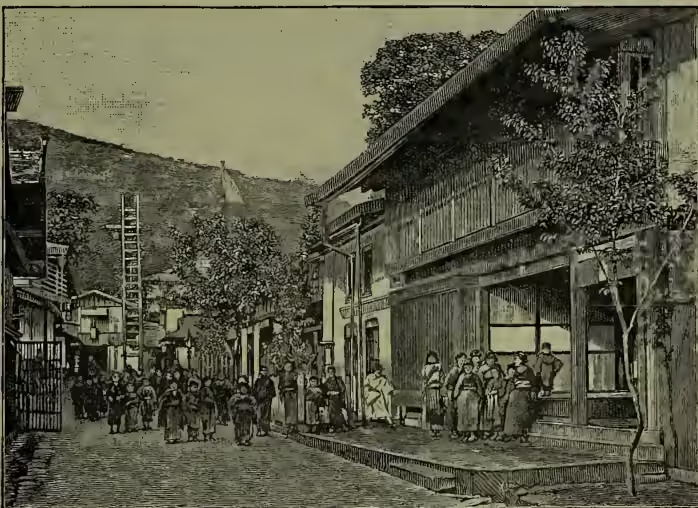
The town costume of the Japanese gentleman consists of a loose silk robe extending from the neck to the ankles, but gathered in at the waist, round which is fastened a girdle of brocade silk. Over this is worn a loose, wide-sleeved jacket, decorated with the wearer's armorial device. White cotton socks, cleft at the great toes, and wooden pattens complete the attire. European costume has been prescribed by government as the official dress, and the empress and her suite have recently adopted foreign costume, being followed to a certain extent by the fashionable ladies of the capital. Hats are not generally worn, except by those who follow European fashions or in the heat of summer. The women wear a loose robe, overlapping in front, and fastened with a broad heavy girdle of silk (obi), often of great value. In winter a succession of these robes are worn, one over the other. The formerly universal chignon coiffure of the women, stiff with pomatum, which was done up by the hairdresser once or twice a week, is rapidly yielding to the simpler Grecian knot. The poorer classes wear nothing more than a loose cotton gown, tied at the waist, and a loin-cloth, frequently working only in the loin-cloth. Women of the lower class think nothing of exposing the person to the waist. The women powder profusely, a white skin being highly appreciated, and dye the lips a deep red: jewellery is not worn. The old-fashioned coiffure of the men, still frequently seen among the lower classes, especially among fishermen, is peculiar. The head is shaven on the top, leaving a broad rectangular bald space, and the hair of the unshaven portion, formed into a compact mass like a candle-end, is then turned forward upon the crown. The children's heads are shaven grotesquely; priests and many old women shave the head completely. Long hair is frequently worn by discontented politicians and philosophers, while widows wear short hair. Both Japanese men and women are fond of smoking tobacco; the bowl of the pipe they use is less in size than half a thimble, and requires constant refilling.
Although the Japanese are a singularly united people, yet the nation divides itself into two portions, the governing and the governed. The former, representatives of the military class and numbering some 4000 families, are high-spirited and masterful; the rest of the nation are submissive and timid. Many of the seemingly contradictory opinions given forth regarding the Japanese can be reconciled by a recognition of this fact.
Mode of Living, &c.—Japanese houses are slight constructions of wood; in place of windows and shutters they have an inner set of paper screens, and an outer set of wooden shutters, both sliding in grooves. In the northern districts at least two sides of the house are closed in with walls of mud plastered on wicker-work. The floors are covered with thick soft straw mats, measuring 6 by 3 feet, and the accommodation of the houses is reckoned by the number of these mats. On them the inmates sit, eat, and sleep, the bedclothes—heavily-padded quilts—being kept during the day in adjoining closets. The surface of these mats is scrupulously clean, for boots and clogs are removed before entering. In winter heat is obtained from charcoal boxes, either movable or set into the floor, and most of the cooking is done over charcoal braziers. Rice is the staple food of the people, but in the poorer mountainous regions millet often takes its place. Fish, seaweed, and beans in all forms are served with the rice, especially in the soups, which likewise contain bean-curd, eggs, and vegetables. Chestnuts and hazelnuts are also largely eaten, and the walnut is made into a sweetmeat. Shōyu (soy), a sauce made of beans and wheat, is the universal condiment. Generally speaking, the food is unsatisfying and mawkish to foreigners. Fowls are now pretty widely used for the table, and pork and beef, as well as bread, are increasingly eaten. The meat-shops are frequented at night, as taverns are in England.
Japanese towns are subject to conflagrations to such a degree that in crowded city districts houses are supposed to last on an average only three years. The people store their valuables in square towers of bamboo wattle-work and mud, which are left standing when the fire has swept past. Incendiarism followed by robbery is a common crime, formerly punished savagely. The institution of a gendarmerie in 1881, and the more stable nature of the edifices recently erected in the capital, have greatly lessened these fires.
The Japanese are a dyspeptic people, more dying from diseases of the digestion than from any other cause. Skin diseases, well treated at the various solfataras, are common; bone diseases are also rife. Lung diseases are not so deadly as in Great Britain, and child-birth is attended with little or no danger. A very dangerous disease peculiar to the country and yielding to no specific remedy is kakké, a form of elephantiasis or beri-beri. Smallpox was formerly a scourge, but compulsory vaccination has remedied this. Cholera appeared in force in the year 1879, and again violently in 1886. The houses are built low on the ground, the drains are open, wells are close to closets and rubbish-heaps. However, there are now both an active sanitary society in Tôkyô and a foreign professor of sanitary engineering in the university, and water-works with the latest improvements had been provided for Yokohama by 1890, when the capital and Nagasaki had also water-work schemes under consideration. Infant mortality is small. Suicide is common, especially among men, three out of four male suicides hanging themselves, one out of every two female suicides drowning herself. The figures for 1890–94 showed an annual average of 4606 men and 3000 women.
Manners and Customs.—Many of the customs once characteristic of Japan have, since the abolition of feudalism, become obsolete. Among these is seppuku or hara-kiri (see HARI-KARI), for long a legalised mode of suicide. The wearing of swords by civilians in public was forbidden by law in 1876. The social position of women is more favourable than in most non-Christian countries, but still leaves much to be desired. However, the attitude assumed by the empress and the imperial princesses is rapidly bringing about a social equality of the sexes. Formerly concubines were recognised by law, and a certain number of imperial mistresses are attached to the court, whose children are open to the succession—the present emperor and crown-prince being the sons of mistresses. A man can, however, have only one legal wife, and the keeping of concubines in the same house with a wife is more and more discontenanced by social opinion. Divorces are easily obtained by husbands, and the nuptial tie is little respected among the lower classes; but women of the well-to-do classes are modest and virtuous. Marriages are arranged through an intermediary, and both sexes marry at an early age. As the continuance of families is a point of great importance, adoption is largely resorted to in order to prevent families dying out. Prostitution is prevalent. It was formerly no uncommon thing for a dutiful daughter to sell herself for a term of years to the proprietor of a house of ill-fame in order to retrieve her father's fallen fortunes. When she returned no stigma attached to her; rather was she honoured for her filial devotion. Licensed houses of ill-fame have always been confined to certain districts, outside the city limits, and are carefully inspected. Hot baths are a great institution in Japan. Formerly it was a general custom for persons of both sexes to bathe together; and this primitive custom still prevails in rural districts, although forbidden in the cities and always unknown in Tôkyô. Great respect is paid to the dead, and posthumous names are conferred after death, some of the most celebrated names in Japanese history being posthumous titles. Heavy sums are lavished on funerals.
Until lately the only vehicles in Japan were two kinds of palanquin—viz. the kago and the norimono; but in all the more level districts these have now been superseded by the jinrikisha ('man-power-carriage'), a sort of two-wheeled perambulator drawn by a man who runs between the shafts. In many of the more mountainous regions the roads are impracticable even for the jinrikisha.
The Japanese are essentially a pleasure-loving people, and spend comparatively large sums upon amusements. The theatre, though formerly despised by the samurai class, who refused to enter its doors, forms one of the chief national resorts. The female parts are taken by men, but theatres exist where only women act. A single performance lasts from morning till sunset, and a whole household will hire a box and spend the entire day at the theatre. Many of the arrangements are primitive, especially the orchestra, whose music is thin, harsh, and monotonous. This is generally true of Japanese music, which is in a primitive stage; the principal instruments are the stringed samisen, koto, and kokyū, and the wind-instruments called shakuhachi and shō, the latter mostly used at funerals. Professional musicians are in great request and are well paid, especially the young women known as geisha, whose dances are wonderfully graceful. Flower-shows are very popular, and flower-gardens are crowded at the proper seasons—the plum and peach blossom season being in February and March, the cherry-blossom season and the peony season in April, the wistaria season in May, the iris season in June, the lotus season in August, the chrysanthemum season in October and November. The time of greatest festivity is the New Year, now held contemporaneously with our own, when pine-trees are planted before the doors, the houses are gay with decoration, and presents are lavishly made. The favourite game at this season is oyobane, a kind of battle-drome and shuttlecock. January is the kite season; the smaller kites are of various fantastic shapes, while the larger and more powerful ones are usually rectangular. Wrestling, juggling, and archery are favourite sports, and among indoor games go (checkers) and shōgi (chess).
Language and Literature.—The Japanese language belongs structurally, like Corean and Manchurian, to the Altaic family, and like other Altaic languages, delights in long involved sentences, the introductory details being heaped up to an extraordinary length, so that when the final verb is reached many of these are apt to be already forgotten. The verbs, which are burdened with untranslatable honorific endings, come at the close of the clause. Grammatical gender is unrecognised; case is indicated by separable particles; there are no articles; prepositions follow the words they govern. The language, though difficult to master, is easily pronounced and musical. The introduction of Chinese civilisation in the 6th century was followed by a wholesale absorption of Chinese words and characters, but the language remained grammatically unchanged, as obscure and involved in its idioms and constructions as before. Chinese ideographs are said to have been reduced to a phonetic syllabary by the Buddhist priest Kōbōdaishi in 810. In process of time this system, the Hiragana, was rendered more complex by the addition of variants, and this led, apparently, to the introduction of another and simpler alphabet, entirely without variants, known as the Katakana character. The revolution of 1868 caused the language to become more Chinese in vocabulary than ever, from the necessity of coining a host of new scientific terms, although many European words were also transferred simpliciter. A movement, powerfully supported, has been on foot for several years to introduce the Roman alphabet, a reform which would save much tedious labour, as Japanese youths have to spend years in familiarising themselves with the difficult Chinese ideographs. The literature of Japan is meagre and vapid when compared with European literature. Poetry came to be a mere matter of the manipulation of words, a feminine accomplishment, associated with fine calligraphy, although the classical poetry has left some charming remains. Both the classical prose and poetry owe much to women writers. A cloud rested on literature during the troublous feudal times, lasting from the 12th to the 17th century. The revival of the Shintō religion by Mabuchi, Motoori (1730–1801), and other scholars was accompanied by a great improvement in style; but this Neo-classical Japanese has been servilely imitated, and is fast becoming fossilised. At present the language, though capable of expressing almost every shade of thought required in a complete modern civilisation, labours under these difficulties: (1) there are countless homonyms—e.g. fifty-four characters pronounced kō, often requiring pictorial explanation in speaking; (2) the colloquial and written styles differ wholly, and thus literature fails to receive fresh impulses, and is not the heritage of the whole nation. The greatest of Japanese novelists is Bakin (1767–1848), but his works are terribly spun out. The light prose, which made its appearance in the 17th century, is well represented by Yayu and Ikku. From the Kojiki, or 'Records of Ancient Matters,' downwards Japanese literature is full of indecencies. Much of the place nomenclature of Japan has been traced by Mr Chamberlain to an Aino source. Double names abound, a native and a Chinese form, especially for the provinces, that with the shū termination, as in Shinshū, being the Chinese form. Most family names were originally place names.
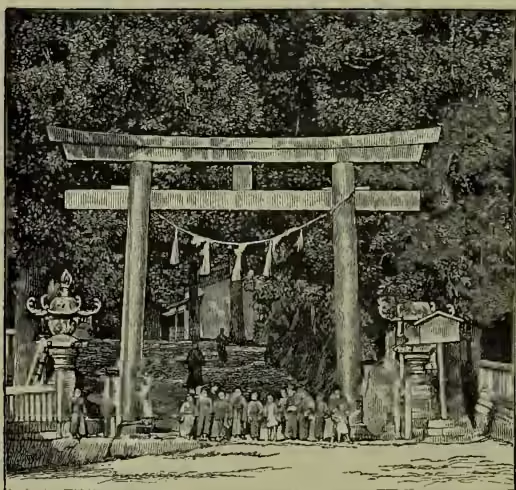
Religions of Japan.—There are two prevailing religions in Japan—Shintō or Kami no Michi ('The way of the gods'), the indigenous faith; and Buddhism, introduced from China in 552. (1) Shintōism.—The characteristics of Shintōism in its pure form are 'the absence of an ethical and doctrinal code, of idol-worship, of priestcraft, and of any teachings concerning a future state, and the deification of heroes, emperors, and great men, together with the worship of certain forces and objects in nature.' The principal divinity is the sun-goddess Amaterasu, from whom the Mikado is held to be descended. After the restoration the government attempted to free Shintōism from the Buddhist innovations which had contaminated it, and to revive it in its pure form as the national religion. Shintō temples are singularly destitute of ecclesiastical paraphernalia. A metal mirror generally stands on the altar, but even this is a Buddhist innovation. The spirit of the enshrined deity is supposed to be in a case, which is exposed to view only on the day of the deity's annual festival. The worship consists merely in washing the face in a font, striking a bell, throwing a few cash into the money-box, and praying silently for a few seconds; nevertheless, long pilgrimages to famous shrines and to the summits of sacred mountains are often taken to accomplish this. Shintōism is rather an engine of government than a religion; it keeps its hold on the masses chiefly through its being interwoven with reverence for ancestors and patriotic ideas. (2) Buddhism.—Of Buddhists there are no fewer than thirty-five sects. The monks have assumed the functions of priests, and Japanese Buddhist worship presents striking resemblances to that of the Roman Catholic Church. Notwithstanding the increased patronage recently bestowed upon Shintōism by the government, Buddhism is still the dominant religion among the people. The most popular, as well as the wealthiest and most enlightened, of the Buddhist denominations is the Monto or Shinshū sect, which recognises one God in Amida Buddha (only, however, an abstract principle personified), discontenances asceticism and clerical celibacy, and cultivates preaching, the favourite topic being the duty of self-reliance. It would be a mistake, however, to suppose that a clear line can be drawn between adherents of Buddhism and Shintōism respectively; in the popular mind the two faiths are so blended that the temples of both are frequented without much discrimination. The better-educated classes are mostly agnostics, striving more or less to regulate their lives by the maxims of Confucius. The priests retain their hold on the people largely as being custodians of the graveyards and performers of funeral rites. Their moral influence is not weighty, many being bad boys for whom their fathers have found it impossible to find good wives. In the Meiji period none of the imperial family have entered the church; they affect in preference the army and navy. Some of the more active sects, notably the Mōto sect at Kyōto, which has established a large college, are rising to the occasion and sending out preachers and propagandists to meet the active forces of modern Christian missions. Japan is a land of temples, but many are now falling into decay, while others are turned into schoolhouses. Every grove has its shrine and torii, a structure in wood or stone, consisting of two upright pillars joined at the top by two transverse beams or slabs; metal torii are also not unknown. The Buddhist monasteries in the Japanese middle ages were undoubtedly wonderful centres of civilisation, and the priests for long commanded reverence by their self-denial.
Christian Missions.—Full toleration is extended to all forms of religious belief, in so far as they do not conflict with the peace and order of the community. Francis Xavier introduced Christianity in 1549, but his work was extinguished in blood, till scarcely a trace of it was left. When, however, the country was opened in 1854 it was found that 22,000 historical Roman Catholic Christians had survived persecution in the neighbourhood of Nagasaki. Christianity may be said to have finally died out in Tōkyō in 1715. The Roman Catholic Church has now a bishop of north and one of south Japan, and schools and convents scattered over the country. The Greek Church has built an imposing cathedral in Tōkyō, and carries on a flourishing work in the capital and the north-east of Japan. Of the Protestant missions the Presbyterians, five sects working together, and the American Congregationalists are the most flourishing. The American and Canadian Methodists, the Baptists, Episcopalians, and others are also actively at work. In 1893 the number of Protestant missionaries was 150 men, 100 un- married ladies, and 102 native ministers, and the membership at the 532 stations was over 20,000. There were 10,297 scholars at the mission schools, and at Sunday schools 21,597 pupils. There were 32,000 Roman Catholics, with 62 missionaries and 40 unmarried ladies; and 14,000 members of the Greek Church. Osaka is the centre of the work of the Church Missionary Society, but the bishop who presides over it and the Society for the Propagation of the Gospel resides in Tōkyō. The Young Men's Christian Association of America has a resident secretary in Tōkyō, and is represented by teachers in almost every province.
Education is general and compulsory. There is a complete system of local elementary, middle, and normal schools, and a central university in the capital, with five higher middle schools as feeders, one in Tōkyō, the others at Sendai, Kyōto, Kanazawa in Kaga, and Kumamoto. There is also a higher normal school in the capital. The elementary school course extends over eight years (six to fourteen), four years being devoted to an ordinary and four to a higher course. There were, in 1888, 25,530 elementary schools, 52 middle schools, and 46 normal schools, besides 18 girls' high schools, 89 technical, 1741 special, and 67 kindergarten schools. The university, reorganised in 1886, when it absorbed the late Imperial College of Engineering and other institutions of a high grade, consists of five colleges—Law and Politics, Literature, Science, Engineering, and Medicine. It is attended by over 700 students, and is a powerful and well-equipped institution, costing the country £42,000 annually. On its staff are 8 German professors, 7 British, 1 American, and 1 French. Other institutions in the capital are the Music Academy, the Technological School, the Dendrological School, the Nobles' School, attended by the young crown-prince, the Peeresses' School, the Girls' Higher School, the Ladies' Institute, the English Law School, the Higher Commercial School, besides eight other commercial schools in the country. Education is perfectly free from class restrictions, even the Nobles' School being by no means exclusively aristocratic. Mission schools have been doing excellent work. The capital is full of private schools and colleges, the Semmon-Gakkō, founded by H. E. Count Ōkuma; the Keiō-Gijiku, conducted by Mr Fukuzawa, one of the leaders of modern Japanese thought and editor of a popular daily paper; the Kyōritsu-Gakkō, &c.
The printing-press is very active. Daily newspapers abound and are sold astonishingly cheap. The press laws are stringent, and imprisonments under them frequent. During the war of 1895 the sanitary and surgical appliances and methods of the Japanese were scientifically perfect. Japanese physiologists and chemists (such as Kitasato) now rank with the foremost European and American scientists.
Army and Navy.—The Japanese army was organised after European methods in the years 1868–72 by a French military mission. A mild form of conscription (1 out of every 28 young men above twenty) came into force in 1883. The presence of German military advisers resulted in the departure in 1888 of the last of the French military mission. The soldiery carry the Murata rifle, an adaptation of the chassepot. In 1890 the army numbered, in service, 49,294, of whom 3685 were commissioned officers and 131 engineers; 1st reserve, 113,065 and 22 engineers; 2d reserve, 51,691. In 1895, after the war, the regular army was reported to number no less than 279,000 men. The navy, organised under a British naval mission, possessed in 1895, after the war, some 30 ships of all kinds, including those captured from the Chinese, and 3 modern coast-defence gun-vessels, besides 5 obsolete steamers and sailing-vessels, some of which are used as training-ships. There were also 3 powerful ships of the latest design fitting out and in reserve, and 5 more under construction. Of torpedo boats there were 5, with 17 more under construction, also 4 stationary school ships, and 6 or 7 small fast craft for harbour defence. The three naval stations are Yokosuka, 15 miles south of Yokohama; Kure, on the Inland Sea; and Sasebo: the principal arsenal is at Yokosuka. The personnel consists of 850 commissioned officers and 12,000 sub-officers and men. The naval college was removed in 1888 from Tōkyō to the island of Etajima, in the Inland Sea, close by Kure.
The Japanese police is a most efficient force, chiefly recruited from the old samurai, and numbering over 27,000. A gendarmerie was established in 1881. The convict system is an excellent one, and convict establishments yield a profit to the government.
Railways.—The railway-system began with two lines, one from Tōkyō to Yokohama, and the other from Hyōgo to Ōsaka and Kyōto. In 1877 a great impetus was given to railway construction by the formation of private companies. The lines now in course of construction will, when completed, give the following trunk lines: (1) a central railway between the two capitals (finished); (2) a continuation through Hyōgo to Shimonoseki; (3) a line from Tōkyō to Aomori; (4) a west-coast railway by the Shinano Mountains to Niigata; (5) a line in Kyūshū from the Strait of Shimonoseki to Kagoshima. Shikoku and Yezo have each one short railway. Numerous branch and loop lines are finished or under construction. The gauge is a narrow one; most of the engineers are English-trained. Total mileage open in 1896, 2500 miles.
In the mechanical arts the Japanese have attained to great excellence, especially in metallurgy, and in the manufacture of porcelain, lacquer ware, and silk fabrics; indeed, in some of these departments works of art are produced so exquisite in design and execution as to excel the best products of Europe. The Emperor Gotoba, eighty-third of his line, founded about 1200 a school of sword-making in Kyōto, which he himself practically superintended; Masamune (14th century) blades are the most famous. Gotō Yūjō (1435-1513) may be said to have created the art of chiselling in metals in Japan. Excellently-finished cutlery is still made in Ōsaka and Tōkyō. The porcelain industry virtually dates from the 13th century, when Shunkei, the 'Father of Pottery,' flourished at Seto in Owari; hence the Japanese name Setomono for all kinds of earthenware. Shunkei studied for six years in China; but Japan also owes much to Corea, whence artisans arrived at various periods on the invitation of Japanese nobles. Among the most celebrated wares are the cracked Satsuma, which dates from about 1640, the Hizen, the Kaga, and the Owari. Much of the art decoration of these is executed in Tōkyō. The lacquer industry dates from prehistoric times; some of the finest specimens of lacquer ware extant date from the shōgunate of Yoshimasa (1436-80); towards the end of the 17th century lacquering perhaps reached its acme of perfection. The bronze and inlaid metal-work of Japan is highly esteemed. The best enamel (shippō), an art introduced from China two and a half centuries ago, is made in Kyōto. Silk-weaving is carried to high perfection, especially in the two districts of Kwansei, round Kyōto, whose looms supply artistic silk and cotton goods, and Kwantō, round Maebashi, north of Tōkyō, which supplies ordinary wearing materials. Factories with their modern improvements are, however, gradually taking the place of the old-fashioned looms. Kyōto is also a centre for embroidered goods, often so exquisitely finished as to resemble paintings. The Japanese make neat carpenters and coopers. Their saw and plane, instead of being pushed, are drawn towards the manipulator; they are very skilful in the use of the adze, but their axe is a clumsy instrument.
Japanese pictorial art divides itself into several schools. The primitive school, of which the celebrated Sugawara Michizane and Kose Kanaoka are the leading names, took its rise in the 9th century. The first really native school, which is known as the Yamato Riu, and later on as the Tosa Riu, dates from 1000; it devoted itself principally to the painting of court-life scenes of ceremony, illustrations of the early native romances, careful drawings of horses and falcons, &c., landscape being subordinate. The drawing was careful and with a fine brush; gold and bright colours were lavishly used. The perspective was isometrical, and the liberty was frequently taken of ignoring the roofs of buildings when depicting the interiors. Kōson, the last famous painter of this school, died in 1866. The Chinese school, which may be traced back to 1400, reached its highest development in the great master Kano Motonobu or Ko-Hōgen (1476-1559), and held pre-eminence for three centuries. The works of this school are characterised by quiet and harmonious colouring, and a bold use of the pencil; the scenery depicted is conventional, often impossible, and nearly always in its origin Chinese. The advent of Hokusai (1760-1849) marked a new departure. Hokusai, a man of the people, struck out a new path, and is one of the most realistic of the world's painters. It is this popular school, held in comparatively slight respect in Japan itself, which has the chief attraction for foreign lovers of art.
Commerce and Industries.—The commercial and industrial progress of Japan has of late been most satisfactory. Until the year 1880 Japan had not accommodated her expenses to her income. A diminution of expenses then began, culminating, at the close of 1885, in a wholesale dismissal of unnecessary officials. The ministry of finance had already taken in hand the question of the paper currency, which fell steadily from 1879, until in 1883 it touched 80 per cent. discount. Contrary to all expectation, silver payments were resumed in 1884, a wonderful triumph of finance. Since then private companies have been encouraged to buy over government undertakings and develop new schemes. Foremost of such are the Nippon Ginkō (Bank of Japan), a semi-government institution, the Nippon Yūsen Mail Steamship Company, numerous railway companies, various tramway lines, &c. Japanese commercial morality and far-sightedness do not enjoy a high reputation. Wholesale transactions have been rendered impossible by want of good faith, and excellent undertakings have been nipped in the bud for the same reason. The chief ports are Yokohama and Kōbe (or Hyōgo), the outlet for the rich products of central Japan, now a formidable rival to Yokohama and eclipsing Nagasaki, which will always have a certain importance as long as the Takashima coal-mine remains unexhausted. Niigata is a foreign port only in name; Hakodate, in Yezo, carries on a growing trade. The commercial and industrial development of Japan has of late been marvellous. In 1890-95 the exports increased in value from £11,300,000 to nearly £25,000,000; the imports from £16,000,000 to about £30,000,000. Japan is now seriously threatening the commercial and manufacturing supremacy of Britain and other European countries in many parts of the East, as in Singapore. In respect of volume of trade with Japan Britain comes first, then the United States, then China, then France, and next India. From Great Britain come chiefly cotton and woollen goods, iron and machinery, and chemicals. The staple exports of Japan are tea (United States and Canada), silk (United States, Canada, France, Great Britain), rice (Australia, Great Britain, Germany), porcelain, coals, matches, umbrellas, clocks, mats, fans, gums, camphor, shellfish, hemp, lacquer-ware, copper, salt fish, cuttle-fish, fish-oil, fish-manure, seaweed, mushrooms, &c. In 1895, of 2300 ships (1600 of them steamers) entering and clearing Japanese ports in the foreign trade, nearly 900 were Japanese (350 steamers). The development of the cotton manufacture is a significant feature in the Japanese industrial revolution; in 1896 there were over thirty prosperous cotton factories. The Japanese emigrate to Hawaii, Queensland, &c. In 1894 Britain rescinded the capitulations under which British subjects in Japan could only be tried by consular courts.
Government and Administration.—The government is a hereditary monarchy, the succession being now exclusively in the male line. The cabinet consists of ten ministers of state, presided over by a minister president, their departments being Foreign Affairs, Imperial Household, Interior, Finance, War, Navy, Justice, Education, Agriculture and Commerce, Communications (post and telegraph, &c.). There is also a privy-council, mostly composed of former ministers of state. The new constitution, laid out on German lines, is jealously careful of the supremacy of the throne. The imperial diet consists of two Houses, and its approval is necessary for the passing of every law, debates being held in public. The first general election took place in 1890; provincial assemblies were instituted in 1879. For administrative purposes Japan is divided into forty-three ken or prefectures and three fu or city governments (Tōkyō, Kyōto, Ōsaka). The normal revenue of late years (apart from the war indemnity received from China, q.v.) has been about £14,000,000, and is usually much more than balances the expenditure. The debt in 1895 was £63,000,000. Penal and civil codes have been drafted on a European basis. Taxation mostly falls upon land; the land-tax is levied in the form of a percentage of the market value of the land. It has hitherto been impossible for Japan, owing to the restrictions imposed by the treaties, to increase the revenue from customs duties. The liquor and tobacco duties are heavy.
Coinage, Weights and Measures, &c.—The coinage is practically of silver, although gold coins are still issued. The mint for metal coinage at Ōsaka, organised and superintended until quite recently by British experts, turns out exquisitely-finished coins. The silver dollar or yen has since 1880 circulated generally in the Far East on a par with the Mexican dollar; its present value is about 3s. There is a subsidiary silver coinage of 50, 20, and 10 sen pieces, besides a nickel 5 sen piece; also a copper coinage of 2 sen, 1 sen, 5 rin, 2 rin, and 1 rin pieces (10 rin = 1 sen; 100 sen = 1 yen). The paper mint in Tōkyō turns out a redeemable paper currency.
For lineal measure, the artisan's and land shaku answers pretty closely to the English foot (= 9942119); the dry goods shaku is longer (1.242765). Long distances are measured by ri; 36 cho = 1 ri = 2.44034 English miles. Land is bought and sold by the tsubo (= 36 sq. feet). Weight is reckoned by kin (1 kin = 1.32507323 lb. avoird.) and by kwamme (16 kwamme = 100 kin).
On January 1, 1888, mean solar time for 135° long., or 9 hours E. of Greenwich, was adopted as standard time for all Japan. This meridian passes through Akashi, fully half a degree W. of Kyōto.
Authorities.—The works of Kaempfer (2 vols. Lond. 1727) and of Siebold (20 vols. Leyden, 1832–51) remain always classical. The best handy compendiums of information on Japan are the Handbook for Japan, in Murray's series, compiled by Satow and Hawes (1884), the Ancien Japon of Appert and Kinoshita (Tōkyō, 1888), and A Concise Dictionary of Japan: Roads, Towns, Laws, &c., by W. N. Whitney (Tōkyō and Lond. 1890). As general treatises J. J. Rein's Japan (2 vols.; Eng. trans. 1884–88) and W. E. Griffis's The Mikado's Empire (New York, 1876) may be consulted, the first being scientific, the second popular. Anderson's Pictorial Arts of Japan (Lond. 1886) and Morse's Japanese Homes (Boston, U.S. 1886) are valuable special treatises. For the language and literature consult the grammars of Aston, Chamberlain, and Imbrie, and the dictionaries of Hepburn, Satow, and Gubbins, and Chamberlain's Classical Poetry of the Japanese (1880). A mine of information is contained in the Transactions of the Asiatic Society of Japan (Lond. Trübner), the Transactions of the German Asiatic Society, the Transactions of the Seismological Society of Japan, and the Chrysanthemum, a monthly review now extinct. The Imperial University sends out memoirs; and there is a Japan Weekly Mail (Yokohama). See also works by Arnold (1891), Murray (1894), Hearn (1895), and Parsons (1896); and books on the Far East by Curzon (1894) and Norman (1895).