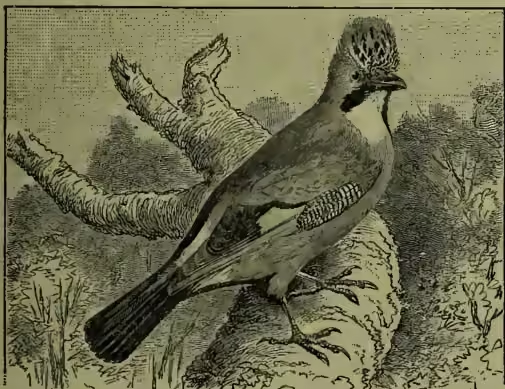
Jay (Garrulus), a genus of short-winged, short-billed birds of the Crow family (Corvidæ), represented in the palæarctic region by about 12 species. The jays inhabit woodlands, and the adults are generally found alone or in pairs. They are almost omnivorous, feeding chiefly on berries, seeds, nuts, and fruits, but eating also worms, insects, larvae, birds' eggs, and even young mice and the nestlings of singing-birds. The well-known blue and black markings on the wing-coverts are characteristic of the whole genus, of which the Common Jay (G. glandarius), the only British species, may be taken as a type. This bird is comparatively common throughout England and Wales, and is found in the south and east of Ireland, and in Scotland as far north as Inverness-shire. Its numbers, however, are everywhere gradually decreasing, owing to the constant war waged against it by gamekeepers on account of its partiality for the eggs of game-birds.
It is also sought after for its beautiful blue feathers, which are used in the making of artificial flies. The common jay builds, in thick trees or high bushes, a cup-shaped, basket-like nest of sticks lined with grasses. The eggs, 5 or 6 in number, are of a greenish-gray colour, thickly speckled with light-brown, and sometimes marked with fine black lines. The adult bird measures about 14 inches. The prevailing colour is a light brown, but the tail-feathers and quills are black; the wing-coverts are black, barred with bright blue and white; the head bears an erectile crest of whitish feathers with black streaks. Though the genus Garrulus is strictly confined to the Old World, closely allied genera, Cyanocitta, the Blue Jays, and Xanthura, the Long-tailed Jays, are found in North and South America. The Common Blue Jay (C. cristata) measures 11½ inches, and is of a grayish-purple colour. It is common throughout Canada and the southern and eastern States, and sometimes does valuable service in ridding a district of caterpillars. When taken young jays are easily tamed, and are very popular as pets; for, though their natural note is harsh and unpleasant, they possess considerable powers of imitation.