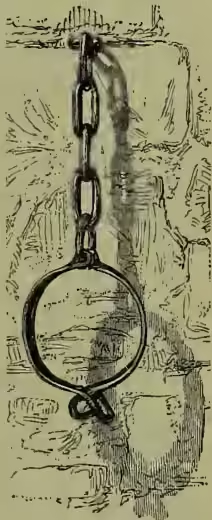
Jougs, JUGGS, or JOGGS, the name given in Scotland to a form of pillory which was used also in Holland and probably in other countries. The jougs were nothing more than an iron ring or collar, fastened by a chain of two or three links to a pillar or wall in some public place, such as a market-cross, a market tron or weighing post, a prison door, a church door, a churchyard gate, a churchyard tree, a tree beneath whose branches courts were held, and the like. The ring or collar opened by a hinge or joint, so as to enclose the culprit's neck, when it was secured by a loop or staple and a padlock. The jougs were employed as a punishment as well for ecclesiastical as for civil offences. They may be traced as far back as the 16th century, and, although they have not been in use for the last hundred years, they may still be found hanging at a few country churches. The accompanying wood-cut represents the jougs at the churchyard gate of the picturesque village of Duddingston, 2 miles S.E. of Edinburgh. The Branks (q.v.) were occasionally hung on the same pillar with the jougs.