Juniper (Juniperus), a genus of trees and shrubs of the natural order Coniferae, sub-order Cupressineæ, having unisexual flowers, the male and female generally on separate plants, and the fruit a fleshy galbule (popularly a berry), containing three small nuts. The species are all evergreen, and have small, narrow, rigid leaves, which are opposite, or in whorls of three or four, or imbricated in four rows. They are natives chiefly of temperate and cold regions, and are found in Europe, Asia, Africa, and America.—The Common Juniper (Juniper communis) is found in all parts of Europe and the north of Asia, and in the northern parts of North America. Only in favourable circumstances does it become a tree of 15, 20, or at most 30 feet in height, and in general it is only a shrub from 2 to 6 feet high. The fruit takes two years to ripen. It is round, of a bluish-black colour, with a whitish bloom; is of the size of a small currant, and is produced in great abundance.
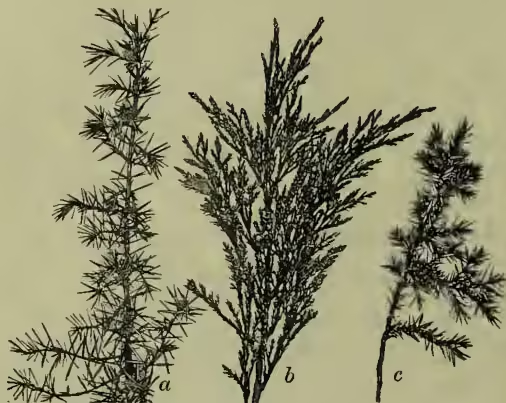
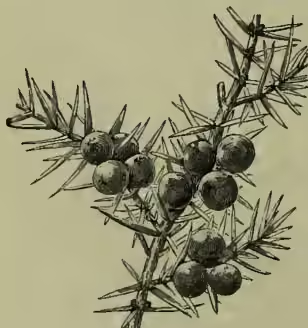
The little nuts or stones of the fruit have on the shell three glands, which abound, before ripening, in an essential oil—Oil of Juniper—present also in the young wood. This oil changes to a true turpentine when the fruit reaches maturity, so that to obtain the oil the green fruit must be used. The wood is yellowish red, brownish in the heart, hard, and fragrant. When of sufficient size it is much valued by turners. It is also used for veneering. The berries have a strong and peculiar flavour, and are much used for flavouring gin, which derives its name from them (see GIN). They also enter into several medicinal preparations, being stimulant, sudorific, and diuretic.—Oil of juniper is lighter than water; specific gravity, 0.839. It is limpid and nearly colourless, and is obtained by distilling the unripe fruit, or the twigs, with water.—Spanish Juniper (J. oxycedrus) grows in arid situations in the countries round the Mediterranean Sea. Its fruit is about the size of a hazelnut; and from its fruit and wood is procured an essential oil of disagree- able odour, called Huile de Cade, which is used in veterinary practice, particularly as a cure for scab in sheep.—Virginian Juniper (J. virginiana), the Red Cedar of North America, is an evergreen tree, often 30–50 feet high, of conical form, with horizontal branches and very small leaves. The berries are small and bright blue. The heartwood is of a beautiful red colour, valued by turners, &c., while for cigar boxes and lead-pencils it has practically superseded the now scarce Bermudas Cedar (J. bermudiana), a lofty tree, with very fragrant reddish-brown wood.—The Himalaya Mountains produce several species of juniper trees of considerable size, beautiful appearance, and valuable wood.—The Swedish juniper of British shrubberies is merely a variety of the common juniper. The Savine which is J. sabina, is separately treated. See SAVINE.