Jute and Jute Manufactures. Some attempts on a small scale to utilise jute-fibre for the manufacture of carpets were made at Abingdon, in Oxfordshire, about the year 1820 or soon after it. But it was at Dundee, which had long been one of the principal seats of the linen industry, that, in 1832 or 1833, the spinning and weaving of jute first began to give promise of commercial success. The fibre, then little known in Europe, was at first received with suspicion, and for some years it was slowly and somewhat stealthily introduced as a textile material. By the year 1850, however, the use of jute had become extensive, and since then, owing, among other things, to the improvements in preparing and spinning machinery, the manufacture of this fibre has rapidly extended, and is now carried on at Dundee, the chief seat of the industry, on a gigantic scale. Jute cloth for Gunny-bags (q.v.) and for native clothing has long been woven on hand-looms in
Bengal, where the plants yielding the fibre are cultivated. Since 1857 a number of large jute-mills, fitted up with textile machinery, driven by steam-power, have been erected in the neighbourhood of Calcutta. The comparatively small cost at which jute can be raised and manufactured will no doubt secure its permanent success as a textile industry; but the fibre is decidedly inferior to flax in strength and especially in durability.
Jute is obtained from the bark of two closely allied species of plants belonging to the lime-tree order (Tiliaceæ). One species, Corchorus capsularis, is cultivated in central and east Bengal; the other, C. olitorius, is grown, but to a more limited extent, in the neighbourhood of Calcutta. The former grows from 5 to 10 feet, sometimes even to 14 feet, in height, but the latter is rather a smaller plant. The chief difference between the two is in the form of the fruit, which in C. capsularis is globular, and in C. olitorius much elongated. Both are annuals with yellow flowers, and they can be best cultivated on a loamy soil or upon one of clay and sand. The higher lands produce the finest qualities of jute. Such as is grown upon mud-banks or upon submerged lands is mostly larger and coarser. The sowing time, which is regulated by the nature and position of the soil, extends from March to June. When the plants flower, which they do in some places in the end of June, the cutting of the crop begins, but this is often not done till the fruit is formed. The harvest is not entirely finished till October, and it is from late reaping, with the plants in seed, that coarse jute is obtained, the crop yielding the best fibre if cut during the flowering period.
The fibre, which is the inner bark, is separated from the stem by retting—i.e. steeping in water (see FLAX). Sometimes the jute is placed in rivers, but more generally in tanks or stagnant pools. To prevent any risk of discoloration of the fibre in the process the jute stalks in some districts are first stacked for a few days to allow the leaves to decay. According to the nature of the water used and the character of the crop, the period of retting lasts from two days to fully three weeks. Care must be taken to stop the process as soon as the fibre begins to separate from the stem, otherwise it rapidly deteriorates. It is believed that retting weakens the fibre, and that if it could be separated from the bark by some inexpensive mechanical process a better quality of jute than it is now possible to obtain would be sent into the market.
The best qualities of jute are of a pale clear yellow or buff colour, with a silky lustre, easily spun and comparatively strong. But there are at least half a score of well-known commercial varieties. Some are bright-coloured, soft, and strong, and such are best for textile fabrics—i.e. comparatively soft, for all jute is of a hard and woody nature. Other kinds are coarse and strong, and suited for making ropes. One or two varieties which are of weak fibre are suited for making paper. One kind, which is long, soft, and fine, but of bad colour, is largely used for gunny-bags.
In order to lessen the harsh and brittle character of jute it is subjected to a softening process on a kind of crushing mangle, from cisterns attached to the top of which oil and water are at the same time sprinkled evenly upon it. Formerly whale-oil was used for this purpose, but of late years a heavy paraffin oil or some similar mineral oil has been largely substituted for it, a change which caused a great fall in the price of whale-oil. The mangle consists of four horizontal rows of fluted rollers, 9 inches in diameter, between which the jute passes in a continuous layer, entering at one end between the first pair of the two upper rows, and coming out at the opposite end between the last pair of the two lower rows. Besides simply turning round, the rollers have also a slight lateral motion, so that the jute is thoroughly crushed or nipped. This crushing—together with the help of the oil and water—softens the fibre, and prepares it for the spinning processes.
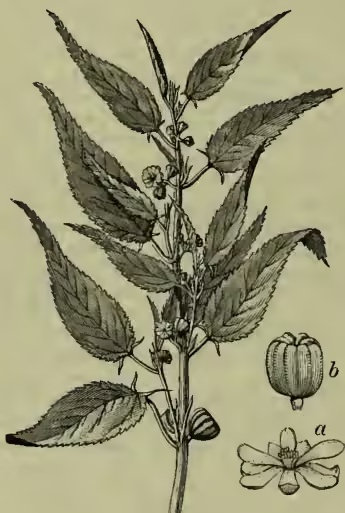
a, flower; b, fruit.
Jute was formerly, and to a small extent is still, spun by two distinct processes, called 'line' spinning and 'tow' spinning, which correspond to those in use for flax. The main difference between them is that in 'line' spinning the fibre is heckled on machines with heckle-stocks furnished with steel teeth, which dress and separate the line or best part of the fibre from the tow, or least valuable portion. In the 'tow' spinning the fibre is first carded on carding-engines, each of which has a peculiar arrangement of revolving cylinders, armed with card points or pins of steel wire. What may be called the carding process of spinning is no longer confined to jute tow, but the whole of the jute is now, as a rule, spun on this system—i.e. it is not heckled at all. Jute-fibre as obtained from the plant being from 6 to 7 feet long, and often considerably more, it requires to be broken into lengths of from 14 to 18 inches. This is done on the machine called the breaker-card, upon which also the jute is cleaned and the fibres laid more or less parallel by the action of the card points. The jute leaves the breaker-card in the form of a continuous lap or sliver, 3 to 4 inches broad, and fifteen of these are drawn out and delivered as a single sliver by the second carding engine, called the finisher-card. This attenuation is accomplished by the doffing-rollers having fifteen times the surface speed of the feed-rollers.
The sliver, or rather slivers, are next taken to the drawing-frame, where their fibres are further straightened and equalised. The drawing-frame has feed-rollers, travelling gills with steel teeth, and drawing and delivery rollers. Here four slivers from the finisher-card are caught by the feed or retaining rollers, passed through the travelling gills, and drawn out into one sliver by the drawing-rollers, which, as well as the delivery-rollers, move at times the speed of the retaining-rollers. The sliver from the drawing-rollers is, besides, usually doubled by passing two of them between the delivery-rollers. The process is repeated on a second drawing-frame with finer and closer teeth than those on the gills of the first. The object of doubling and drawing out the slivers so frequently is that the thick place of one sliver may be corrected by the thin place of another, and also that the different kinds of jute may be thoroughly mixed both as to quality and colour.
Roving is the next operation, and the roving-frame in the arrangement of its rollers and gills is similar to the drawing-frame, but in the former the parts are smaller and the gill-teeth finer and more closely set. As the sliver on this machine, after being still further attenuated by drawing-out rollers, requires to be twisted into a loose thread or 'rove,' a spindle and flier are provided, as well as a bobbin upon which to wind it. Finally the bobbins of 'rove' are taken to the spinning-frame, and spun into yarn upon the 'throstle' principle. See SPINNING.
Jute fabrics are for the most part woven of yarn retaining its natural colour. But for some purposes it is bleached, and when used for carpets or curtains it is dyed various colours. Although it can only be made pure white with difficulty, it readily bleaches pale enough to admit of its being dyed without injury even to bright colours. Dyes upon jute are, however, fugitive unless they are dyed by a special and expensive process, which is only carried out to a small extent in practice. At Dundee the ordinary fabrics made of jute are Hessians, sackings, carpets, tarpauling, and backings for floorcloth. The last-named are woven on looms of extraordinary width (see FLOOR-CLOTH). Dyed carpets, curtains, table-covers, and the like, of this material, are attractive enough in appearance, and carpets especially are largely made. These are cheap but not very durable. Millions of small, brightly-dyed prayer carpets for Moslems are sent from Dundee to the East. Fabrics made of jute are easily rotted by damp, and cannot be often washed and dried like linen or cotton goods without injuring them. This fault of jute soon betrays itself if it is mixed with flax for towelling. Jute, from its somewhat glossy lustre, is occasionally used to sophisticate silk; and it has been employed to some extent to make wigs and other articles in imitation of those made of human hair, chiefly for theatrical purposes.
The following calculation made by Indian commercial men in 1883, and quoted in Watt's Dictionary of Indian Products, gives an idea of the extent of the jute trade in different parts of the world. Of raw jute to supply its factories per week, Scot- land (Dundee) required fully 18,400 bales, England 1860 bales, and Ireland 730 bales; total for the United Kingdom, 21,000 bales. France required weekly 4000 bales, Germany 2170 bales, and other European countries between them 2000 and 3000 bales. The annual consumpt in all Europe was then estimated at 321,400 tons, or 1,800,000 bales. There were actually shipped in the year 1882-83 to Europe 2,364,400 bales, but some may have been re-shipped. At that time the twenty-two Indian factories consumed yearly 107,000 tons, and other countries not included above (chiefly America and Australia) required another 107,000 tons. The total annual consumpt of raw jute in the world at that time was thus about 535,400 tons, the value of which may be roundly taken at £6,000,000. In 1892-98 the jute annually shipped from Calcutta fluctuated from 2,216,000 bales to 2,990,000 bales; and the price varied from £10 per ton to £13, 15s. In 1896, one of the years when imports were greatest, the total import was 340,649 tons, value £4,167,492; while of jute yarn there were exported from the United Kingdom 37,224,300 lb., value £378,356, and of jute woven goods, 257,146,200 yards, value £2,269,692. Of British exports, three-fourths go to the United States, and an increasing quantity to Germany. Of 7190 textile manufactures in the United Kingdom in 1890, only 116 were jute-mills.
Dundee has no monopoly: Indian rivalry has become formidable. The number of Indian steam factories, mostly near Calcutta, was, in 1890, twenty-four, giving employment to 49,000 persons, and using up annually 143,450 tons of jute. From a comparative statement of the wages paid to six classes of work-people in a Dundee and in a Calcutta jute-mill, published in 1884, it appears that in Scotland they earn from one-half to two-thirds more than they do in India, with the exception of weavers, whose pay is more nearly equal in the two countries, and of unskilled labourers, whose wages are very small in the East. But it is said that to produce a finished piece of jute fabric seven persons in India are required to do as much as three at home. The classes of goods manufactured are, however, not exactly the same in both countries, and for this, as well as for other reasons, the comparison cannot be very accurately made.
The value of jute manufactures (yarns and woven fabrics) exported from the United Kingdom in 1894 was £2,423,913. The United States import annually some 20,000 tons of jute, besides 70,000 or 80,000 tons of jute-bulks (lower part of stem and upper part of roots). The States may be said to pay $10,000,000 annually for imported jute and jute goods, though the plant is now being grown successfully in the southern states, and though machinery is being developed with the view of rendering America independent of foreign jute.