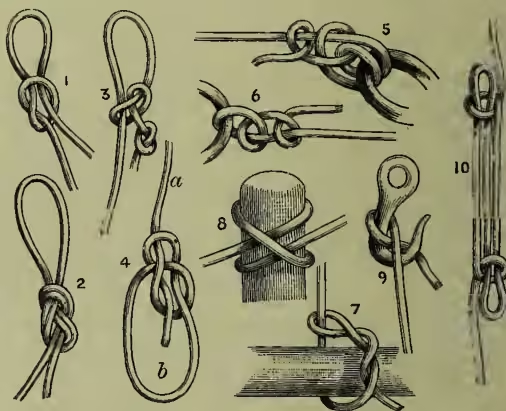
Knots and Splices include all the various methods of tying, fastening, and joining ropes or cords. From 150 to 200 different kinds of knots may be enumerated, mostly used on shipboard, though almost all occupations using ropes or cordage have special kinds of knots adapted to their different requirements. While the great majority of these are purely technical, there are a few so generally useful in the everyday occurrences of life that they may be shortly described. The figures represent the various knots before they are drawn taut, the better to show the method of tying. Generally, the requirements of a useful knot may be stated to be that it should neither 'slip' nor 'jam'—i.e. that, while it holds without danger of slipping while the strain is on it, when slackened it should be easily untied again. The simplest knot is the common one tied on the end of a thread or cord to prevent it slipping. By passing a loop instead of the end of the cord the common slip-knot (fig. 1) is formed; and a useful fixed loop is got by tying a simple knot, or the 'figure of 8 knot' (2), on the loop of a cord. One of the simplest and most useful running-knots for a small cord is made by means of two simple knots (3). The most secure method of fastening a line to, say, a bucket is the standing bowline (4); and a running bowline is formed by passing the end a through the loop b, thus making a running-loop. Another good knot to make fast a bucket is the anchor-bend (5). Out of the score or so of methods of fastening a boat's painter the one which will be found most useful is the well-known two half-hitches (6). The timber-hitch (7) is useful for attaching a line to a spar or a stone, and the clove-hitch (8) is invaluable for many purposes. It is very simple and cannot slip.
A simple method of fastening a rope to a hook is the blackwall-hitch (9), where the strain on the main rope jams the end so tightly against the hook that it cannot slip. There are many methods for shortening a rope temporarily, one of them being the sheepshank, the simplest form of which is shown in fig. 10.
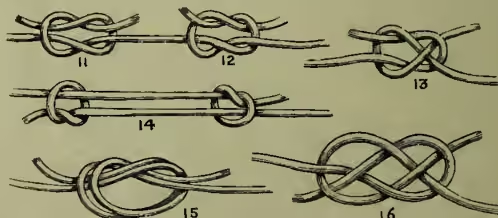
Of the methods for uniting the ends of two cords the simplest and one of the most secure is the common reef-knot (11), which must be carefully distinguished from the 'granny' (12), which will jam if it does not slip; the reef-knot will do neither. For very small cords or thread the best knot is the weaver's (13). The fisherman's knot is a very useful one for anglers, and is formed by a simple knot in each cord being slipped over the other (14); when drawn taut it is very secure, and it is easily separated by pulling the short ends. A useful method of uniting large ropes is shown in fig. 15: tie a simple knot on the end of one rope and interlace the end of the other, and draw taut. This tie may also be made with the figure of 8 knot. For very large ropes the carrick-bend (16) is the simplest and most secure. The bowline-bend is formed by looping two bowline-knots into each other. For attaching a small line to a thick rope the becket-hitch (17) is very useful.
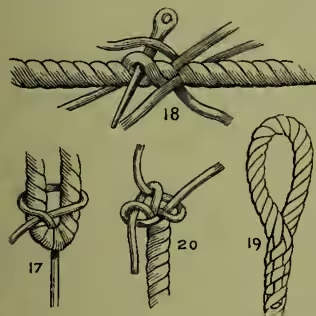
Splicing is the process employed to join two ropes when it is not advisable to use a knot. The three chief varieties of the splice are the short-splice, the long-splice, and the eye-splice. The short-splice is made by unlaying the ends of two ropes for a short distance and fitting them closely together; then, by the help of a marlinspike, the ends are laced over and under the strands of the opposite rope, as shown in fig. 18. When each strand has been passed through once, half of it is cut away and the remainder passed through again; half of the remainder being also cut away, it is passed a third time, and, when all the strands are so treated, they are hauled taut and cut close. This reducing the thickness of the strands tapers off the splice. The long-splice is employed when the rope is used to run through a block, as it does not thicken it. The ends of the two ropes are unlayed for a much longer distance than for the short-splice, and similarly placed together. Then one strand is taken and further unlayed for a considerable distance, and its vacant place filled up with the corresponding strand of the other rope, and the ends fastened as in the short-splice. Other two of the strands are similarly spliced in the opposite direction, and the remaining two fastened at the original joining-place. The eye-splice is, as the term implies, used to form an eye, or round a dead-eye, and is shown finished in fig. 19.
To prevent a rope fraying at the ends a variety of methods are employed, the simplest being to serve or whip the end with small cord. Other methods are by interlacing the ends, one of which, the single-wall, is shown at fig. 20, the ends afterwards being drawn taut and cut short.
The theory of knots, from the scientific point of view, was first treated of by Listing in his 'Vorstudien zur Topologie' (Göttinger Studien, 1847); and the subject is most exhaustively considered by Professor Tait (Trans. Roy. Soc. Edin., 1876-77), in a paper in which the various kinds of knots are analysed according to their number of crossings, and their 'knottiness,' 'beknottedness,' and 'knotfulness' are dealt with.
See Dana, Seaman's Manual (9th ed. 1863); Tom Bowling, Book of Knots (1866); Captain Alston, Seamanship (new ed. 1871); J. Tom Burgess, Knots, Ties, and Splices (1884).