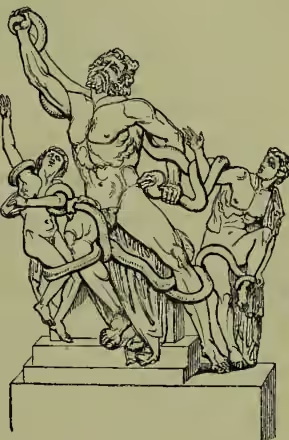
Laocoön, according to classic legend, a priest of Apollo, afterwards of Poseidon, in Troy, who married against the will of the former god, and who warned his countrymen against admitting the wooden horse into Troy. For one or both of these reasons he was destroyed along with his two sons by two enormous serpents which came up out of the sea. This legend is not Homeric, but of later origin. It was a favourite theme of the Greek poets, and is introduced in the Aeneid (ii.) of Virgil. The subject is represented in one of the most famous works of ancient sculpture still in existence, a group discovered in 1506 at Rome, on the side of the Esquiline Hill, and purchased by Pope Julius II. for the Vatican. It was carried by Bona- parte to Paris in 1796, but recovered in 1814. The whole treatment of the subject, the anatomical accuracy of the figures, and the representation both of bodily pain and of passion, have always commanded the highest admiration. According to Pliny, it was the work of the Rhodian artists, Agesander, Polydorus, and Athenodorus; various dates have been assigned to it, from 200 B.C. till 200 A.D.; but the best authorities place its date at a little before 100 B.C. For an admirable æsthetic exposition of its merits, see Lessing's Laocoön (1766; new ed. with bibliography by Blümner, 1880; Eng. trans. 1836, 1853). There is a recent German Monograph by Kekulé (1883).