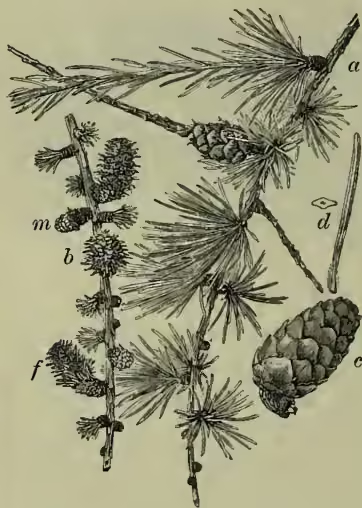
a, twig with shoots; b, twig with male (m)
and female (f) flowers; c, mature cone;
d, needle with section.
Lardner, DIONYSIUS, a successful populariser of physical science, was born in Dublin, 3d April 1793, and, after four years as clerk to his father, a solicitor, entered Trinity College. He first attracted attention by a Treatise on Algebraic Geometry (1823), and a work on Differential and Integral Calculus (1825). But he is best known as the originator and editor of Lardner's Cyclopædia, a series of 132 volumes on scientific subjects, published between 1830 and 1844. Lardner himself wrote the volumes treating of mechanics, hydrostatics, geometry, arithmetic, heat, and electricity. This was followed up by the historical series entitled the Cabinet Library (12 vols. 1830-32) and Museum of Science and Art (12 vols. 1854-56). He also wrote several useful handbooks of various branches of natural philosophy. In 1828 Lardner had been appointed professor of Natural Philosophy and Astronomy in University College, London; but in 1840 he lost his chair through running away with the wife of an army officer, who claimed £8000 damages from him. However, Lardner went to the United States, and there made five times that sum by lecturing. He lived in Paris from 1845 to 1859, and died at Naples on 29th April 1859.