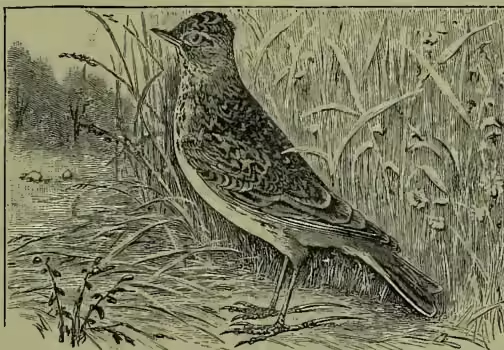
Lark (Alauda arvensis), a familiar songster, otherwise well known as the symbol of poets and the victim of epicures. It is included among Passerine birds, type of the family Alaudidae, which comprises over 100 species, widely distributed in Europe, Asia, and Africa, with spreading stragglers in Australia and North America. The plumage is usually sandy brown, the colour of the ground; the lower legs bear scales, behind and before; the hind-claw is very long and straight; the bill is strong and conical. The skylark measures about 7 inches in length; the males and females are alike in plumage; the food consists of insects, worms, and seeds. It nests in April, making a structure of dry grass in a hollow in the ground, usually among growing grass or cereals. The eggs (three to five) are dull gray, mottled with olive-brown; two broods are usually reared in the season. Great crowds of larks come to Britain from the Continent in autumn, and later on there is a general movement southwards. It has been introduced into Australia and New Zealand, and to some extent in the United States.
‘The lark is a creature of light and air and motion, whose nest is in the stubble and whose tryst is in the clouds.’ Its song ‘at heaven’s gate,’ idealised by Shelley, Wordsworth, Hogg, and other poets, ‘is not especially melodious, but blithesome, sibilant, and unceasing.’ ‘Its type,’ Burroughs well says, ‘is the grass, where the bird makes its home, abounding, multitudinous, the notes nearly all alike and in the same key, but rapid, swarming, prodigal, showering down as thick and fast as drops of rain in a summer shower.’ The bird very rarely sings on the ground, but when soaring or descending.
There is no doubt that larks when very numerous, as they often are, may do considerable damage to autumn-sown wheat or young green crops. This fact is sometimes urged to excuse the custom of catching them for the cage or table. They are caught in horse-hair nooses, or netted, or shot after being attracted and mesmerised by 'twirling' some bright glistening object. 'It is estimated that, during last century, in Leipzig alone over five million larks were received annually; in 1854 there were brought to the London markets over 400,000; and the official returns state that in 1867-68 more than a million and a quarter were taken into Dieppe.'
In Europe there are several other common species of lark—e.g. the Wood-lark (A. arborca) and the Crested Lark (A. cristata), the former of which is locally distributed in England and Wales, and the latter a rare visitor. Among the other genera may be noted the Shore or Horned Larks (Otocorys), with a hornlet over each eye; these are 'the only larks which occur regularly in the western hemisphere.' One species (O. alpestris) has occasionally been found as a straggler in Britain, just as the species of Alauda occasionally wander beyond their usual range.