Laurel (Laurus), a genus of Lauraceæ, restricted, containing only a single species, the Noble Laurel or Sweet Bay (L. nobilis), a native of Asia Minor, but now diffused over all the countries around the Mediterranean Sea. It is often a mere bush of 15 feet or less, but sometimes becomes a tree of 30 or even 60 feet high. It has rather large, lanceolate, leathery, shining leaves, reticulated with veins, and axillary clusters of yellowish-white flowers of no beauty. The fruit is oval, bluish-black, and about half an inch long. Both the leaves and the fruit are bitter, astringent, and aromatic, and were formerly much used in medicine as a stomachic and stimulant. The leaves are still used in cookery for flavouring. They contain a volatile oil (oil of sweet bay), and a bitter, gummy extractive. See the article BAY, and the illustration there.
By the ancient Greeks the laurel was called daphne; it was sacred to Apollo. Berry-bearing twigs of it were wound round the forehead of victorious heroes and poets; and in later times the degree of Doctor was conferred with this ceremony—whence the term laureation; and, according to some, the term Bachelor (q.v.). And to this day a laurel-crown is the emblem of the honour to which poets, artists, and warriors aspire.
The Noble Laurel is common in shrubberies in Britain, but not nearly so common as the species of Cherry-l Laurel, which share with it the name Laurel, as do not a few other shrubs botanically very different, but somewhat similar in their evergreen foliage.
LAUREL-CHERRY, or CHERRY-LAUREL, is a name given to those species of Prunus (sub-genus Cerasus) (see CHERRY) which have evergreen leaves. They have small flowers in long racemes, and small fruit—the fruit of a nauseous taste—and most parts of the plant, but particularly the buds, leaves, and kernels, remarkably abounding in hydrocyanic (prussic) acid, and therefore very poisonous. The Common Cherry-l Laurel (often spoken of simply as the Laurel or Common Laurel, or even more erroneously as the Bay Laurel), Prunus (Cerasus) Laurocerasus, is a shrub, sometimes of the very largest size, with large ovate-lanceolate, convex, smooth, remotely serrated, shining, light-green leaves, and erect racemes of flowers. It was discovered towards the middle of the 16th century by Belon, at Trebizond, and thirty years later introduced by Clusius through the imperial ambassador at Constantinople, and planted at Vienna, whence he soon widely distributed it. Gerard thus mentions it as a choice garden shrub in
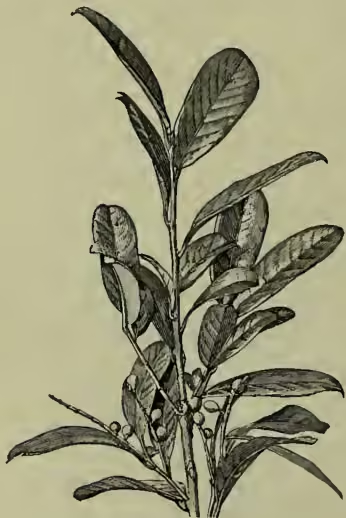
(Prunus Laurocerasus).
England before the end of the century. It is now naturalised throughout the south of Europe, and is one of the most common ornamental shrubs in Britain, where it suffers only from such severe frosts as are of rare occurrence. It is propagated by seeds, layers, and cuttings. Its leaves resemble bitter almonds in smell and taste, and have in great abundance the same essential oil (see ALMONDS, OIL OF), and hydrocyanic acid. From these leaves, by maceration in water for twenty-four hours, and subsequent distillation, is obtained the Laurel-water, or Cherry-l Laurel water, formerly employed in medicine as a substitute for hydrocyanic acid. The leaves are sometimes employed also for flavouring puddings, sauces, &c., and are safer for such purposes than oil of bitter almonds, but ought to be used with caution, fatal accidents being on record. A bottle of cherry-l Laurel leaves bruised and moistened is often carried by entomologists to kill their captured prey. Neither the essential oil nor the hydrocyanic acid seems normally present during the life of the leaf; both are believed to be produced by the decomposition of amygdalin, or by a ferment, but neither of these has been successfully isolated. Several varieties are in cultivation—notably, e.g., var. latifolia, large leaved; colchica, dwarf, with narrow, shapely serrate leaves; and caucasica, which is said to be the handsomest, hardiest, and most vigorous of all. Another species, also very common as an ornamental shrub in Britain, but not quite so hardy, is the Portugal Laurel (Prunus or Cerasus lusitanica), a large shrub—sometimes a tree—with smaller dark-green leaves and lateral racemes. It does not grow so well under the shade of trees as the common cherry-l Laurel. From the dissimilarity of form, size, and tint of their leaves, these species contrast well in the shrubbery. The variety myrtifolia is small and compact. The North American cherry-l laurels are Prunus caroliniana of the southern states, and P. ilicifolia of California, both small and handsome evergreens.