Lead is one of the metals which have been known from early times. It is mentioned in Job, xix. 24, and articles made of it by the ancient Romans—some of them inscribed and dated—such as water-pipes, water-tanks, weights, rings, and small ornamental cylinders, are still preserved. As examples found in the grounds of some of the old abbeys and cathedrals show, the Roman method of making pipes from sheet-lead, which differs from the modern way, continued in use till late in the middle ages. Small lead weights of curious forms have been found among Viking remains dating as early as the 10th century. Of lead compounds, litharge and red lead were known to the ancients.
Lead (symbol Pb, atomic weight 207) is a soft metal of a bluish-white colour, tending to gray, and having also a bright metallic lustre when newly cut or melted. Its surface soon tarnishes, however, when exposed to the air, by taking on a thin film of what is supposed to be suboxide. But the oxidation increases so slowly that lead suffers less than most ordinary metals either by exposure to atmospheric agencies or by being placed in damp soils. Lead can be scratched with the nail, and easily cut with a knife, and it makes a streak upon paper. Its specific gravity varies from 11.352 in the ingot to 11.365 when rolled into sheets, and its melting-point is 633° F. (334° C.). It is highly malleable and in a less degree ductile, but its tenacity is small—a wire th of an inch being unable to carry a load of 20 lb. Lead is not a good conductor of heat or electricity. When gently heated it can be forced by pressure through perforations, so that pipes and solid rods for rifle-bullets, &c. are in this way manufactured. It is well to bear in mind that pipes, gutters, and cisterns made of lead are injured by hot water. The two former are often twisted and rendered useless by the constant flow of hot liquids through them. Neither sulphuric nor hydrochloric acid in the dilute state has any action upon lead.
The Action of Lead upon Water is of great importance, because the metal is so much employed for pipes and cisterns, and because lead salts dissolved even in minute quantities in drinking-water act as cumulative poisons, and are therefore injurious when taken for some length of time into the system. Lead is rapidly acted upon by pure water to which air has access, such as rain; and it is also dissolved to an appreciable extent by the water of rivers or lakes which is practically free from lime. In these cases the water after passing through lead pipes has an alkaline reaction. The combined action of air (i.e. of its free oxygen) and water oxidises the lead. After a time this hydrated oxide which dissolves is converted by atmospheric carbonic acid into an insoluble basic carbonate of lead. The oxide is again formed and the corrosive action continues or may continue. Bicarbonate or sulphate of lime, which are common salts in potable waters, prevent water acting on lead. So do some other salts; but ammonium nitrate, on the other hand, assists the solution of the lead. Sir Robert Christison found that a very small amount of peat- extract in solution prevents the action of an otherwise pure water upon lead. But in the case of even a soft and almost pure water, like that supplied to Glasgow from Loch Katrine, the action is so slow that short-service pipes of lead when constantly used are harmless.
Native lead is of rare occurrence, but it has been found very sparingly in a few places. The metal is obtained chiefly from galena or sulphide of lead, which forms veins in different geological formations. There are several oxides of lead, two of which, plumbic oxide and red oxide, are of importance in the arts.
Plumbic Oxide (monoxide of lead, massicot, litharge), . Massicot, from which red lead is manufactured, is obtained in the form of a yellow powder by heating lead to dull redness. Litharge is produced when lead is oxidised, as in the cupellation furnace, at a high temperature in a current of air. The melted litharge flows from the cupel into iron pots, and after cooling breaks up into crystalline scales of a colour varying from a pale to a reddish yellow. This is called flake litharge, and when ground it is termed buff or levigated litharge. Both massicot and litharge enter into the composition of Cements (q.v.). Litharge is used in the fabrication of oil-varnishes to increase their power of drying, in the preparation of lead plaster, and for glazing earthenware. Red Oxide of Lead (red lead or minium), , is occasionally found native. Its manufacture is referred to below. There is another kind of red lead, called orange lead, containing more oxygen than minium. Plumbic Peroxide (binoxide of lead, puceoxide), , is obtained by treating the red oxide with dilute nitric acid. This oxide, which is of a brown colour, is used mixed with sulphur along with other ingredients for tipping some kinds of matches, the mixture of puceoxide with sulphur being spontaneously inflammable when rubbed.
The most important lead salts are the following: Plumbic Carbonate (carbonate of lead, white lead), : the cerussite of mineralogists, and now largely mined in the United States as an ore of lead. White lead is manufactured on a large scale by the process described below. Plumbic Chloride (chloride of lead), . The minerals matlockite and mendipite are both oxychlorides of lead. By a process introduced by H. L. Pattinson, a basic chloride of lead is made for use as a white pigment, which is, however, not so serviceable as ordinary white lead. Lead Acetate (sugar of lead), , is prepared by dissolving massicot in dilute acetic acid. It can be obtained in transparent crystals or in scales by evaporating the solution. It is soluble in part of cold water, and in eight parts of alcohol. Like litharge, it is used in the manufacture of oil-varnishes, and it is an important substance in medicine. For the chromate of lead, which is employed as a yellow pigment, see under CHROMIUM.
The following are some of the tests for lead compounds in solution: An addition of hydrochloric acid produces, unless in very dilute solutions, a white precipitate of lead chloride unaltered on adding ammonia. Sulphuretted hydrogen produces a black precipitate, and this precipitate when heated with strong nitric acid is converted into insoluble white sulphate of lead. Chromate of potash produces a yellow precipitate, which has the same appearance as the precipitate this chromate gives with baryta, but the chromate of lead is soluble in caustic potash, while chromate of baryta is insoluble. Lead compounds, when mixed with a little carbonate of soda, are easily reduced to the metallic state if heated on charcoal in the inner blowpipe flame.
Ores and Smelting.—Until recent years only a small quantity of lead was obtained from any other ore than Galena (q.v.). This is a sulphide of lead (lead, 86.6; sulphur, 13.4), and is found extensively, more or less pure or associated with other ores, in Great Britain, Germany, Spain, and other European countries. About one-third of the British supply is obtained from the Crossfell district, where the counties of Cumberland, Durham, and Northumberland meet. A few other English counties, Wales, the Isle of Man, and Scotland, also yield lead. The total quantity of ore now annually raised in Great Britain is about 50,000 tons, yielding nearly 40,000 tons of lead—less than was formerly usual.
The United States is now a large producer of lead, the Colorado smelting-works alone, which first rose into importance in 1878, yielding as much as 70,000 tons in the year 1887. The works and mines of this state are chiefly at Leadville, where much of the ore obtained is cerussite or native carbonate of lead. The earlier discovered Nevada lead-veins produced 31,000 tons of lead in 1877, but only 3400 tons in 1887. Utah, Idaho, Montana, New Mexico, Missouri, and Kansas also produce lead. The total lead produce of the United States in 1896 was 187,000 short tons (of 2000 lb.).
Some of the rarer lead minerals, not already mentioned, are anglesite or sulphate of lead, lanarkite, which is a basic sulphate, pyromorphite or phosphato-chloride of lead, and bournonite, consisting of the sulphides of lead, copper, and antimony. All galena is more or less argentiferous.
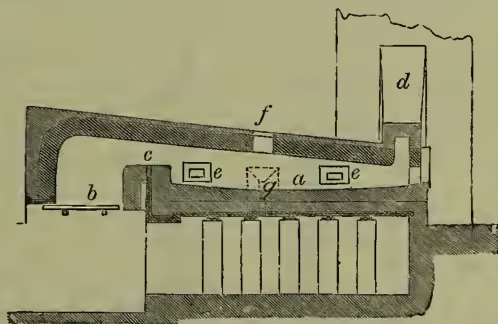
Galena when taken from the mine is broken up into small pieces or reduced to powder, and the impurities, in so far as these can be removed mechanically, separated by machines noticed under METALLURGY. If the dressed galena is nearly pure, as it often is, the smelting operation is simple. A charge of ore amounting to at least 20 cwt. is first partially roasted or calcined for about two hours on the bed of a reverberatory furnace, such as is shown in fig. 1, which results in one portion being converted into oxide and another into sulphate of lead, while some of the sulphur goes to form sulphurous acid, which escapes as gas. There remain on the hearth of the furnace oxide, sulphate, and some unaltered sulphide of lead. These, when the heat is raised and the furnace doors closed to practically stop the supply of air, react upon each other, forming sulphurous acid and metallic lead. Towards the end of the process some lime is thrown in to aid in the manipulation of the slag and undecomposed ore; and when a further portion of metal is extracted from these the melted lead is run off into a vessel, and the slag removed from the furnace. The changes which take place in the later or melting stage of the process are shown by the following equations:
In the northern lead districts of Great Britain the calcined ore is removed from the reverberatory furnace and smelted with the aid of a blast of air on a separate ore-hearth called the 'Scotch furnace.'
Owing to lead being to some extent volatile at a red heat, a considerable quantity of the metal would, if not prevented, pass from the smelting-furnaces into the atmosphere as smoke or fume, and cause a loss of, sometimes, 10 per cent. of what the ore should yield. Moreover, lead smoke destroys vegetation for some distance around the furnaces, and herbage on which the fume condenses is apt to poison animals feeding upon it. At Holywell in Flintshire, Alston Moor in Cumberland, and at other lead-works this smoke is conveyed through a system of flues whose combined length amounts in some cases to several miles. Sometimes it is one very long flue. The fume condenses on the sides of these flues, openings being left to collect it. Condensing chambers are also used, in one form of which the lead fume is precipitated by being forced through water. These condensers are constructed to save the expense of long flues, but sometimes both are employed. The lead is of course extracted from the collected fume. In the Harz Mountains, and in some other lead-mining and smelting districts lead is extracted from complex ores—that is to say, from argentiferous galena associated with comparatively small quantities of the sulphides of copper, iron, zinc, and antimony, together with a gangue of quartz (silica), alumina, calcspar, heavy-spar, and brown-spar. For such ores what is called the precipitation by iron or the iron-reduction process is, in some cases at least, more suitable than the air-reduction process described above. A certain proportion of iron is added to the charge of ore in a blast-furnace, with charcoal or coke for fuel, because the sulphide of lead is completely reduced when heated with metallic iron, since this metal has a greater affinity for sulphur than lead. The reduction of these complex ores is, however, rather a combination of processes than a single one. Besides lead and silver, copper and sometimes other metals are obtained as accessory products.
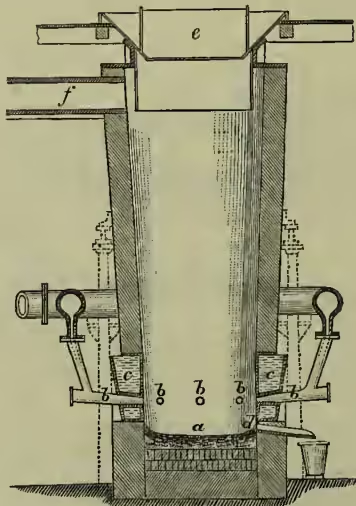
As an example of a water-jacketed blast-furnace for lead-smelting we give in fig. 2 a vertical section of the cupola-shaped one called the Pilz furnace now in use at Freiberg, and which has also been adopted in the United States. It has eight tuyères, and varies in size from 4 feet in internal diameter, and 14 feet high from the hearth-plates, up to 20 feet in height, with a proportional width across. In the United States, however, the Rachette or rectangular form of blast-furnace seems to be preferred, because its capacity can be increased by lengthening it on plan without also increasing the height, as must be done if a circular furnace is made larger in diameter. The pressure of the blast in these furnaces is from to 1 lb. per square inch. The ore smelted at Leadville, Colorado, is, as already stated, largely cerussite or carbonate of lead, and this is easily reduced in a blast-furnace by coke or charcoal.
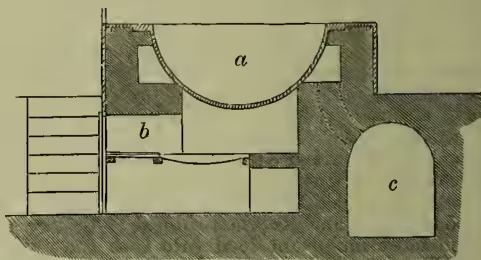
a, pot; b, fireplace; c, main flue.
Desilverising, &c.—Lead usually contains antimony, tin, zinc, and other metals as impurities. These are separated by fusing the metal in shallow pans, when the foreign metals form oxides, and as such are skimmed off. Lead reduced from galena always contains a little silver, of which 8 or 10 oz. to the ton of lead is a very common proportion, although it often exists in much larger quantity, and as little as 2 oz. to the ton can now be profitably extracted. The desilverising process patented by H. L. Pattinson of Newcastle-on-Tyne in 1833 is still much used. A series of cast-iron pots about 6 feet in diameter (see fig. 3) is used in the process. The argentiferous lead from the smelting-furnace is melted in one of these and allowed to cool slowly, and at the same time it is briskly stirred. A portion of the lead is thus made to separate in small crystals, which, as pure lead solidifies at a higher temperature than when it is alloyed with silver, leaves the fluid portion richer in silver. Suppose that the lead to begin with contains 10 oz. of silver to the ton; then if two-thirds of the charge of this pot, which is usually the centre one of several, is transferred as crystals to another pot it will contain only about 5 oz. of silver to the ton. The one-third remaining in the liquid state will contain 20 oz. of silver to the ton. With both portions this process is repeated several times, the one becoming poorer, and the other richer in silver after each crystallisation. When the lead is enriched to the extent of from 250 to 300 oz. of silver to the ton the concentration is usually stopped, although it is sometimes carried a good deal further. The silver is then obtained from this rich lead by melting it on a flat bone ash cupel, placed in a reverberatory furnace, and exposing it to a current of air which reduces the lead to the oxide, or litharge of commerce, leaving the silver on the cupel. Fully 320,000 oz. of silver are in this way annually separated from British lead, the latter at the same time being improved in quality.
The Rozan process for desilverising lead is the same in principle as Pattinson's, except that steam is used instead of manual labour, the result being that there is a considerable saving in the cost.
Another method of desilverising lead, known as Parkes' process, was patented in 1850. By this method the silver is separated by adding to the melted lead from 1 to 2 per cent. of zinc, which has a greater affinity for silver than lead. The zinc carrying the silver with it forms, on cooling, crusts on the surface. From these crusts the zinc is afterwards distilled, leaving silver mixed with some lead as a residue. A modification of Parkes' method was patented in France by Condurié in 1866. He uses superheated steam for the separation of the zinc from the crust or scum, and for getting rid of any foreign metals remaining in the desilverised lead. It is said that a very pure commercial lead is obtained by Condurié's process.
Rolled out into sheets, lead is largely used for roofing houses and for water-cisterns; and water-pipes are now made from it without soldering, as already stated. It is also of great service in the construction of large chambers for the manufacture of sulphuric acid. Its value for the manufacture of shot is well known. Alloyed with antimony, &c., it is largely consumed for type-metal, and with tin for solder. Much lead is also required for the manufacture of pewter, Britannia metal, &c. See ALLOY.
White Lead or Carbonate of Lead is a substance very extensively used as a white pigment, as a cement, and for pottery glazes. White lead is still largely made by the old Dutch process. Metallic lead is cast into the form of stars, gratings, or thin perforated slabs in such a way as to facilitate its conversion into the carbonate. These pieces of lead placed in earthenware vessels, like flower-pots, containing a little weak acetic acid, are built up in tiers in the form of a stack, and surrounded with spent tan or horse-dung. The heat given out from the dung volatilises the acid, which along with the air changes the surface of the lead into the basic acetate, and this is, in turn, converted into the carbonate by the carbonic acid given off from the hotbed. Metallic lead requires from four to eight weeks for conversion into white lead, during which a repetition of these reactions goes on. In 1890 a company was formed in London to work R. MacIvor's process, which consists in acting upon oxide of lead (litharge) by a solution of acetate of ammonia, and then precipitating carbonate of lead from the solution by injecting carbonic acid. By this process white lead is very quickly made. The acetate of ammonia is recovered and used again.
Minium, Red Lead, or Red Oxide of Lead, is much consumed in the manufacture of flint-glass, as a cement, and as a pigment. For glass-making it requires to be made of very pure lead, as a slight trace of copper would impart a colour to the glass. Minium is prepared by heating massicot or monoxide of lead to a temperature of 600° F. in iron trays, in an oven, carefully avoiding fusion. More oxygen is thus gradually absorbed; and a bright-red compound is formed which is the red lead of commerce. Orange lead, made from white lead instead of from massicot, is a very pure kind of red lead.
Yellow Lead.—This name is sometimes given by manufacturers to a mixture of the oxides of lead and antimony, which is to some extent used to give a yellow colour to earthenware and as a pigment.—The so-called Black Lead (q.v.), of which pencils, &c. are made, contains no lead.
LEAD-POISONING, or PLUMBISM.—Minute doses of lead introduced into the system for some time bring on peculiar and distinctive symptoms. In the 18th century, before its cause was ascertained, the disease was well known in Poitou (hence called 'colica pictonum'), in Devonshire, and in the West Indies. It was proved by Sir George Baker in 1767 that it was due in each case to the presence of lead in the prevalent alcoholic drink of these regions—wine, cider, rum respectively, owing to its introduction during the process of manufacture. It is occasionally met with in consequence of the action of water, generally very soft water, on the lead pipes through which it passes to the consumers. But it most often attacks persons brought much into contact with lead compounds, such as makers of white lead, workers in the glaze of potteries, painters, and plumbers. The intestinal canal and the nervous system are affected; gout also occurs. See W. D. Prendergast's monograph on lead-poisoning (1898).
(1) Lead or painter's colic is much the most common form of the disease. It consists in more or less severe attacks of pain in the abdomen (see COLIC), not differing much except in their persistence and frequent recurrence from pains otherwise produced, attended by obstinate constipation and frequently by vomiting. They may be so slight for some time that they do not interfere with the sufferer's continuing his work. Lead-colic is rarely fatal; but may be so if the cause of the affection is not recognised.
(2) The commonest affection of the nervous system is paralysis of some of the voluntary muscles; usually those first and most affected are the extensor and supinator muscles of the forearm, and the muscles of the ball of the thumb; and from the characteristic deformity thus arising the condition is termed wrist-drop. Other muscles may be first or alone affected; but in almost all cases the muscles of the upper limbs are those where the disease manifests itself. It is not certain whether the nerve-trunks or the centres in the spinal cord are the primary seat of morbid change. Atrophy of the brain-substance, or of the optic nerves, epileptic attacks, and coma occasionally occur as results of lead-poisoning. All the nervous disorders are generally preceded by lead-colic.
(3) The association of gout with lead-poisoning is frequent; and the former is certainly sometimes produced by the latter. But it is probable that gouty subjects are specially sensitive to the action of lead. Cirrhosis of the kidneys (see KIDNEYS, DISEASES OF) occurs in some cases; but whether it is ever a primary effect of lead-poisoning, and not due to induced gout, is not quite certain.
Besides the more obvious effects of the poison above described, there are others of great importance, as they aid in the discovery of the cause of the disease. The most distinctive is the formation of a dark line along the edges of the gums close to the teeth, due to precipitation of lead in the form of sulphide in the tissues. The general health usually suffers, the complexion is sallow and the skin dry and harsh.
Prevention.—The most important point to be attended to is that those exposed to the cause of the disease should pay scrupulous attention to cleanliness; should never eat in their workrooms, or without washing their hands; and where dust containing lead is present should wear respirators during their work. Lemonade or some other drink slightly acidulated with sulphuric acid should be used as a beverage, for it forms the insoluble and inert sulphate of lead with any other lead compound which has obtained access to the stomach. Where the water-supply is at fault lead pipes must be discarded, or means must be taken to render the water hard before it is admitted to the pipes.
Treatment.—When lead is present in the system and causing any of the symptoms above described, its removal can be effected by the administration of iodide of potassium (see IODINE). Sulphuretted baths, formerly recommended, are of doubtful efficacy. Lead-colic requires the free administration of castor-oil or other purgatives; and lead-paralysis is often benefited by stimulation of the affected muscles by electricity.