Leeches (A.S. leece, 'a physician;') Hirudinea or Discophora), a class of worm-like animals, usually suctorial parasites, sometimes genuinely carnivorous. They are widely distributed in fresh and salt water, and occasionally on land. The body is extensile and ringed, but the superficial rings do not correspond to the true segments; no appendages are present, but there is a posterior attaching sucker, and the mouth is powerfully suctorial; the body-cavity is almost obliterated by a spongy growth of connective tissue; the animals are hermaphrodite.
The Medicinal Leech (Hirudo medicinalis), formerly much used in blood-letting, has a slightly flattened body 2 or 3 inches in length, greenish black in colour, mottled on the under side, and with six rows of reddish and yellowish spots along the back. The skin is slimy and frequently casts its cuticle; there are 102 superficial skin-rings, with sense-spots on every fifth, while ten distinct eye-spots are borne on the head.
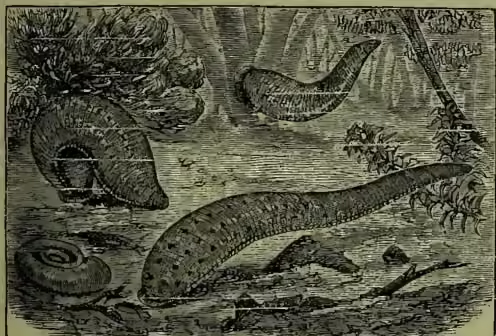
The animal is very muscular, moves rapidly by alternately fixing its oral and posterior suckers, and swims with graceful undulations. The mouth contains three semicircular 'saws,' each with eighty to ninety minute teeth of lime and chitine, by the saw-like action of which the leech gives its characteristic triradiate bite. From animals thus bitten the leech sucks blood, and falls off when its many-punched gut is gorged. A secretion from the pharynx seems to keep the blood from coagulating, and after a heavy meal the leech can fast and digest for a year. Its opportunities are in many circumstances few and far between, but it certainly makes the most of them. About the leech's own blood, it is worth noting that it is coloured red with hæmoglobin. Leeches are at home in slow streams and in marshes, sometimes venturing ashore in search of victims higher than the insect larvæ, fishes, and amphibians which they may hit upon in the water. The eggs are laid about June in the moist ground by the side of the water, and are enclosed in cocoons which are secreted from the skin. The growth of the young leech is slow, may continue in fact for four or five years, while the total length of life sometimes reaches a score. The medicinal species occurs in Britain, but is much commoner on the Continent. When the medical use of leeches, which is of ancient origin, was a constant practice, the swamps of western France were very important sources of supply. There the vampires were sometimes fed by driving old horses or cattle into the enclosures, and the primitive custom of wading in the water till the leeches fix on the bare legs is still practised by collectors. It is calculated that thirty millions used to be employed annually for medical purposes in France and England, but nowadays they have gone much out of fashion; yet a hatchery near Hildesheim still raises some millions annually. When kept by apothecaries they ought to be allowed free play in a closed glass aquarium with water-plants, instead of being huddled together in a dark vessel.
Leeching, or the application of leeches for the purpose of abstracting blood, is sometimes used instead of venesection, where general depletion is indicated, particularly in children; but much more often for the purpose of local depletion in localised inflammations. In the diseases of infants and young children, leeches must be applied with caution. In applying leeches the part should be thoroughly cleaned, and the leeches, after being dried by rubbing them in a clean linen cloth, should be placed in an open pill-box, or in a wine-glass, and applied to the spot at which it is desired that they should attach themselves. When it is wished to affix a leech to the inside of the mouth, it is placed in a narrow tube called a leech-glass. When the animals will not attach themselves readily they may sometimes be induced to bite by moistening the part with milk or blood. They usually drop off when filled; if they do not, they may be induced to do so by sprinkling them with common salt; they must never be pulled away. The quantity of blood which a leech is capable of drawing may be estimated on an average at about a drachm and a half, besides what flows from the wound after it has fallen off. It is usually desirable to promote to some extent this flow, which is readily done by the application of warm fomentations or poultices. The bleeding generally stops spontaneously after a short time; if it goes on longer than is desirable, the application of the fluff of a hat, or of a bit of cobweb, will usually check it. If these means fail, a little cone of lint should be inserted into the bite, over which a compress should be laid and a bandage applied; or the bite should be touched with a stick of nitrate of silver (lunar caustic) scraped to a point. Leeches, when applied to the mouth or interior of the nose, have been occasionally swallowed, and have given rise to very unpleasant symptoms. A moderately strong solution of common salt readily dislodges them. The 'artificial leech,' sometimes used, is a mechanical arrangement for producing a small freely-bleeding wound in the skin.
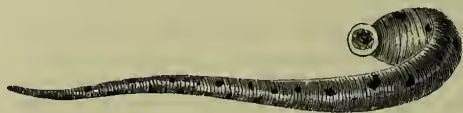
The Horse-leech (Hæmopis sanguisuga), whose 'daughters' (whether of this precise species or not) 'cry Give, give,' is common in Britain and elsewhere. It is about inches in length, feeds largely on earthworms, but has blunt teeth, and is not used medicinally. Another horse-leech is the voracious Aulastoma, which is carnivorous rather than parasitic. Among the numerous land-leeches which attack horses, cattle, and men, one of the most troublesome is Hæmadipsa ceylonica, graphically described by Sir James S. Tennent. It is only about an inch long and as thin as a knitting-needle, but it pursues its desired victims with considerable rapidity, and makes itself most irksome both to man and beast. So abundant are land-leeches in some warm and moist parts of the East that soldiers and workmen are sometimes fatally weakened by the minute but persistent blood-letting. All the above and some other genera, such as the eight-eyed Nepelis of our ponds, are called Gnathobdellidæ, being usually provided with three tooth-plates, but without a 'proboscis.' In another set, Rhyncobdellidæ, the forepart of the body is retractile and forms a proboscis. Here are included many interesting forms: the little fresh-water Clepsine, sometimes found with the young attached to the parent; the large, warty, marine Pontobdella, which fastens on rays; Piscicola on fresh-water fishes, such as perch and carp; and Branchellion, with numerous lateral leaflets of skin. The largest leech known is the South American Macrobodella valdiviana, a carnivorous form living in moist earth, and sometimes said to measure two feet and a half.
See C. O. Whitman in Quart. Jour. Micr. Sci. for 1886; Moquin-Tandon, Monographie de la Famille des Hirudinées, with Atlas (2d ed. 1846); Verill, Fresh-water Leeches (Washington, 1875).