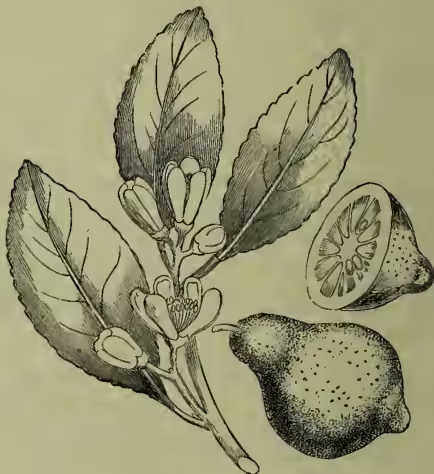
Lemon, the fruit of a small tree (Citrus Limonum) belonging to the same natural order as the Orange (Aurantiacæ). The general character of the leaves and flowers and fruit of the lemon-tree is so well illustrated in the accompanying cut that description may be dispensed with. There are many varieties of the lemon, but they may all be included under the following four distinct types: (1) The Common or Genoa Lemon, which is the most plentiful in the shops. (2) The Thin-skinned Lemon, which is of large size, having a thin smooth shining fragrant rind, with an almost entire absence of white spongy matter beneath it. The pulp is very delicate and juicy, with a delicious aroma. (3) The Sweet Lemon, which, while having the external appearance of the lemon, has the pulp sweet like that of the orange. (4) The Citron Lemon, or the Ligurian Lemon of commerce. It is a large oblong fruit, with a thick rough warded rind, which is eatable. The pulp, however, is the least delicate of all lemons.
The peculiar and grateful flavour of the juice of the lemon is mainly due to citric acid. It forms, when properly diluted, an agreeable and refreshing drink (see LEMONADE), and is useful in febrile and inflammatory diseases. The most valuable of its properties, however, is the prevention and cure of scurvy; hence it or the very similar lime-juice (see LIME) is an important article in sea stores. The well-known uses of the rind, either fresh or preserved, in the cook's and the confectioner's arts for flavouring and ornamenting dishes, cakes, and candies need only be alluded to, to show the importance of the lemon to civilised man. The essential oil (see below) is obtained from the rind. The lemon is largely cultivated in all the warmer countries of the south of Europe and those bordering on the Mediterranean, and it is naturalised in some parts of South America and in the East and
West Indies, and in parts of Australia. See Bonavia, The Cultivated Oranges and Lemons of India and Ceylon (1890).
The Oil or Essence of Lemons is extracted from the fresh lemon peel either by pressure or by distillation. The former is the usual method. The peel, removed from the fruit, is bent so as to rupture the oil vesicles, and the oil is collected in sponges, or the peel is sometimes rasped with short needles, and the exuding oil collected. The yield is variable, amounting on the average to 10 oz. of oil from 400 fruits. The oil has the same composition as that of turpentine—viz. , but it contains a small quantity of cymene and other oils. While it is often adulterated with turpentine, there is no doubt that the fragrant portion, even in genuine oil, can be removed, leaving about 90 per cent. of liquid having a decided turpentine odour. This fragrant portion, according to some authorities, is an oxygenated substance, and therefore differs distinctly from the bulk of the oil, which has the composition previously stated. Its chief use is as a flavouring agent, the ordinary essence of lemon of the shops consisting of a solution of the oil in alcohol. It also enters into most perfumes, such as eau de Cologne, &c.
The so-called Salt of Lemons, or Salt of Sorrel, is the binoxalate of potash. See OXALIC ACID.