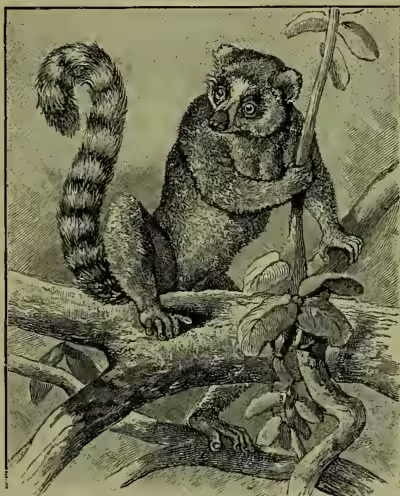
Lemur (Lat. lemur, 'a ghost'), a genus which has given its name to a large group of mammals, the lemurs. These animals appear to stand between the Insectivora and the monkeys. The hand with an opposable thumb is fashioned after that of the monkeys, but in most structural features they either show affinities to lower groups or are peculiar. The German name, 'Halb-Affen' ('Half-Apes'), as also the term 'Prosimii,' which has been applied to the group, indicates its position at the base of the Primates. The Lemurs are forest-dwellers, and mainly nocturnal in their habits. They can be for the most part readily tamed. One of the chief points of interest attaching to the group is its peculiar geographical distribution. By far the majority of the genera are confined to the island of Madagascar; a few forms are found in the Orient, and on the African continent. Their range from Malaya to Madagascar has been accounted for by the supposed former existence of a continent (for which the name 'Lemuria' was proposed by Mr Selater) connecting these now widely-separated regions. Undoubted remains of these animals have, however, been found in Europe and in America; this of course indicates their wider range in ancient times; the isolation of genera at the present day is therefore probably due to the disappearance of forms occupying the intermediate tracts of country, and no Lemuria is necessary. Besides Lemur, the genera Indris, Propithecus, Hapalemur, Sepilemur, Cheirogaleus, and the curious and aberrant Cheiromys (see AYE-AYE) are confined to Madagascar. The Angwangtilo (Arctocebus) and Perodicticus and Galago (q.v.) are African. The Tarsier and Nycticebus are found in Malaya, and the Loris in Ceylon. Some of the fossil forms show affinities with the Insectivora, others with the Ungulata.