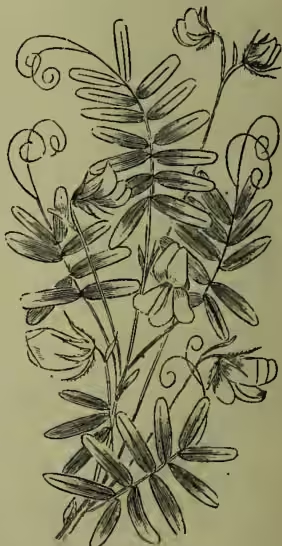
Lentil (Ervum lens), an annual plant belonging to the natural order Leguminosæ. It is a native of the countries bordering on the Mediterranean, and has been cultivated from the very earliest times. In Egypt and Syria it is still made into pottage, and another favourite mode of cooking it in those countries is by parching it in a frying-pan. The lentil is extensively cultivated in the warmer parts of Germany, France, and the south of Europe generally. It is also cultivated to some extent in Asia. The Hindus, in common with the Egyptians, regard it as the best food on which to undertake long journeys or laborious work. Flour of lentils is highly nutritious and contains, according to Playfair, more nitrogenous matter than any other edible leguminous plant. Einhoff found in 3840 parts of lentils 1260 parts starch and 1433 parts analogous to animal matter. The foods known as Revalenta arabica and Ervamenta arabica (words compounded of the botanical name of lentil) are simply specially prepared forms of the flour of lentils, in no way superior to the ordinary flour which can be purchased at greatly less prices. Mixed with peas in the making of pea-soup, lentils diminish the tendency to flatulence, and lentil soup is much esteemed by vegetarians and others in Britain. By Roman Catholics lentils are eaten during Lent, both in soups and in the form of haricot, as a substitute for flesh-food. The lentil is a weak, straggling plant, rarely exceeding 18 inches high, often much more dwarfed, having pinnate leaves terminating in tendrils. The flowers are white, lilac, or pale blue, small, and formed like those of a pea. There are three varieties of lentil recognised in the countries in which it is cultivated: the small brown, which is the lightest flavoured and the best esteemed for soups and haricots; the yellow variety, which is slightly larger; and the lentil of Provence, which has seeds as large as a small pea, but is better appreciated as fodder for cattle than for the grain as food for man. It has been frequently suggested that lentil might be grown as an agricultural crop in Britain, and its cultivation has been attempted, but without success, not so much from deficiency of warmth as from excess of atmospheric moisture. It is sown at the rate of about bushel per acre, and its cultivation and harvesting are similar to those of the Tare (q.v.), to which it is related. The produce in grain is fully a fourth less than that of the tare, and in respect of straw it does not yield a third of the weight of that crop. The grain, however, on the Continent sells at twice the price of peas.