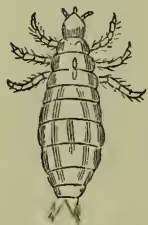
Lice (Pediculidæ), a family of small, wingless, parasitic insects, included beside bugs, aphides, Coccidæ, &c. in the order Hemiptera or Rhynchota. The body is flat, the legs are short and furnished with firmly-grasping claws, the mouth is suctorial, the eyes are simple. They live on or partly in the skin of vertebrates, usually mammals, and suck the blood of their hosts. The pear-shaped eggs or 'nits' are attached to hairs, feathers, and the like; the young have no metamorphosis, though they may moult as usual. Three species occur on man. The head-louse (Pediculus capitis) occurs on the scalp; the body-louse (P. vestimenti) lays its eggs in clothes, and is the P. tabescentium of the 'lousy disease' in regard to which many fabulous reports are on record. Both multiply rapidly and give great annoyance, usually preventable by cleanliness, and removable by various (e.g. white precipitate) ointments in the first case, by destroying the clothes in the second. The 'crab-louse' (Phthirus pubis or inguinalis) is fortunately rarer; it occurs on various parts of the body—pubic regions, axilla, eyebrows, &c. The true lice harboured by dogs, horses, cattle, swine, &c. are referred to the genus Hæmantopinus. The 'bird-lice' (Mallophaga) have mouths adapted for biting, and are not included in the above family or even order, being more nearly allied to the termites than to the bugs. A common and large genus infesting birds is Philopterus; species of Trichodectes occur on dogs and sheep.