Lichens, familiar plants which form encrusting growths on rocks and stones, on the stems and branches of trees, on walls and fences, and on the earth itself. They are common in every zone, and at all levels from the seashore to the mountain summit. Usually the first plants to settle on a bare, stony surface, they slowly hide the nakedness of the rock with their flat incrustations or shaggy tufts, generally gray or greenish, yellow or red in colour. Especially familiar are the yellow patches which beautify old walls, the hoary tufts which grace decaying trees, and the gray clumps which raise their cup-like fructifications on damp rocks. They are hardy, long-lived plants, able to survive prolonged desiccation.
In 1866 De Bary hinted that lichens were not single plants in a class by themselves, but that they were double plants, each made up of an intimate combination of an alga and a fungus.
Two years later Schwendener virtually established this so-called 'dual hypothesis.' 'As the result of my researches,' he says, 'all these growths (lichens) are not simple plants, not individuals in the ordinary sense of the word; they are rather colonies, consisting of hundreds and thousands of individuals, among which, however, one dominates, while the rest in perpetual captivity prepare the nutrients for themselves and their master. This master is a fungus, a parasite which is accustomed to live upon others' work; its slaves are green algae, which it has sought out, or indeed caught hold of and compelled into its service. It surrounds them, as a spider its prey, with a fibrous net of narrow meshes, which is gradually converted into an impenetrable covering; but, while the spider sucks its prey and leaves it dead, the fungus incites the algae found in its net to more rapid activity, indeed to more vigorous increase.' This view has been corroborated by many botanists, especially by Bornet, Treub, Rees, and Stahl, and is accepted by most, though it is only fair to say that it is still denied and resented by some distinguished lichenologists. The proof of the theory is two-fold: the two component sets of cells have been studied apart and referred to their position among Algae and Fungi; while, on the other hand, it is possible to manufacture lichens by bringing together the respective algae and fungi which in
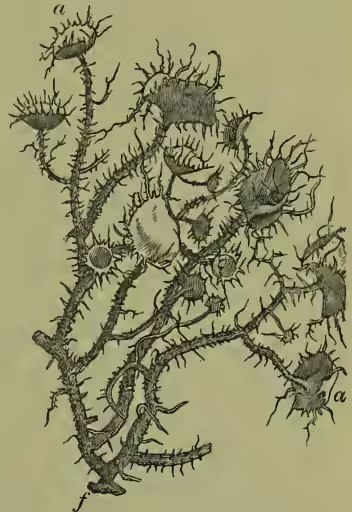
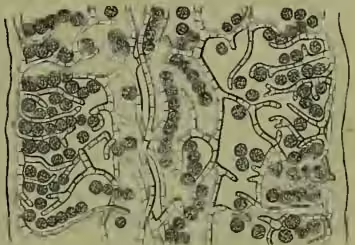
Fig. 2.—Section through Collema pulposum, magnified 350 diameters: The threads are the fungus; the round cells the algae. nature are wont to grow in partnership. For these reasons lichens are regarded not as single, but as double organisms—as an intimate union of algal and fungal cells, living in mutual helpfulness or symbiosis. Some at least of the algal cells can live apart, and some become associated with several fungi to form different lichens; but it must be clearly recognised that the customary combinations are of long standing, since the partner fungi do not and cannot live independently. As to the physiological conditions of the partnership, it is enough here to notice that root-like filaments from the fungal cells absorb water and salts from the rain and the substratum, and pass this inorganic material to the algae; that the latter, like all green plants, are able in sunlight to split up the carbonic acid absorbed from the air, and to build up organic compounds like starch; that these organic products pass by osmosis from the algal-cells to the fungus, while it is likely enough that the waste products of the fungus are in turn utilised by the algae. (It is, however, quite probable that the fungi of some lichens in favourable situations among decomposing vegetable matter absorb this in the usual fungal fashion.) To the curious complementary association of fungi and algae to form lichens, a parallel has been demonstrated by Geddes, Brandt, and others, in regard to Radiolarians and some other animals, with which 'yellow cells,' or 'symbiotic algae,' live in habitual partnership (see SYMBIOSIS). Lichens propagate by spores developed in various ways from the component fungus, but with these the partner algae must be speedily associated. In some cases, indeed, fungal-spores and algal-cells are liberated together. Another frequent mode of multiplication is by means of brood-buds, which consist of a few algal-cells plus a separated portion of the fungus.
Most of the lichen-forming fungi are Discomycetes or Pyrenomycetes; the associated algae are very varied—e.g. Palmellaceæ, Chroolepideæ, Nostocaceæ, Confervaceæ, &c. There are about 6000 species of lichens, for the classification of which reference must be made to the cited literature.
Lichens assist in weathering the surfaces of rocks, into the substance of which the fungi sometimes send numerous filaments, and they are thus the preparers of soil and the forerunners of higher vegetation. 'Iceland Moss' (Cetraria islandica) is used for food and medicine; 'Reindeer Moss' (Cladonia rangiferina) is the fodder of the reindeer, and is also utilised in Scandinavia for the manufacture of a sort of brandy; pigments known as Litmus, Orseille, &c. are procured from Roccella tinctoria and R. fuciformis, both marine.
See ALGÆ, FUNGI, SYMBIOSIS. See also De Bary, Comparative Morphology of Fungi, &c. (trans. 1887); A. W. Bennett and G. Murray, Handbook of Cryptogamic Botany (1889); Bornet, Recherches sur les Gonidies des Lichens (Ann. Sc. Nat. xvii. and xix. 1873-75); K. Goebel, Outlines of Classif. and Morph. (trans. 1887); Ch. Luerssen, Med. Pharm. Botanik (1878); Schwendener, Die Algentypen d. Flechtengonidien (1869); Sachs, Text-book of Botany (trans. 1882); Stahl, Beitr. z. Entwicklung d. Flechten (1877-78); W. A. Leighton, Lichen-flora of Great Britain and Ireland (3d ed. 1884). For the works of Johow, Rees, Treub, Tulasne, and for the systematic works on lichenology, see references in the above. For a protest against the 'dual hypothesis,' see M. C. Cooke, British Fresh-water Algae (Inter. Sc. Series, 1890).