Life-saving Apparatus. Life-buoys and life-belts and other life-saving appliances are inventions for the preservation of life in cases of shipwreck. In the mercantile marine and passenger ships there are now life-belts for every man and to spare. Buoys are carried on the bridge and at the stern of most ships in the mercantile marine. The danger to ships' ordinary lifeboats is that, from being so long out of the water, unless attended to they get so dry that when floated they fill. Although against regulations, these boats have been known to be filled with cargo. Sometimes the handiest life-buoy is an empty water-cask, well bunged up, and with ropes around it to hold on by. There are various kinds of buoyant pillows, life-jackets of india-rubber cloth, and mattresses. The cork-mattress of Admiral Sir A. P. Ryder can float three men in an upright position.
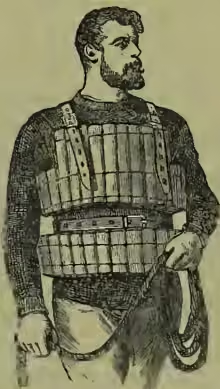
The life-belt of the Royal National Lifeboat Institution, designed by Admiral Ward in 1854, is made of cork covered with canvas, and is both strong and buoyant. It has four separate compartments, so that if one should be punctured and burst the belt's buoyant power is not entirely destroyed. It is represented in the fig. Each lifeboatman's life-belt must have sufficient extra buoyancy to support a man heavily clothed, with his head and shoulders above the water, and to enable him to support another person besides himself. It must be flexible in order to fit tightly into the shape of the wearer. There is a division between the upper and lower parts so that it can be securely fastened round the waist, and not impede breathing or the muscular action of the chest or arms.
The Merchant Shipping Life-saving Appliances Act, 1888, stipulates that the owner and master of every British ship must see that it is provided with such boats, life-jackets, and other appliances for saving life at sea as are best adapted for securing the safety of the crew and passengers. The penalty to the owner if in fault in proceeding on a voyage without the necessary life-saving appliances, or if these have been lost or destroyed, is £100; to the master £50, if in fault. The rules which came into force on 1st November 1890 were drawn up by a committee appointed by the President of the Board of Trade, and may be made, rescinded, and varied by the Board. The rules under this act give the number of boats for steamships carrying emigrants, the boats under davits being sufficient to accommodate all persons on board. If the boats under davits do not furnish sufficient accommodation, then additional wood, metal, collapsible, or other boats of approved description, or approved life-rafts shall be carried. Ships of this class must also carry not less than one approved life-buoy for every boat placed under davits, and life-belts sufficient for each person on board ship.
The same regulation as to boats and life-belts and buoys applies to sailing-ships, to steamships carrying passengers between places in the United Kingdom and ports in Europe between the Elbe and Brest, except that a deficiency of boats or life-rafts may be made up by an equivalent number of approved buoyant deck-seats or deck-fittings. Not fewer than six approved life-buoys must also be carried, and life-belts sufficient for every one on board. The same applies to other steamships carrying passengers within certain specified limits of the home trade: there are also rules for steamers going short excursions, and for those plying on rivers and lakes. The boats must be of lifeboat construction, with approved appliances for lowering them. A life-raft must for every person carried have 3 cubic feet of strong and serviceable enclosed air-tight compartments. Approved buoyant apparatus shall be deemed sufficient for a number of persons to be ascertained by dividing the number of pounds of iron which it is capable of supporting by thirty-two. An approved life-belt shall mean a belt which does not require to be inflated before use, and which is capable of floating in the water for twenty-four hours with 15 lb. of iron suspended from it. An approved life-buoy shall be built of solid cork, and fitted with life-lines and loops, and capable of floating in the water for at least twenty-four hours with 32 lb. of iron suspended from it. All life-belts and life-buoys must be so placed on board ship as to be readily accessible to passengers.
Mortars and Rockets.—When a lifeboat is not at hand, or a raging sea and shoal coast render its use impracticable, a distressed ship may often receive help from shore by means of the mortar or rocket-apparatus. Captain Manby in 1807 invented his life-mortar, to discharge a shot with curved barbs that would lay hold of the rigging or bulwarks of the ship; the rocket-apparatus is based upon this. Sergeant Bell of the Royal Artillery had previously (1791) devised a method of firing a shot and line from a distressed ship. Colonel Boxer, Tregrouse, Dennett, Carte, and others made variations and improvements in line-throwing apparatus. (The Lyle gun, the invention of Captain D. A. Lyle, United States army, weighs only 185 lb., has a much longer range than the epouvette mortar, and combines the other advantages of great strength and simplicity, requiring only the insertion of a cartridge with a line attached to the shot.) The usual method of procedure is to fire a rocket over the wreck; by the light line attached the wrecked crew haul out the whip or double or endless line rove through a tail-block. A thicker rope is pulled over to the ship by means of the line, and a hawser by means of the rope, on which articles can be slung and drawn to and fro. The life-buoy being run out along the rope, the crew can be saved one by one; or, by the life-raft, introduced in America about 1848, seven or eight can be drawn ashore at a time. The Life-rocket Department is under the Board of Trade. There were 292 rocket-stations in Great Britain in 1889, 7 cliff-ladder stations, and 4 heaving-line and life-buoy stations; and 226 lives were saved by means of the rocket-apparatus in 1888–89. In 1881 657 lives were saved. The coasts of the United Kingdom are classified into coastguard divisions or wreck-registrars' districts, and the coastguard-inspector has control over all the rockets, mortars, buoys, belts, and lines kept at the various seaside stations in his district. At each station is kept a cart, expressly made to contain all the requisites for the rocket-apparatus, ready packed. The Board of Trade now gives a sum of money for every life saved, besides medals for special acts of bravery.