Lifeboat, a boat adapted to live in a stormy sea with a view to the saving of life from shipwreck. Its qualities must be buoyancy, to avoid foundering when a sea is shipped; strength, to escape destruction from the violence of waves, from a rocky beach, or from a collision with the wreck; great lateral stability, or resistance to upsetting; speed against a heavy sea; facility for launching and taking the shore; immediate self-discharge of any water breaking into her; the important advantage of self-righting if upset; and stowage room for a large number of passengers. Although Henry Greathead (1757-1816), a boat-builder at South Shields, has very generally been credited with designing and building the first lifeboat about the year 1789, yet it is certain that Lionel Lukin, a coach-builder in Long Acre, who was not a resident at a seaport but a native of an inland town, Dunmow, in Essex, designed and fitted a boat which he called an 'unimmergible' boat, for saving life in cases of shipwreck, some four or five years before Greathead brought forward his plan for a lifeboat. Lukin took out a patent for his boat in November 1785, and a Bamberough coble which he fitted up was reported to have saved several lives in the course of the first year of its use. Nothing effectual, however, was done for the shipwrecked mariner until the year 1789, when a terrible wreck took place at the mouth of the Tyne, all hands being lost at a short distance from the shore, in the presence of thousands of spectators who were powerless to render any assistance. As the result of the strong feelings which this disaster aroused, a committee was formed at South Shields, and premiums offered for the best model of a lifeboat. From the plans sent in two were selected, one by William Wouldhave, a painter, and the other by Henry Greathead; the latter eventually received the premium, and Greathead, being a boat-builder, was employed to construct a boat on his own plan with some of Wouldhave's ideas introduced. This boat was 30 feet long by 10 feet wide, and rowed ten oars double banked; it was of the form of a steamer's paddle-box boat, with stem and stern alike, and had a curved keel, which was entirely Greathead's invention. It had, however, no means of freeing itself of water or of self-righting in the event of being upset. Lifeboats on this plan were promptly placed on different parts of the coast, and were the means of saving altogether some hundreds of lives, and even now a few boats of this type are to be found on the north-east coast.
In the year 1823 Sir William Hillary published a powerful appeal to the nation on the subject of the great loss of life from shipwrecks on our coast, and in the following year he induced Thomas Wilson, M.P. for the city of London, to take steps to convene a meeting at the London Tavern, which resulted in the establishment of the Royal National Institution for the Preservation of Life from Shipwreck (now known as the Royal National Lifeboat Institution), under the patronage of George IV. and other members of the royal family, the two archbishops, the principal bishops, and many noblemen and gentlemen. For many years the society did good work on the coast in providing and maintaining lifeboats, and rewarding their crews, &c., but after a time its work languished. In December 1849, however, another deplorable accident took place at the mouth of the Tyne, when the South Shields lifeboat, on the Greathead plan, which went out, manned by twenty-four pilots, to the assistance of a shipwrecked crew, was upset, and drifted ashore bottom up, no less than twenty of her brave crew being drowned under the boat. This lamentable disaster once again called public attention to the lifeboat work, and in 1850 Admiral the Duke of Northumberland offered the sum of a hundred guineas for the best model of a lifeboat. In response 280 models and plans were sent in, a selection of which was afterwards shown in the Great Exhibition of 1851. James Beeching of Great Yarmouth proved to be the successful candidate for the offered premium, and he constructed a twelve-oared boat on his plan; it was 36 feet long, and was the first self-righting lifeboat ever constructed. Others followed; but, this type of boat not proving altogether satisfactory, the Lifeboat Committee requested one of their number, James Peake, Assistant-master Shipwright in keel, B, represents the ballast, composed of iron. The festooned lines are the life-lines outside the boat, for men to catch hold of when overboard.
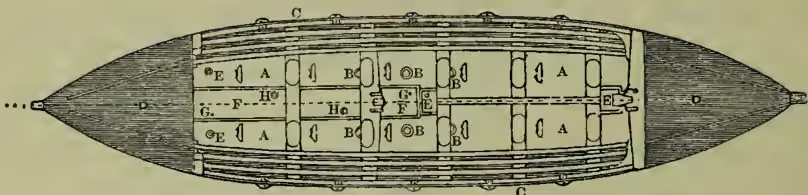
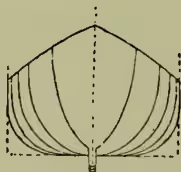
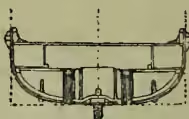
In fig. 2 the unshaded space, A, represents the uncovered part of the deck; B, the relieving-tubes; C, the side air-cases above the deck; D, the end air-cases; E, the ventilating scuttles; F, the water-ballast tanks; G, the plugs; and H, the pumps of the ballast tanks. Fig. 3 represents the body plan or cross-sections at various distances from stem to stern. Fig. 4 gives the midship section.
The lifeboat transporting-carriage is a very important auxiliary to the boat. Nearly every lifeboat, except a few of the larger size, is provided with a carriage, on which she is kept in the boat-house ready for immediate transportation to the most favourable position for launching to a wreck. A lifeboat is thus made available for a greater extent of coast than she otherwise would be; and even when launched from abreast of the boat-house she can generally be much quicker conveyed to the water's edge than without a carriage. In addition to this ordinary use, a carriage is of immense service in launching a boat from a beach; indeed, to such an extent is this the case that a boat can be readily launched from a carriage in a high surf, when without one it would often be very difficult to do so. The carriage consists of a fore and main body. The latter is formed of a keelway, and of bilge-ways attached to it, and resting on the main axle, the boat's weight being entirely on the rollers of the keelway. Its leading characteristics are that while for launching it forms an inclined plane, down which the boat can be launched off the rear end with considerable impetus; it can also be used for replacing the boat, the incline plane being reversed by removing the fore-carriage. A very full equipment of stores is
Woolwich Dockyard, to embody as many as possible of the good qualities of the best plans into a new design. This was accordingly done, and such a lifeboat was built in Woolwich Dockyard, at the expense of the government. Many modifications and alterations were afterwards made in the boat, and this design of lifeboat has been greatly improved of late years by the officers of the Royal National Lifeboat Institution, so that the self-righting lifeboat can truly be designated an omnium gatherum, and cannot be looked upon as any one man's design or invention.
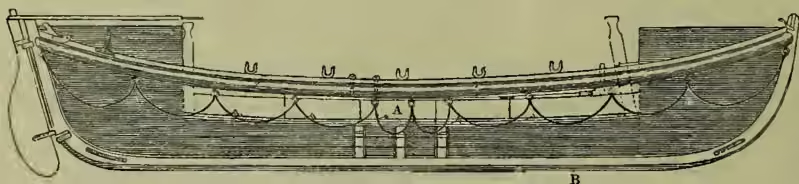
The following drawings show the general outline and principal fittings of a 34 feet by 7½ feet self-righting boat. Fig. 1 gives the profile or broadside view, the shaded part showing that devoted to the air-cases, which give extra buoyancy. The letter A shows the deck, and the unshaded parts the relieving-tubes, by which any water that breaks on board escapes. The shaded part of the supplied to the lifeboats of the Institution, such as cork life-belts, anchors and cables, grappnels and lines, life-buoys, lanterns, rockets, and many other articles, together with portable or launching skids.
The boats of the National Lifeboat Institution, and all belonging to them, are kept in roomy and substantial boat-houses, under lock and key, in charge of paid coxswains, under the general superintendence of local honorary committees of residents in the several localities. Each boat has its appointed coxswain at a salary of £8, and an assistant at £2 a year, with further allowances under special circumstances. The crew consists, in addition, of a bowman, and as many boatmen as the boat pulls oars. The members of the volunteer crews are registered, and, wherever practicable, at least double the number of men required are entered on the register. Such men are mostly resident boatmen, fishermen, or coastguardmen. On every occasion of going afloat to save life the coxswain and each of the crew receive alike from the funds of the Institution (whether successful or not) 10s. if by day, and £1 if by night; and usually 4s. each for every time of going afloat for exercise. A reward of 7s. is given to the man who first brings intelligence of a wreck at such a distance along the coast as not to be in sight of the coastguard station or other lookout. A flag hoisted by day, and the firing of a carronade (or other alarm signal) by night, are the well-known signals for calling the crew together. On boarding wrecks, the preservation of life is the sole consideration. Should any goods or merchandise be brought into the lifeboat, contrary to the coxswain's remonstrance, he is authorised to throw them overboard.
The average cost of a lifeboat station is £1050, and is made up as follows: Lifeboat and her equipment, £700; boat-house, £350. The average annual expense of maintaining a lifeboat station is £70. The Royal National Lifeboat Institution in 1890 had 297 lifeboats under its management on various parts of the coasts of the United Kingdom. They were instrumental during 1889 in saving 420 lives from different wrecks, besides preserving a vast amount of property, and assisting to save or absolutely saving 17 vessels from partial or total destruction. Besides the launches resulting in the saving of life or property, the lifeboats went out 141 times in response to signals of distress or what were supposed to be such, only to find either that the vessels were out of danger or that incorrect signals had been made. During the year the Institution also granted rewards for the saving of 207 lives by means of shore-boats, fishing-boats, or by other means, so that the committee bestowed rewards, in the year 1889, for the saving of 627 lives, making a grand total of 34,670 lives, for the saving of which the society has granted rewards since its establishment in 1824. Every effort is made by the committee to place and maintain the lifeboat service in the highest state of efficiency, but this cannot possibly be done without a very large annual outlay. In 1890 the Institution produced the latest novelty in shipbuilding in the shape of a steam lifeboat, which was named the 'Duke of Northumberland,' and stationed at Harwich for trial. The Institution had for several years been earnestly endeavouring, by the offer of gold and silver medals and in other ways, to find a means of propelling lifeboats mechanically. A steel steam lifeboat of 1890 was propelled by a turbine wheel. To the end of 1896 the total number of lives saved was 40,544; in 1896 alone, 461 lives and 20 vessels. The expenditure for the year was £75,417.
Lifeboat societies have been successfully organised on the principles of the Royal National Lifeboat Institution in France, Germany, Spain, Russia, Austria, Italy, Turkey, Holland, and Denmark. In the United States the life-saving service is a government organisation, under the Treasury Department at Washington, and extends to both the sea and lake coasts. There are three classes of stations: (1) complete life-saving stations, with resident crews; (2) lifeboat stations, with a resident keeper only and volunteer crews; and (3) provisioned houses of refuge, in charge of a keeper, for the desolate eastern coast of Florida. At many of the stations the English lifeboat is used, but its weight and draught are too great for use along the flat Atlantic sand-beaches, and there it has been superseded by the light American surf-boat of cedar, fitted with air-cases at the ends and cork-fenders. The first lifeboat station was built at Cohasset, Massachusetts, in 1807; the first stations erected by the government were eight, placed on the New Jersey coast, between Sandy Hook and Little Egg Harbor, in 1848. The whole coast is now divided into 12 districts, and the splendid conception of a girdle of stations round all the sea and lake shores promises to be fulfilled. On the Atlantic coast they are placed 5 miles apart, on an average, and a system of patrol is carefully maintained. The cost of a fully equipped station is about 6000, and of a house of refuge about half that amount. The keepers receive 700 a year, the crew each $50 a month.