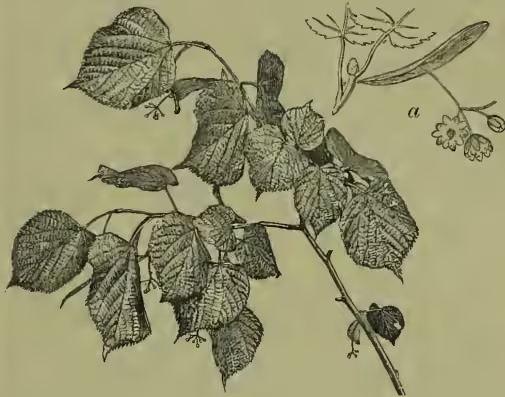
a, a flower.
Lime, or LINDEN (Tilia), a genus of trees of the natural order Tiliaceæ, natives of Europe, the north of Asia, and North America. The species are very similar; graceful umbrageous trees, with deciduous, heart-shaped, serrated leaves, and cymes or panicles of rather small yellowish-green flowers; each cyme or panicle accompanied with a large, oblong, yellowish membranous bractea, with netted veins, the lower part of which adheres to the flower-stalk. The wood is light and soft, but tough, durable, and particularly suitable for carved work. It is much used by turners, and for making pill-boxes. The charcoal made of it is often used for tooth-powder. It is regarded by the makers of gunpowder as being superior to every other for their purpose; it is used also for medicinal purposes and for crayons. The use of the fibrous inner bark for making ropes, mats, and other plaited work is noticed in the article BAST. It is also used as a healing application to wounds and sores, being very mucilaginous, and abounding in a bland sap. The leaves are in some countries used as food for cattle, but cows fed on them produce bad butter. The flowers have an agreeable odour, and abound in honey, much sought after by bees. The celebrated Kovno Honey, much valued for medicinal use and for making liqueurs, is the produce of great lime forests near Kovno, in Lithuania. The infusion and distilled water of the dried flowers are gently sudorific and antispasmodic. The former is in France a popular remedy for catarrhs. The seeds abound in a fixed sweet oil. The European Lime, or Linden (T. europaea), often attains a large size, particularly in rich alluvial soils. Some botanists distinguish a small-leaved kind (T. parvifolia or microphylla) and a large-leaved (T. grandifolia) as different species; others regard them as mere varieties. The Hooded or Capuchin Lime is an interesting monstrous variety. The lime-tree is often planted for shade in towns; and the principal street of Berlin is called Unter den Linden, from the rows of lime-trees which line it. The lime is a very doubtful native of Britain, although indigenous on the Continent from Scandinavia to the Mediterranean. In Britain the lime-tree is generally propagated by layers. The American Lime (T. americana, or T. glabra), commonly called Basswood in America, has larger leaves than the European species. It abounds on the shores of Lakes Erie and Ontario. Other species take its place in more western and more southern regions.