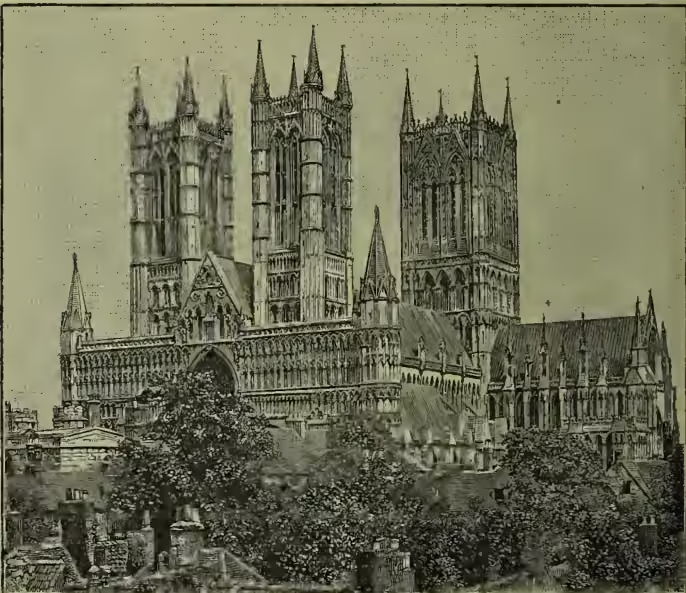
Lincoln, a city of England, the capital of Lincolnshire, and a parliamentary, county, and municipal borough, is situated on the Witham, 42 miles S. of Hull, 33 NE. of Nottingham, and 130 N. by W. of London. Built on the slope of a hill, which rises 210 feet above the river, and is crowned by the cathedral, the city is imposing in effect, and can be seen from afar in the flat fen-country. It is very ancient, is irregularly laid out, and contains many interesting specimens of early architecture—notably the castle, commenced in 1086 by William I.; the Newport Gate, or Roman arch, on the north side of the city; the Exchequer and Stonebow gateways, the latter supporting a guildhall of medieval architecture; the Jew's House (Norman), associated with the legend of Hugh of Lincoln (q.v.); St Mary's Guild (Norman); and the middle grammar-school (to which additions have recently been made), founded in 1567 in the Grey Friars. But the chief glory of Lincoln is its cathedral, admittedly one of the finest in England. Erected between 1075 and 1501, it measures 524 feet by 82 (or 250 across the transepts), and in style is mainly Early English. Its matchless central tower (1235-1311, and 265 feet high) was previous to 1547 surmounted by a spire, as till 1808 were the two western towers (completed 1450). Other noticeable features are the west front (partly Norman), with its three doorways (1123); the Galilee or south porch (circa 1240); the Decorated choir (1254), with its rich sculpturing; the decagonal chapter-house (restored since 1888); Norman font (1075-93); and Great Tom of Lincoln (see article BELL), hung in the central tower, which also contains a mellow-chiming clock (1880). Besides the cathedral, there are fourteen churches of various dates, a county hall (1823-26), theological college, school of science, and bishop's palace (1886-87) embodied with a former palace of 1149. Several iron-foundries and important manufactories of agricultural machinery are in operation here, and an active trade is done in flour. The horse-fair, held annually in the spring, is one of the largest in the world, and the race-meetings, which take place on the Carholme, date back to at least the reign of James I. One member is returned to parliament for the city, which, moreover, is the depot of the Lincolnshire regiment, and gives the inferior title of earl to the Duke of Newcastle. In the history of Lincoln the most noteworthy incidents have been frequent invasions by the Danes (786-875); great fires (1110 and 1124); a battle (1141) between the adherents of Stephen and the Empress Matilda during their struggle for the English crown; the second coronation of Henry II. (1155-58); an earthquake (1185), which did much damage, especially to the cathedral; the battle of Lincoln, or Lewis Fair, fought 4th June 1218; five parliaments held here between 1301 and 1386; six royal visits; and lastly, the siege of the town, and desecration of the cathedral, by the parliamentarians under the Earl of Manchester (1644). Among the sixty-four bishops of Lincoln were Remigius, who in 1073 transferred the see hither from Dorchester in Oxfordshire; St Hugh of Avalon; Robert Grosseteste; Cardinal Beaufort; Fleming and Smith, the respective founders of Lincoln and Brasenose colleges at Oxford; Cardinal Wolsey; Tenison and Wake, afterwards archbishops of Canterbury; Thurlow, a brother of the Lord Chancellor; and Christopher Wordsworth, the founder of the theological college. Pop. (1801) 7398; (1831) 11,873; (1881) 37,313; (1891) 43,983. See the works cited at the article LINCOLNSHIRE.