Lion (Felis leo), the largest and most majestic of the Felidæ. It is, when mature, of a nearly uniform tawny or yellowish colour, paler on the under-parts; the young alone exhibiting spots like those common in the Felidæ. The male has usually a great shaggy and flowing mane; and the tail, which is pretty long, terminates in a tuft of hair. The whole frame is extremely muscular, giving, with the large head, bright-flashing eye, and copious mane, a noble appearance to the animal, which, with its strength, has led to its being called the 'king of beasts,' and given rise to fancies of its noble and generous disposition, having no foundation in reality. A lion of the largest size measures about 8 feet from the nose to the tail, and the tail about 4 feet. The lioness is smaller, has no mane, and is of a lighter colour on the under-parts. The strength of the lion is such that he can carry off a heifer as a cat carries a rat.
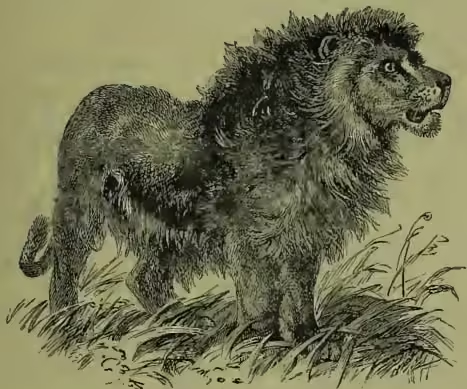
The lion is an inhabitant of the tropical and subtropical regions of Africa and Asia. It was anciently much more common in Asia, and was found in some parts of Europe, particularly in Macedonia and Thrace, according to Herodotus and other authors. The Cave Lion (Felis spelæa), whose bones are met with in cave-deposits of England and the Continent, hardly differs from Felis leo. The lion is not in general an inhabitant of deep forests, but rather of open plains, in which the shelter of occasional bushes or thickets may be found. The breeding-place is always in some much secluded retreat, in which the young—two, three, or four in a litter—are watched over with great assiduity by both parents, and, if necessary, are defended with great courage—although, in other circumstances, the lion is more disposed to retire from man than to assail him or contend with him. When met in an open country the lion retires at first slowly, as if ready for battle, but not desirous of it; then more swiftly; and finally by rapid bounds. If compelled to defend himself he manifests great courage. The lion often springs upon his prey by a sudden bound, accompanied with a roar; and it is said that if he fails in seizing it he does not usually pursue, but retires as if ashamed; it is certain, however, that the lion also often takes his prey by pursuing it, and with great perseverance. The animal singled out for pursuit, as a zebra, may be swifter of foot than the lion, but greater power of endurance enables him to make it his victim. Deer and antelopes are perhaps the most common food of lions. The lion, like the rest of the Felide, is pretty much a nocturnal animal; its eyes are adapted for the night or twilight rather than for the day. It has a horror of fires and torch-lights; of which travellers in Africa avail themselves, when surrounded by prowling lions in the wilderness by night, and sleep in safety. Lions rapidly disappear before the advance of civilisation. In India they are now confined to a few wild districts; and in South Africa their nearest haunts are far from Capetown and from all the long and fully settled regions.
The mane of the lion, and the tuft at the end of the tail, are not fully developed till he is six or seven years old. The tail terminates in a small prickle, the existence of which was known to the ancients, having been discovered by Didymus Alexandrinus, one of the earliest commentators on the Iliad; it was supposed by them to be a kind of goad to the animal when lashing himself with his tail in rage. The prickle has no connection with the caudal vertebrae, but is merely a little nail or horny cone, about two lines in length, adhering to the skin at the tip of the tail. It has been stated to occur also in the leopard.
There are several varieties of the lion, slightly differing from each other in form and colour, but particularly in the development of the mane. The largest lions of the south of Africa are remarkable for the large size of the head and the great and black mane. The Persian and other Asiatic lions are generally of a lighter colour, and inferior in size, strength, and ferocity to the African lion. Guzerat and the south of Persia produce a some- what smaller variety, remarkable as being almost destitute of mane.
The lion is easily tamed, at least when taken young, and when abundantly supplied with food is very docile, learning to perform feats which excite the admiration of the crowds that visit menageries. The greatest of lion-tamers, Van Amburgh, died in his bed at Philadelphia, 29th November 1865; still, exhibitions of this kind are not unattended with danger, as too many instances have proved. Lions were made to contribute to the barbarous sports of the ancient Romans; a combat of lions was an attractive spectacle, and vast numbers were imported into Rome, chiefly from Africa, for the supply of the amphitheatre. Pompey exhibited 600 at once.—Lions were kept in the Tower of London from the 13th century till 1834; and one died here in 1770 after seventy years' confinement. They have not unfrequently bred in the menageries of Europe (with particularly good results in the Dublin Zoological Gardens), and a hybrid between the lion and the tiger has occasionally been produced. For the lion in heraldry, see HERALDRY.