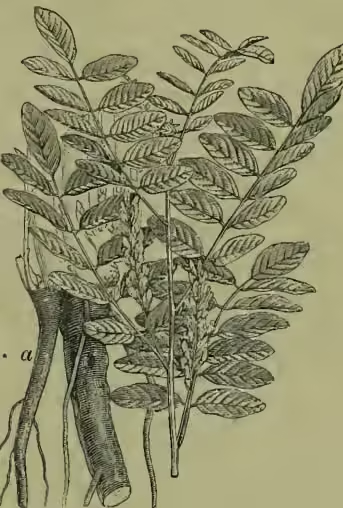
a, root.
Liquor Laws. Restrictive legislation with regard to the sale of intoxicating drink is almost confined to the English-speaking peoples, and has been carried further in some of the British colonies and in portions of the United States than it has gone as yet in the United Kingdom. Sunday closing, for example, which is partial in the mother-country, is very general in the daughter-lands, and the principle of local option with regard to liquor licensing is widely spread in the colonies, while total prohibition exists in the state of Kansas and in some other American communities.
In those of the United States in which there is not a local majority in favour of prohibitive legislation, the High License system is being gradually adopted, with the effect of destroying disreputable saloons.
The Dominion of Canada has a local option law, under which the localities have power by a bare majority of votes to close without compensation all places for the sale of drink. The act provides for a reversal of the operation upon a change of local opinion, and while the act has been largely put in force it has been subsequently suspended in many districts. In addition to this law, which is known as the Scott Act (1878), and applies to the whole Dominion, there are restrictive laws in several of the provinces. In some, as in Ontario, the maximum number of licenses that can be granted is regulated according to population, and sale of drink is forbidden on Saturday evenings as well as on Sundays. Generally speaking, it may be said that in all the provinces of the Dominion, except Quebec and British Columbia, there is a good deal of restriction, and in the North-west Territories there is total prohibition of the sale of alcoholic drink—a prohibition which, however, was originally imposed by the Dominion government for the purpose of preventing sale of drink to Indians, but which has been continued in spite of the present existence of a very large white majority. Throughout the greater part of Canada two provisions prevail, which exist also in many states of the American Union and in some of the Australasian colonies. The one is that known as the Civil Damages clause, which provides that wherever any person comes to his death by suicide or otherwise during intoxication the seller of the liquor that caused the intoxication is liable to an action for damages. The other is a provision that the relatives of intemperate persons may notify sellers of drink not to sell it to such persons, and that magistrates may put such persons under notice as habitual drunkards, to whom also drink cannot be sold. This last law, with regard to putting persons under special prohibition, is being gradually adopted in all new liquor acts passed by British colonies and by American states, but there are considerable variations in the mode of application. In some cases the law is so severe that both the publican and the habitual drunkard are subject to punishment if the drunkard is found in the neighbourhood of the licensed house. In certain colonies and provinces, in addition to relatives and magistrates, ministers of religion may put the law in force; and there is a general tendency to strengthen clauses sharply restricting the liberty allowed in the United Kingdom for the consumption of drink by persons who are given to the immoderate use of liquor, and who, owing to such use, waste their property, endanger their health, and diminish the comfort of those about them.
Turning to the Australasian colonies, Victoria possesses, alone among English-speaking countries, the principle of local option accompanied by compensation. New Zealand and Queensland possessed in 1890, when South Australia and Tasmania were entering upon legislation more similar to that of Canada. The New Zealand act creates elective licensing committees, but no new licenses can be granted until the ratepayers have determined on a poll, by a bare majority, that the number of licenses may be increased. In Queensland two-thirds of the ratepayers in any locality have power to close all houses, and a bare majority power to reduce the number of licenses or to put a stop to the issue of fresh licenses. In New South Wales there exists a mild form of local option as to new licenses or the increase of licenses, which, however, can scarcely be said to exceed an expression of local opinion for consideration by the licensing magistrates.
The South African colonies have stringent legislation, not very well enforced in practice, against the sale of drink to the aborigines, but interfere less than does the Dominion of Canada or than do the Australasian colonies with the drinking habits of the white population.
In the crown colonies there is an extraordinary variety of legislation upon the licensing of houses for the sale of intoxicating liquors. In many there is Sunday closing, some imitate the self-governing colonies in forbidding the sale of drink to minors, but few of them possess any form of local option, although that system exists in some, as, for example, the Bahamas.
Throughout Canada and Australia, as in the United States, there is a large party in favour of total prohibition; and the example of the state of Kansas is pointed to as showing the advantages of the system. On the other hand, in Canada, Australia, and some of the United States there is much evasion of the present laws; and this evasion has been in the Dominion one of the chief causes which have led to the abandonment of the prohibitive provisions of the Scott Act in districts where it had previously been put in force. Generally speaking, however, it must be noted that the tendency of legislation and of opinion in the English-speaking countries is towards an extension of the principles either of local option or of prohibition.
Much attention has been called in parliament to the liquor question in India and Ceylon, and it has been asserted (and the House of Commons, to judge by a vote in which the government was defeated in 1889, seems to have credited the assertion) that the Indian government has tried to stimulate the sale of drink among natives with a view to the improvement of the revenue; while a similar attack has been made upon the colonial government of Ceylon. The Indian government stoutly denies the charge, and maintains not only that it has had no such intention, but that the measures which have been taken of recent years are rather calculated to decrease than to stimulate the sale of drink. On the other hand, there can be little doubt that the sale of drink in India has increased, the government maintaining, however, that this has been only a consequence of a change in the habits of the people and of the increase in the rate of wages. All organs of native opinion appear, nevertheless, to support the view taken by the majority of the House of Commons. Some official writers, and others friendly to the government of India, have argued that there has in fact been no increase in the consumption in India of intoxicating liquors, and that the increase shown by statistics is only the result of the suppression of illicit distillation. It is, however, obvious that, in face of the strong opinion which exists upon the subject in India and in the House of Commons, government will have to take steps to check that consumption of strong drink which is obnoxious to the religious views of most of the Indian people. See LICENSING LAWS, GOTHENBURG, TEMPERANCE.