Liver. The liver is the largest gland in the body. It weighs from 3 to 4 lb., and measures about 12 inches from side to side, and 6 or 7 inches from its anterior to its posterior border. It is situated in the right hypochondriac region, and reaches over to the left; being thick behind, convex on its upper surface, where it lies in the concavity of the diaphragm, and concave below, where it rests against the stomach, colon, and right kidney. This lower surface presents a fissure dividing the organ into a right and a left lobe. The liver is retained in its position by five ligaments. Besides the right and left lobes, there are three smaller lobes. The great bulk of the organ is, however, made up of the right lobe, which is six times as large as the left. The vessels of the liver are the hepatic artery, which comes off from the cœliac axis, and supplies the organ with nutrient blood; the portal vein, which conveys to the liver the venous blood of the intestines, spleen, and stomach, and from which (after the vessel has ramified like an artery) the hepatic veins arise and convey the blood from the liver into the inferior vena cava.
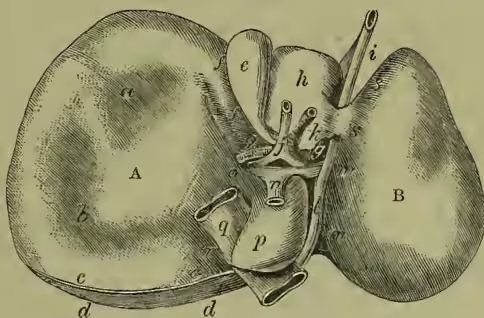
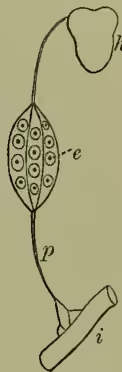
In fact, the liver is a great glandular mass placed in the path of the veins passing from the stomach and intestines towards the heart. The blood, laden with nutritious matter, has to pass through the liver before it can get into the general circulation; in its passage it comes into intimate relationship with the minute hepatic cells, which alter its constitution, abstracting or adding various constituents. The bile is one of the products of the liver cells, which, obtaining their raw material from the blood, secrete this fluid into tiny ducts (drains). These join with other vessels to form larger and larger ducts (just as veins join with other veins to form larger vessels), which finally leave the liver and pass towards the gall-bladder. Here the Bile (q.v.), which is constantly secreted, is stored up ready to be discharged into the intestine during digestion. The bile, which is of a brown, or in some animals, of a green colour, is coloured by pigments (bilirubin, biliverdin), which are undoubtedly decomposition products of hæmoglobin, the colouring matter of the blood. It appears, therefore, that the red corpuscles of the blood which contain this pigment are continually suffering dissolution, probably the old and useless cells being destroyed within the body by the agency of other cells. Whether their destruction actually takes place within the liver is not yet absolutely certain, but it is certain that the liver removes their colouring matter from the system. Occasionally it happens that the liver may have a heavier task thrown upon it than it can undertake. Thus, a rapid dissolution of corpuscles may take place from various conditions; for instance, there may be an excess of blood after a bloodless amputation, where the blood of a limb before the operation has been driven into the rest of the body; or, again, when the blood from the after-birth has been allowed to flow into the body of a baby. In these cases the liver may be unable to excrete all the pigment and jaundice will arise. A similar condition will follow any obstruction to the outflow of bile from the liver (gall-stone, inflammation of ducts, &c.). The already secreted bile will in that case pass back into the system through the absorbent lymphatics. In the bile are certain organic salts, taurocholate and glycocholate of sodium. It is probable that these result from the destruction of albumen, perhaps that of the red blood-corpuscles. Of these salts and their rôle in the economy there is much to be learned; they are probably in part reabsorbed from the intestine into the blood.
These functions of the liver commence at an early period of intra-uterine life, the excreted bile accumulating in the intestine, and forming the greenish substance, meconium. After birth the bile may be looked upon not only as an excretion from the body, but as performing in its outward passage through the intestine the part of an aid to digestion and absorption (see BILE, DIGESTION).
But the liver has other and perhaps equally important functions to perform. It is a great storehouse of food material. When the body is well nourished the liver cells store a certain quantity of fat, which they can part with during starvation. In stall-fed animals, beer-drinkers, &c. the liver is loaded with fat, while the liver (paté de foie gras) of the Strasburg goose is a mass of fat, with hardly any vestige of the original tissue left.
Claude Bernard was the discoverer of one of the greatest functions of the liver. It appears that carbohydrates and proteids absorbed in a soluble form into the blood are, for the most part, seized by the liver and prevented from entering the general circulation. The liver retains them chiefly in the form of glycogen or animal starch, ; and after a good meal as much as 5 per cent. of the organ may consist of it alone. This glycogen is then discharged from the liver, probably in the form of a soluble sugar, as the economy is in need of it. We have here a wonderful provision for regulating the food-supply to the tissues, for it would be of obvious disadvantage to them were they inundated with pubulum directly after each meal, and then left without any at all. Many parts of the body, the muscles for instance, are capable of storing glycogen on their own account; but this power is limited, and the great glycogen storehouse is the liver.
We have already seen that there is evidence that proteid substances are broken down in the liver. The greater part of the nitrogen of the proteid is excreted by the kidneys in the form of urea, which substance, as has experimentally been shown, has its primary origin in the liver itself. If carbonate of ammonia be injected through the organ it is converted into urea, which appears in increased quantity in the blood, and is excreted by the kidneys. After a highly nitrogenous diet urea in like manner appears in the blood, the nitrogen having separated from the proteid molecule. In birds and reptiles, where the nitrogen waste of the body is uric acid, not urea, the former substance is also formed by the liver, extirpation of the organ causing a marked diminution in the uric acid formation.
DISEASES OF THE LIVER.—The liver, like other organs of the body, is subject to disorder and disease. It is subject to congestion from exposure to cold, and it is certain to suffer from any prolonged violation of the laws of dietetics. The European living in India who persists in the food habits of a cold climate, although he lives in a warm one, is certain to develop a ‘liver.’ The beer-drinker acquires a fatty liver, and the dram-drinker an organ in which the cellular elements have greatly diminished, the mass of the organ becoming mere fibrous tissue. The most important, because the commonest, malady connected with disorder of the liver is that known as biliousness. The acute form, or ‘bilious attack,’ has been shortly noticed under Bile (q.v.); but many persons suffer habitually or for long periods from an allied condition. The symptoms are very various; but the most common are dull pain with a feeling of weight in the region of the liver, and pain in the right shoulder, usually worst after meals; a bitter taste in the mouth, with coated, yellowish tongue, dull headache, giddiness; sometimes drowsiness, sometimes sleeplessness; and generally more or less depression of spirits. The condition is most apt to occur in those who take too much or too rich food or drink, with too little exercise. It is probably caused not merely by deficient secretion of bile, but by imperfect performance of the other functions of the liver, especially the disintegration of albuminoid bodies. For the removal of the condition the most important measure is proper regulation of the patient’s habits. Great care in diet must be enjoined, particularly as regards alcoholic drinks. Of these malt liquors and sweet or strong wines are the most injurious; but it is generally best to abstain from them altogether. Rich dishes must be avoided, and sugar and meat be taken in moderate amount. Exercise in the open air is very important: riding is the most, walking probably about the least, useful form. With regard to drugs, mercurials (e.g. blue pill) often give great relief; but their habitual use is dangerous. A daily draught in the morning of some saline aperient is generally desirable; and nitro-hydrochloric acid in small doses, with some bitter tonic, is often very useful. Biliousness seldom seriously shortens life, but it often grievously interferes with its enjoyment, and with the power of doing work with any vigour or satisfaction.
Congestion of the liver occurs in at least some cases of biliousness, and in inflammation of the organ; but also in consequence of disease of the heart or lungs causing interference with the return of blood through it. In long-standing cases of this disease the substance of the liver presents a peculiar mottled appearance, whence it is called nutmeg liver.—Gall-stones (see CALCULUS) and Jaundice (q.v.) have already been considered.
Acute inflammation (hepatitis) and abscess may occur in the course of other diseases, especially pyæmia; but in their most characteristic form they are much more common in hot countries, and in a large proportion of the cases accompany or follow dysentery. The symptoms are extremely variable; there may be fever, pain, or weight in the liver and right shoulder, and disturbance of digestion; but in some cases all these are absent. If the abscess be in the anterior part of the liver, its presence may be indicated by bulging, or enlargement with alteration of shape of the organ; but if deeply seated no indication of its presence may be found.
Treatment.—In the early stages the disease sometimes seems to be checked by the administration of large doses of ipecacuanha and the application of poultices or hot fomentations; and even when an abscess is present it may subside spontaneously, or may discharge through lung, stomach, bowels, or skin with a favourable result. Such cases, however, are exceptional; and the introduction of the aspirator and of antiseptic methods has shown that surgical interference in such cases need not be dreaded as it once was. Evacuation and opening of liver abscesses have in fact in recent years saved many lives that would otherwise in all probability have been sacrificed.
Acute yellow atrophy of the liver is a curious and happily rare disease, chiefly affecting young women, in which rapid and intense jaundice, attended by severe nervous symptoms (headache, delirium, coma, &c.), but without fever, almost invariably leads to a fatal issue in a few days. After death the liver is found much diminished in size; and its secreting cells are reduced to a mass of oily debris. The symptoms much resemble those of phosphorus poisoning; but the causes of the disease are as yet obscure.
Cirrhosis of the liver, or interstitial hepatitis (Gr. kirrhos, 'yellowish'), begins as an inflammatory affection, in which lymph (see INFLAMMATION) is effused in the areolar tissue surrounding the branches of the portal vein. The smaller branches become obliterated by the pressure, and, as the lymph subsequently contracts, larger branches of the veins and ducts become strangulated, and the surface of the organ assumes the uneven or bossed appearance known as hobnailed. In this affection the liver is probably at first somewhat enlarged, and occasionally remains so, but in general as the contraction of the effusion goes on it at length becomes considerably smaller than the natural size. The ordinary cause of this disease is spirit-drinking, and it is popularly known as the gin-drinker's liver. The obstruction to the portal circulation occasions the effusion of serum into the peritoneal cavity; and this effusion often goes on so rapidly as soon to force up the diaphragm and impede respiration. The lower extremities may become anasarcos, but the arms and face are never affected. The portal obstruction often also gives rise to hemorrhage from the bowels or stomach. In a fully developed case of cirrhosis the liver is so altered in structure that palliative treatment is all that can be attempted. This must be directed to the relief of the dropsy, and, if medicines fail to remove or diminish it, temporary relief may be obtained by tapping; but the disease is a very hopeless one.
Amongst the other affections of this organ are the fatty liver. The liver in this case is much enlarged, of a pale colour, and rounded at the edges; the disease is most commonly found associated with phthisis and in cases of general obesity. Closely allied to this is the lardaceous or waxy liver (see WAXY DISEASE). Tubercle, syphilitic disease, and different forms of cancer, generally secondary to cancer elsewhere, are not unfrequently found in this organ. It is also much the most frequent seat of Hydatids (q.v.).