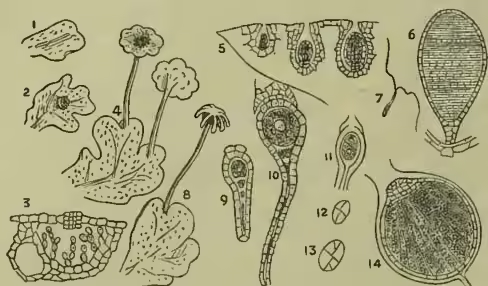
Liverworts (Hepaticæ) are green flowerless plants closely allied to mosses. They grow profusely on damp rocks, not unfrequently on leaves and stems in moist tropical regions, and sometimes even in the water. The majority are prostrate creepers, but others raise themselves in upright leafy growths, intermediate between the wholly leaf-like Thallophytes (e.g. seaweeds) and the higher Cormophytes (e.g. fern) in which distinct stem-structures are developed. There is a marked difference in structure between the upper and lower surfaces: thus, the former turned towards the light bears chimney-like openings (stomata), while the under side next the substratum gives off attaching and absorbing unicellular outgrowths (rhizoids) which are physiologically comparable to the roots of higher plants. If a young plant floating in water be illumined wholly from beneath, the rhizoids will develop on the upper surface—i.e. away from the light as usual. The growth is usually forked or dichotomous, and is often remarkably profuse by the moist river-side or in the damp greenhouse. The plants die away behind as they push ahead with fresh growth, and apart from this they multiply asexually by means of detachable clumps of cells (or gemmæ), which are often formed in special cups on the upper surface. 1 and 2, developing thallus; 2 shows the cup with gemmæ; 3, section across thallus, showing chimney-shaped stoma and green cells under, and mucilage cell on left; 4, male hats; 5, development of antheridia; 6, antheridium nearly ripe; 7, antherozoid; 8, female hat; 9, 10, archegonia before fertilisation; 11, 12, 13, fertilised egg dividing; 14, immature sporogonium, containing spores and elaters.
Like the Hydra among animals, liverworts may be artificially propagated by being cut into fragments, and they have remarkable powers of surviving prolonged desiccation.
On the vegetative thallus male and female hats or reproductive organs are borne, on the same or on different plants, often with a quaint umbrella-like or mushroom-like form. From a female cell fertilised by an actively motile male element there arises a new spore-bearing generation, but this, as in mosses, remains connected with the sexual plant. Within the spore-cases of the spore-producing generation there are long spring-like cells (elaters), which twist and untwist as moisture is absorbed or given off, and in so doing help to scatter the ripe spores. From the latter the new liverworts are established, the life-history thus illustrating the usual alternation of generations between oophyte and sporophyte. The class Hepaticæ includes five orders: (1) Jungermanniaceæ—e.g. Jungermannia and Pellia; (2) Monocleaceæ—e.g. Monoclea; (3) Anthocerotæ—e.g. Anthoceros; (4) Ricciaceæ—e.g. Riccia and Riella—the latter remarkable for its submerged but erect thallus, which forms a continuous spiral round a central axis; (5) Marchantiaceæ—e.g. Marchantia, Lunularia, and Fegatella. The abundant Marchantia polymorpha is a convenient type for the practical study of the class. See Bennett and Murray, Handbook of Cryptogamic Botany (Lond. 1889).