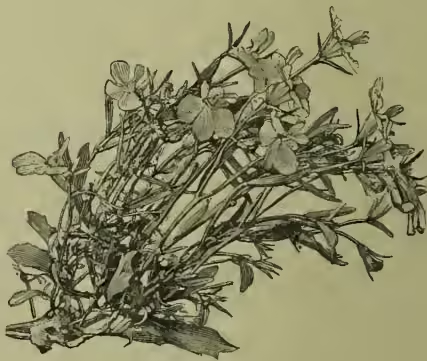
Lobelia, a genus of corollifloral exogens of the natural order Lobeliaceæ, named after the French botanist Matthias de Lobel (1538-1616). This order is nearly allied to Campanulaceæ, one of the most conspicuous differences being the irregular corolla. It contains almost 400 known species, natives of tropical and temperate climates, abounding chiefly in damp woods in America and the north of India. They are generally herbaceous or half-shrubby, and have a milky juice which often contains much caoutchouc. A poisonous character belongs to the order, and some are excessively acrid, as Tupa fueillei, a Chilian and Peruvian plant, of which the very smell excites vomiting; yet the succulent fruit of one species, Centropogon surinamensis, is eatable.—The genus Lobelia is the only one of this order of which any species are British. The Water Lobelia (L. Dortmanni) is frequent in lakes with gravelly bottom, often forming a green carpet underneath the water with its densely-matted sub-cylindrical leaves. The flowers are blue, the flowering stems rising above the water. To this genus belong many favourite garden-flowers, as the beautiful Cardinal Flowers (L. cardinalis, L. fulgens, and L. splendens) and the Blue Cardinal (L. sylvitica), natives of the warmer parts of North America, perennials, which it is usual to protect during winter in Britain. To this genus belongs also the Indian Tobacco of North America (L. inflata), an annual, with an erect stem, a foot high or more, with blue flowers, which has been used as a medicine from time immemorial by the aborigines of North America; both the flowering-herb and the seeds are imported into Britain. It is the former, compressed in oblong cakes, which is chiefly employed. A liquid alkaloid, Lobelina, and a peculiar acid, Lobelie acid, have been obtained from it. In small doses it acts as diaphoretic and expectorant; in full doses, as a powerful nauseating emetic; while in excessive doses, or in full doses too often repeated, it is a powerful acro-narcotic poison. It is the favourite remedy of a special class of empirics, and consequently deaths from its administration are by no means rare. Physicians seldom prescribe it now, except in cases of asthma.