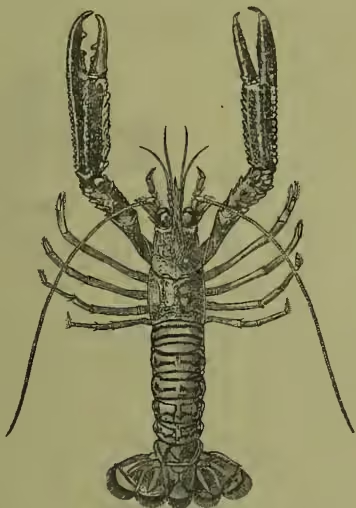
Lobster (Homarus vulgaris), a species of Crustacean, of the order Decapoda, sub-order Macrura (see CRAYFISH). It differs from the crayfish principally in the following characters: the last ring of the thorax is not movable, but continuous with the rest; the scale of the antenna is small; there are twenty branchiae on each side, and the claws are very powerful and unequal. One claw, usually the left, is thicker, more globose and heavier than the other, the biting-edges being furnished with blunt tubercles of different sizes: the other claw is more slender and elongated, and its biting-edges are furnished with numerous small teeth. As an exception two claws, both of one kind or the other, may occur in the same individual. The colour during life is a beautifully clouded and varied bluish black, which changes to a nearly uniform red on boiling. It sometimes attains to the weight of 12 or 14 lb. when loaded with spawn, although a lobster of 1 lb. weight or even less is deemed very fit for the market. The eggs (2000 to 12,000, of which perhaps 1000 are hatched) are deposited from the oviducts in autumn, and then become attached by adhesive threads to the swimmerets or abdominal appendages of the female. They are carried by the parent in this manner for several months, finally hatching about June and July of the following summer. When hatched the young swim about actively in the water, not at first crawling or walking like the adults. They differ from the adults in structure, chiefly in having outer appendages to the thoracic limbs; when first hatched they are about half an inch in length. Lobsters are exclusively carnivorous and very voracious. They are also very pugnacious, and in their combats often lose their limbs. But they exhibit in a remarkable degree the phenomenon of recrescence, limbs rapidly growing again of the same form and structure as those that have been removed, though several moults are required before the full size of the new member is attained. Moultng, or the casting of the shell, occurs in adult lobsters once a year, in the young much oftener, in very old individuals not so often. The creatures are fairly abundant on the coasts of the British Islands and other parts of Europe. They are caught for the market in traps made either of basket-work or of netting stretched on wooden frames, each trap having one or more re-entrant orifices for the entrance of the lobsters. The traps are baited with dead fish. In 1885-95 the number of lobsters landed annually on the coasts of England and Wales varied between 500,000 and 700,000. The landing price is from £4, 5s. to £4, 10s. per 100. In 1890 a lobster-pond was undertaken at Lochbuie in Mull.—The American Lobster (H. americanus) and the Cape Lobster (H. capensis) are the only other species known of the genus Homarus. The former is as valuable as the European species: its claws are much larger than those of the latter. Great quantities are canned and exported from Nova Scotia and New Brunswick, and from Portland, Maine, &c. The Norway Lobster (Nephrops norvegicus) is frequently taken on the British coasts, and appears in the markets. The eyes are kidney-shaped, and not round, as in the common lobster. The claws have also a more slender and prismatic form, and the colour is a pale flesh colour. It is said by some to be the most delicate of all the crustaceans; by others, to be inferior to the common lobster. The
Spiny Lobster, or Sea Crayfish (Palinurus vulgaris), is not uncommon on the rocky coasts of Britain, particularly in the south. It is believed to be the Karabos of the Greeks, and the Locusta of the Romans. It attains a length of about 18 inches. The shell is very hard, and the whole body is rough with short spines. The antennæ are very long, much longer than those of the common lobster. There are no claws or pincers, the first pair of feet being very similar to the others. The Spiny lobster is brought to market in London and elsewhere, but is inferior to the common lobster. Other species of these genera are found in other parts of the world. For anatomy, &c., see Huxley, The Crayfish (1880).