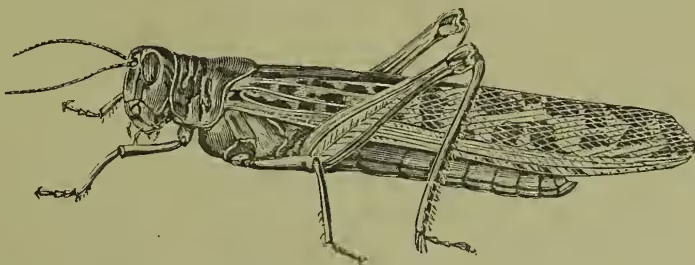
Locust, a name applied to the members of a family (Acrididæ) of orthopterous insects nearly related to grasshoppers. It is unfortunate that the family Locustidæ and the genus Locusta do not include what are usually called locusts, but the related grasshoppers, katydids, &c. Locusts in the popular sense, members of the family Acrididæ, are large, ground-loving insects, of world-wide distribution, famous for their voracious vegetarian appetite. In size they vary from inch to 5 inches in length. They have strong hind-legs with great leaping powers, large heads with formidable mouth-organs, shorter antennæ and robust bodies than grasshoppers. Both winged and wingless forms occur, the former with strong powers of flight, though they are doubtless aided in traversing seas and continents by the prevailing winds. The females have strong ovipositors by which they bore holes for their eggs; the males are without the grasshoppers' stridulating organ at the base of the wings, but rub their thighs against the edges of the wing-covers. The numerous eggs are laid in holes drilled in the ground; the young develop with incomplete metamorphosis, and when hatched generally resemble the parents except in the absence of wings. From the first they are gregarious, and excessively voracious except during their repeated moult; they devour all green things, and even one another, and are often forced by stress of hunger and excessive multiplication to migrate in great swarms, 'which have been traced over a stretch of country many hundreds of miles in length.' They periodically appear in destructive hordes, 'thick as snowflakes,' darkening the sky in 'myriads numberless, the rushing of whose wings is as the sound of a broad river.' Their ceaselessly moving jaws make a noise comparable to a spreading flame or to 'ehariots in battle;' in a few hours cornfields are reduced to bare stalks or stubble; 'the land is as the garden of Eden before them, and behind them a desolate wilderness.' The prophet Joel's description is at once vivid and accurate. Their ravages sometimes cause widespread famine and ruin; their rotting corpses produce pestilential effluvia. In many countries they are eaten, roasted or fried in butter, preserved in brine, plain boiled, or dried in the sun. 'In taste the red locust, which is the female, resembles green wheat, having a very delicate vegetable flavour.' One of the most famous and destructive forms is the Rocky Mountain Locust, Caloptenus spretus; the most abundant migratory species of the East, so often mentioned in the Scriptures, is Pachytylus migratorius. Acridium, Edipoda, Stenobothrus are among the numerous other genera of importance. See GRASSHOPPER; and for a complete account of the Rocky Mountain Locust, see C. V. Riley in Reports of United States Entomological Commission (Washington, 1877-87). For the 'seventeen years' locust' or harvest-fly of North America, see CICADA.
Locust Destruction.—Numerous systems both in the Old and the New World have been adopted for destroying these terrible swarms. They were beaten down as they flew; they were pushed into bags as they crawled, and their eggs were collected and burned on a very large scale before the young were hatched. A bounty has been offered for their destruction, in Minnesota, for instance, so much a bushel being paid, and thousands of bushels brought in. But no method was of any practical avail, until in Cyprus, under British administration, a system was perfected which has been so completely successful that it may be said to be the only one worthy of notice or consideration. It was suggested as early as 1870 by an enterprising land-owner in Cyprus, Mr Richard Mattei, and was modified and perfected by Mr Samuel Brown, government engineer-in-chief in the island in 1881. Mr Mattei was created a C.M.G. in 1886.
By his system, based upon a close observation of the nature and habits of the insects during many years, the locusts are caught while they are 'on the march'—that is to say, while (some ten days after they are hatched) they march across the country in countless hosts or 'armies.' Mr Mattei, having observed that no obstacle causes them to turn back in their onward progress, but that they climb and crawl over everything that bars their direct course, and that furthermore they are unable to obtain foothold on any perfectly smooth or polished surface, hit upon the ingenious expedient of barring their progress by means of long canvas screens put up on stakes and furnished at the top with a band of varnished leather or what is called American cloth. Deep pits are dug at intervals of some few yards on the side of these screens facing the advancing hosts, and the locusts, reaching the obstacle and being unable to surmount it owing to the polished surface on the upper edge, fall down and are caught in the pits, which are themselves edged and lined to a depth of a few inches with polished zinc. Finally, the locusts as they fall into the pits are rendered incapable of crawling out, not only by the smooth surface of the zinc, but by the superincumbent weight of the tens of thousands of fresh victims that are perpetually pouring in upon them. By this system the locusts in Cyprus were in five years entirely destroyed, and at a cost, though large for Cyprus, certainly not excessive, amounting to less than £13,000 a year. But the magnitude of the operations conducted for this comparatively moderate sum of money may be gathered from the statement that there were employed over half a million yards of canvas screen, and thirteen thousand zinc traps, with stakes, tools, and tents for the men engaged, in proportion. Locusts were trapped (in 1883) in about 26,000 pits, and a far larger number of holes were actually dug; while a special staff of no less than 2621 persons was employed during the campaign. Nor was the destruction on a scale incommensurate with these immense preparations. The number of the slain in 1883 is estimated, after careful calculation by Mr Brown, as being nearly 200,000,000,000, with an expenditure of only £12,300. And in the following year the enemy still remained sufficiently numerous to supply a list of casualties numbering over 56,000,000,000 locusts. Taking these numbers together at, say, 250,000,000,000 for the two years 1883 and 1884, and the expenditure during the same period at £27,500, we find the cost of slaying locusts has been 2s. a million, which is perhaps as economical a slaughter of living creatures as is recorded in the history of nature or art. Locust destruction on this system was only commenced in 1881, and in 1886 there were few if any locusts in Cyprus left to be destroyed. See the National Review for March 1888.