Log is the instrument by which a ship's rate of motion through the water is measured. In its oldest and simplest form it is a quadrantal piece of teak-wood called a log-ship, loaded in the are so as to float vertically, point upwards. Every hour or two hours it is hove overboard for twenty-eight seconds, or, if the ship is going very fast, for fourteen seconds. It is attached to a line called the log-line. The supposition is that when hove into the sea it will remain stationary in the water while the log-line is freely paid out from a reel held by hand on board. In actual practice a conical canvas bag, called a log-bag, with its open mouth facing the vessel, is often used instead of the log-ship. The log-line, which is attached to the log-ship or to the log-bag, is divided into equal sections by pieces of marline which are tucked through its strands, each section being that part of a geographical mile which twenty-eight seconds is of an hour, so that the number of sections of the log-line which run out during twenty-eight seconds is the same as the number of geographical miles which the ship is going per hour at the time of testing the speed. To facilitate counting the number of sections of the log-line which have been paid out, one, two, three, &c. Knots (q.v.) are tied on the tails of the pieces of marline. In practice, each section is made 46 feet 8 inches long, which is designedly rather shorter than the theoretical length.
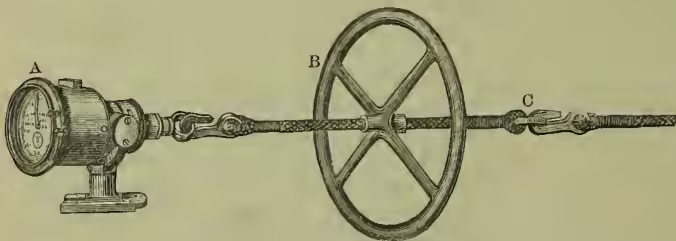
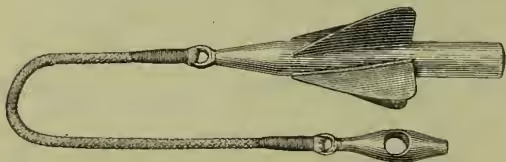
A ship's progress through the water is, however, much more generally obtained, especially near land, by towing continuously a small cylindrical tube to which are attached oblique vanes, usually four in number. This rotator, as it is called, revolves as it is towed with a speed which is proportional to the speed of the vessel. This proportion is ascertained by experiment by the makers, and a registering apparatus, consisting of the usual cog-wheels and pinions, records the revolutions of the rotator, and so records the progress of the ship. In the older form of this log the registering gear is attached directly to the rotator, and is towed with it through the water. The progress of the ship can in this case only be ascertained by hauling the log on board. In the newest forms the rotator alone is in the water. The registering gear is contained in a small case which is secured to the taffrail of the ship, or to an outrigger, so that it can be conveniently read at any moment, the revolutions of the submerged rotator being transmitted to the taffrail register by the tow-line which also rotates. A fly-wheel or rotating triangle or dumb-bells are placed on the tow-line between the rotator and the register, but close to the register, to secure greater smoothness in the working of the latter. The registering dial is usually graduated to knots (nautical miles) up to 100, and a smaller dial gives subdivisions of a quarter of a nautical mile. An automatic bell rings at every mile. But even under the most favourable circumstances a navigator is not justified in regarding any form of log as an instrument of precision.
Log-book.—The courses steered, distances run, wind, state of the weather and sea, leeway, daily employment of the crew, and other incidents, which in the first instance are noted at the moment in the bridge-book or deck-book, are daily entered in the log-book, which thus becomes the diary of the ship.
Official Log-book.—The official log-book is a book issued by the Board of Trade at the beginning and returned to that department at the end of each voyage. It contains a record of the crew and their characters, ship's draught of water, offences committed, desertions, sickness, deaths, medical treatment, collisions, &c., and is thus a sort of civil or police record of the voyage.