London is situated on the north or left bank of the Thames, about 60 miles from the sea, in 51° 30' 48" N. lat. and 5° 48" W. long. It may be reckoned the capital of the British empire, but the Houses of Parliament and the offices of government are in the adjoining city of Westminster. The Thames at London Bridge is about 900 feet wide, being much wider both above and below. This fact probably accounts for the original foundation of the city, which, according to many authorities, took place in 43 A.D., when Aulus Plautius was the Roman governor of Britain. The name is Celtic, and would appear to signify a fort on a lake or lagoon, the Thames being here a tidal estuary which covered all the low-lying land on which Rotherhithe, Newington, Southwark, and Lambeth are now situated. It seems likely that the easiest ford across the river was at Westminster, where it was widest (more than 1200 feet), and that by the building of London Bridge at the narrowest place the old Watling Street from Dover toward Chester was diverted. The old line led from Edgware through Tothill Fields to Westminster, where Stane Gate still marks the place of crossing. The newer road turned eastward at what we call the Marble Arch, and, passing diagonally from Newgate through the city, crossed by the bridge, and was carried on towards Dover on embankments among the shallows, the sites of which are still marked by such local names as Stone Street and Newington Causeway. The course of Watling Street in the city was again diverted, probably in the 13th century, to make way for the extension of St Paul's Cathedral, and now no longer leads in the direction of Newgate.
During the greater part of the Roman occupation of Britain-London consisted of two forts, one at either end of the bridge; and Ptolemy, the geographer, puts London in Cantium, where, and not on the left bank, it is very possible the largest of these forts may have stood. The unwalled suburbs seem to have been populous and wealthy from an early period; and, when abandoned by Suetonius, they were burned by Boadicea in 61 A.D. They were still undefended in 286 and the subsequent years, when the rebel emperors, Carausius and Allectus, held both sides of the channel, making Clausentum (Bitterne, near Southampton) their headquarters in Britain. Asclepiodotus, the general of Constantius, defeated Allectus in the neighbourhood of London, and under one of the Constantines the place began to be looked upon with favour and to be extensively fortified. The wall which for so many centuries was destined to defend the boundaries of the city was built between 350 and 369, and enclosed a space which has been computed at 380 acres. In this Roman wall there was a gate due north of the bridge in what is now Camomile Street, and another at the spot at which the Watling Street, crossing the Fleet or Holborn, took its course towards Tyburn. The new city was defended on the east by the Lea and its extensive marshes, and on the west by the Fleet, whose waters were tidal as far up as what we call King's Cross. Traversing the middle of the city was the narrow stream of the Wallbrook, with the harbour of Dowgate at its confluence with the Thames, and from the remains which have been discovered it is probable that the chief Roman fort, before the building of the outer wall, was on the east or left bank of the Wallbrook, and extended far enough eastward to cover the approaches to the bridge. Some bastions of peculiar strength where the wall reached the Thames on the site of the Tower gave rise to the medieval tradition that the Tower of London was built by Julius Cæsar. From 369 till 412 London was reckoned the capital of Britain, and enjoyed the title of Augusta. After the Roman departure London disappears from history until 457, when the Britons, fleeing before the victorious Hengest, took refuge behind the Roman wall. How far it availed them for defence we know not. London does not again emerge from complete obscurity for about a century and a half, but in 604 we find it named as the 'Metropolis'—i.e. the ecclesiastical capital—of the East Saxons. Mellitus was appointed first bishop, but the Saxons soon expelled him, and Christianity did not make much way with them until Ethelbert, king of Kent, the over-lord of the East Saxon king, took the matter in hand. A little later we hear for the first time of a tribe of Middle Saxons, but London was evidently a place of but small importance, apart from its bridge, as the Saxons preferred to fight without walls, and as no doubt the Roman defences had become greatly dilapidated. At length during the Danish wars they became completely ruinous, and London was abandoned and lay desolate during the long period of thirty years, the lifetime of a whole generation.
To King Alfred we must look as the real founder of modern London. He saw the possibilities of the place as a bulwark against the Danes, and, repairing the wall and gates, made the place again habitable. There is a tradition that he specially rebuilt and strengthened a work on the site of the Tower. During the long period of disaster which followed his reign, the kingdom of some of his successors consisted of little else but London, which the Danes were never able to take, even though they made a canal round Southwark, and half rowed, half dragged their ships to Westminster. Undoubtedly the settlement made in London, whether by Alfred or by one of his immediate successors, formed the germ of the subsequent municipal government. Athelstan is often pointed to as the king who chiefly restored London, and, as we have nothing else, tradition must be received with some respect. The Roman lines of road and the gates were abandoned. New gates at Aldersgate, Newgate, and Bishopsgate were constructed, and posterns seem to have been opened at Ludgate (A.S. Lydgeat, 'a postern'), Cripplegate (A.S. Crepulgeat, 'a covered way'), and possibly at what was afterwards Moorgate. There were two great market-places, one near the western gate, in which the folkmete was held, and where stood the church of St Paul; and the other in East Cheap, of which the only modern remains are Leadenhall Market and the fish-market at Billingsgate. The West Cheap was bordered by the highway still called Cheapside, which led from Cornhill, the northern extremity of the East Cheap, by a bridge over the Wallbrook to the Westgate, now Newgate. There were many empty spaces within the circuit of the walls, and, if we may judge by the comparative size of the local divisions, the first settlers chose the shores of the Thames and the lines of the two great roads for their habitations. It is very probable that ecclesiastically the city was divided into three great parishes; one, of which St Paul's was the church, to the westward; a second, of which St Mary Aldermary was the church, in the centre; and a third, possibly dedicated to All Saints, or All Hallows, in the east.
The municipal government before the Norman conquest was not very complicated in form, and may be compared to that of a county elsewhere in England. The lords of manors in the city were represented by aldermen of wards, and the ward division is the oldest with which we are acquainted. Every magnate had his ward; and the government was carried on by the bishop who was alderman of the ward about St Paul's, and the portreeve who had the Portsoken outside the city to the east. It is not easy to unravel the knot presented to us by the names we meet with in old records of city officials in and before the 11th century. A guild, composed chiefly or wholly of aldermen, was perhaps, under the name of Knighten Guild, the governing body; but this is by no means certain, nor is the tradition that King Edgar was their first founder. Some such body existed; its members transmitted their rights to their sons, and they may or may not have become the governing guild of the city. The king's reeve, or port-reeve—port probably denotes a market—answered to the sheriff or shire-reeve of a county; and the aldermen of wards had many and extensive powers on their respective estates, answering to those exercised in a county by the lords of manors. The reeve united in his own person many offices afterwards separated. He was chamberlain or treasurer; he was 'vicecomes,' and accounted to the king's exchequer for the farm of the city; he was coroner; he was escheator; and he often bore office as a royal minister, like Ausgar, 'the staller,' who fought and was wounded at Hastings. William recognised the great position and ancient rights of London in a special charter by which the privileges enjoyed by the citizens under Edward the Confessor were confirmed to them; but the most important grant from the crown was that of Henry I., who, in 1101, in recognition no doubt of the assistance London had given him in his successful attempt to seize the crown, allowed them, among other things, (1) the right to elect their own chief-magistrate, and (2) the farm of Middlesex at an annual rent, with power to appoint a sheriff of that county. These extraordinary grants, with that of leave to hunt in the neighbourhood of London, are so unlike what we should expect from a Norman king, that some have been tempted to suppose that they were all renewals of privileges enjoyed under the Saxon kings, and there is much plausibility in this view, but their recognition led eventually to the establishment of the mayor. The sheriffs of London and sheriff of Middlesex were no longer 'high' sheriffs; they were the nominees and deputies of the whole body of the citizens. As at Winchester, and some other places, the mayor does not seem to have received any royal acknowledgment during his first years of office; but the date 1189 is generally assigned as that of the first year of Henry, the son of Ailwin, an alderman of old family. There seems to be a question whether this Ailwin is to be identified with a citizen of that name who in 1125, with all his brethren of the Knighten Guild, became canons of the priory of Holy Trinity at the newly-opened Algate (now corruptly called Aldgate), and conferred, with the king's leave, the title of an alderman (of the ward of Portsoken) on their prior, Norman. Be this as it may, the necessities of the kingdom, and the difficulties consequent on the payment of the ransom of Richard I., must be taken as causes for the recognition of the new chief-magistrate; and down to our own day, when (Local Government Act, 1888) this ancient custom was abolished, the citizens elected annually, on Midsummer Day, two sheriffs for the city, one of whom was sheriff also of Middlesex on alternate days. They are now elected for the city only. They enter on their office on Michaelmas Day, and the citizens then proceed to choose the Lord Mayor. Legally any citizen is eligible for the mayoralty, but for many generations the senior alderman who has not passed the chair is chosen.
This may be the most convenient place in which to name the chief municipal officers. The mayor, who has been called 'Lord Mayor' from time immemorial, is held to rank as an earl, but within the city boundaries next to the sovereign. In commissions of Oyer and Terminer his name precedes even that of the Lord Chancellor, and since the reign of Edward III. he has sat as a judge. At first the Lord Mayor was a representative of the city in the House of Commons, and he still takes a seat at the opening of parliament on the ministerial bench. He attends at the Law Courts to be sworn in on the 9th November, and holds office for a year. He is in the city in the position of the Lord-lieutenant of a county, and a commission of lieutenantcy is issued to him and the magistrates he may nominate. The Chamberlain is the city treasurer. The office was separated from that of mayor when the mayoralty was temporarily superseded in the reign of Edward I. He is the official guardian of the orphans of citizens, and has special charge of apprentices. He is annually re-elected during good conduct. The Recorder is the legal adviser of the Court of Aldermen. Geoffrey Hartpole, elected in 1304, was the first Recorder. The Common Serjeant stands in the same position toward the Common Council, who have also their Common Clerk, now called town-clerk. The first Common Serjeant was Thomas Juvenal, elected in 1290. The Court of Aldermen now consists of twenty-six members, of whom the senior sits for the ward of Bridge without, or the borough of Southwark. The others are elected by the city wards.
The Common Council was first elected in 1200, when twenty-five citizens were chosen by the wards to take council with the aldermen. There are now 206 common councillors.
The Common Hall consists only of members of the Livery Companies, and has obtained or usurped many of the rights of the whole body of citizens. An act passed in 1725 regulates admission to the franchise of the city through the livery, but seems to have been founded on a misapprehension, as the Act of 1475 which it was supposed to confirm does not seem to have ever existed. Admission to the citizenship could be obtained by application to the Hustings Court, as well as by joining a company, but the latter course, being the easiest, became usual, and so was supposed necessary.
The hustings, a meeting of the whole body of the citizens, was called in other cities Portmanni-mote, and was an assembly under cover, as distinguished from the folk-mote, held at first in the open space between St Paul's and West Cheap, and afterwards in Smithfield.
The growth of this municipality was slow. At first the rights of the aldermen possessed of hereditary jurisdiction interfered with its progress; but by degrees all the wards were able to elect their aldermen. The interference of the crown also greatly retarded the prosperity of the city. Nevertheless, commerce increased, and the settlement of such foreign merchants as those of the so-called Steelyard, and of the Lombard and other Italian bankers, raised London by the time of Edward III. to a wealthy and prosperous condition. In reading a detailed history it is observed that weak sovereigns caused a depression of trade, while under a strong government confidence was restored and capital was safe. Henry III. was constantly at feud with the citizens, whom he greatly oppressed, leaving to his successor the task of dealing with the disorder he had created. Edward I., to use the language of contemporary chroniclers, 'took the city into his own hands,' and his ministers, Sandwich and Breton, governing like mayors, with the help of the aldermen and the common council, brought everything into order. In 1290 they expelled the Jews. After twelve years the mayoralty was restored. Under Edward II., again, there was disorder and discontent in the city, the great body of the citizens adhering to the party of the queen. Under Edward III. London prospered, new privileges were granted to the mayor, and the French wars were extremely popular. In the end, however, a reaction ensued, and under the weak government of Richard II. things did not improve. The usurpation, as many deemed it, of Henry IV. could hardly have succeeded had it not been for the support of the city; and Henry V., whose French victories inflated trade, was most popular with the citizens. Henry VI. was unable to grapple with the inevitable period of depression which naturally followed; and his queen, Margaret of Anjou, failing to gain the confidence of London, whose importance to the Lancastrian cause she did not know, contrived to divert the weight of the city influence into the opposite scale. The reign of Edward IV., with his strong commercial instinct, by reviving and creating outlets for foreign trade, restored the prosperity of the city. Under the Tudors there were great fluctuations. Although the settled government of Henry VII. tended on the whole to the satisfaction of the city, his continual exactions and the heavy fines he imposed for trivial offences, alienated its loyalty. The accession of Henry VIII. was an occasion of rejoicing. The tenets of the Reformation were warmly welcomed in London, where the priests, monks, and friars had become a heavy burden; and at first the high-handed proceedings of the king in the suppression of the religious houses and the confiscation of their endowments was a popular measure. The further suppression of guilds under his successor led to a considerable change in the feeling of the citizens, many of whom, but for the religious persecution under Queen Mary, would have been very willing to return to the old faith.
The guilds had for centuries been an integral part of the social life of the citizens. The municipal guild, or what we know of it, has already been mentioned. At an early period after the Conquest we hear of 'trade guilds,' that is, of combinations of men of one calling for religious and other purposes. The many attempts made of late to distinguish between trade guilds and religious guilds have ended in failure, for all guilds were religious, and most religious guilds were trade guilds as well. As time went on the governing body occasionally found it convenient to consult a trade guild on the regulation of their particular business. This was especially the case under such mayors as Walter Harvey (1271-72), who, indeed, made an endeavour to enrol every citizen under the banner of a guild of his trade, and to formulate rules for each. Though he failed, his ideas took root; and in a few years many of the guilds obtained royal charters forming them into companies, able to hold lands, and in some cases, as that of the goldsmiths and that of the fishmongers, to regulate the conduct of their respective trades. The old guilds were thus generally merged in the companies whose governing bodies acted as trustees of the funds of the guilds. There was probably a good deal of confusion between the guild property and the companies property, but for the most part that of the guild could be distinguished, because it was applied to religious purposes. The act which confiscated these funds made, of course, a profound impression on the city. Some companies were wholly ruined, having perhaps no funds but those which might be applied to a 'guildable use;' and others, more prosperous, found it expedient, and even necessary, to sell their company estates in order to buy the guild estate which they had administered. The companies which recovered from this heavy blow prospered for the most part eventually, and those now extant deal with large charitable funds and hold large estates, to the great benefit of their tenants and their pensioners.
Under Queen Elizabeth the work of the Reformation was continued and completed. The history of the church in London was greatly complicated with that of the municipality. We have seen that the bishop was an alderman; but at a very early period, a period in fact so early that no record of its date survives, the ecclesiastical and lay administrations drifted apart, and the church had less and less concern in the affairs not strictly religious. There are historical reasons for believing that St Paul's was at first a parish church, but before the end of the 12th century, perhaps as a consequence of the great fire of 1136, the parochial arrangements of the whole city were readjusted, new parishes were formed and their boundaries marked, and a great number of new churches were built. The dean and the lordly canons of St Paul's no longer cared to have the common people worshipping in their church, and built St Peter-le-Querne, at the corner of Cheap, with St Gregory and St Faith closely adjoining St Paul's, the one at the east end, the other at the west. The canons of St Martin's built St Vedast's, and the friars of Newgate Street St Ewen's; and private individuals or wealthy aldermen increased the number of churches as long as they could obtain parishes to attach to them.
When land failed for this purpose, they founded chantries, some in St Paul's, some in other monastic and parochial churches. No doubt the act Quia Emptores, which in 1290 practically forbade the subdivision of manors, had its influence in restricting the multiplication of churches, but the number of city parishes (114) was out of all proportion to the population, great comparatively as that must have been; and, since churches were built rather as chapels where mass might be celebrated than for any other purpose, the later Puritan and Protestant idea, that they should be places where a large number of people could listen to sermons, had no influence on their dimensions. Although there was no abbey in the city, if we except St Mary's in East Smithfield, a Cistercian house founded by Edward III., and sometimes called Eastminster, which never flourished, the number of priories, colleges, and hospitals was immense. The Whitefriars had a large house on the south side of Fleet Street in the western suburb. The Blackfriars occupied the south-western corner of the city, and had leave to divert the course of the wall between Ludgate and the Thames. The Greyfriars were within Newgate, on the site now occupied by Christ's Hospital. Close to them was St Martin-le-Grand, a very ancient foundation for canons, which, in the later years of monasticism, having fallen into decay, was attached to Westminster Abbey. Close to the Franciscans on the north, but without the wall, was the Austin Canons' house in Smithfield. Elsing Spital was within Cripplegate. The Austin Friars had great buildings near Moorgate, and St Helen's Priory, for nuns, occupied the eastern side of Bishopsgate Street. The canons of the Holy Trinity held Aldgate, and south of their priory was that of the Crutched Friars. The suburbs teemed equally with religious houses, and there were several minor foundations within the city. The number of mass priests attending altars in St Paul's alone was reckoned at over one hundred; and the great pestilence of 1348 added largely to the chantries and chapels. In the 15th century this state of things became an intolerable burden, and contemporary literature is full of complaints. Unfortunately, in abolishing monasticism the beautiful churches of the monks and friars were not respected, and although one or two were named as worthy of preservation as preaching-houses, all perished except a portion of Austin Friars and the nuns' aisle of St Helen's. The Austin Friars' church, wholly disguised under a mistaken idea of 'restoration,' still remains as a Dutch church. Even St Paul's was mutilated: the campanile and the cloisters known as Pardon Churchyard were ruined; and after the destruction of the lofty spire, 520 feet high, by fire in 1561, the whole church fell into a very dilapidated condition.
The influence of the church told also upon London in another way. The addition of suburbs to the city as 'wards without' was prevented by the ring of ecclesiastical estates which gradually closed round it. On the east was Stepney, a manor belonging to the bishop. The mayor and corporation obtained a lease of the manor of Finsbury from a prebendary of St Paul's in 1315, and held it till 1867, when it was taken up by the Ecclesiastical Commission. To the westward there were several prebendal manors, and outside Temple Bar was the great parish and manor of St Margaret, Westminster, which belonged to the abbey. Southwark was annexed to the city in 1327, and was made a 'ward without' in 1550. But in addition to Portpool (now Gray's Inn), St Pancras, Rugmere (now St Giles's), and Bloomsbury, the Moor (or Mora), at Cripplegate, Isling- ton, Hoxton, and Eald Street (now Old Street), St Luke's, all of which were manors belonging to canons of St Paul's, the Knights of St John had Clerkenwell; the canons of St Bartholomew, Canonbury; the abbey of Barking had Tyburn, or the eastern half of the parish of St Marylebone; the Knights of St John had the western half, or Lylleston; the abbey of Westminster owned Paddington and Westbourne; and the abbey of Abingdon, Kensington. Finally, the abbey of Westminster held Chelsea for a time. It will be seen that every extension of the city jurisdiction was effected with great difficulty, and the effects of the division of the monastic estates by the Tudor dynasty did not greatly benefit the city, which in fact only obtained St Bartholomew's Hospital and the Grey Friar's from Henry VIII., and Bridewell from Edward VI.
The accession of Queen Elizabeth gave a considerable impetus to London trade. Her reformation of the coinage was only one item of a settled policy; and the Merchant Adventurers, chartered by her father, now stepped into the place previously occupied by the Germans of the Steelyard, which was abolished at the instance of the famous Gresham. The last charter of Queen Elizabeth was granted to the East India Company. The silk manufacture, driven out of Flanders by the cruelties of the Spaniards, was naturalised in England; and even the short-sighted policy of the first Stuart could not repress the rapidly-growing enterprise of the Londoners, whom the discovery of America and of a sea-passage to India stimulated to greater and greater exertions.
While the wealth and population of London thus increased during the 16th and part of the 17th century, the city itself became less and less fit for habitation. Its unhealthiness was partly caused by the deficiency of the water-supply, partly by overcrowding. The plague scarcely ever left its narrow streets and filthy alleys. The sanitary arrangements of the time of Edward I. were scarcely suited to the needs of the time of James and Charles. But, known only to a few Londoners, Sir Hugh Myddelton, by bringing clean water to the city in abundant quantity, bestowed upon it the greatest possible boon. This was in 1620; but some forty or fifty years elapsed before the New River was made generally available. In the meantime the citizens were overwhelmed with one great misfortune after another. James I. had reverted as far as he could to the mistaken policy of such kings as Henry III. and Richard II.; but it was reserved for Charles I., after a long series of high-handed proceedings, to seize the money of the city goldsmiths deposited in the Tower. His downfall was certain when the city turned against him; but, except for a very brief period, the Commonwealth found little favour in London, and Cromwell imposed one humiliation after another upon the citizens. Charles II. was warmly welcomed, and it was mainly owing to the co-operation of the wealthy merchants with Monk that his return was possible. But Charles followed in the footsteps of his father. Extortion and oppression were the instruments of his policy, and in 1672 he closed the Exchequer, and ruined nearly all the London bankers at a blow. He never afterwards was able to win the confidence of the citizens, on whom two other disasters of even greater vehemence had already come—the Great Plague of 1665 and the Great Fire of 1666.
There had been many previous visitations of the plague, and to that of 1625, long known as the Great Plague, 35,000 deaths were attributed. But the epidemic of 1665 threw all others into the shade. It commenced at St Giles's, in the suburbs, and the official statements enumerated the deaths during the year at 97,306. As the population was reckoned at about 500,000, it will be seen that nearly a fifth perished.
There had also been many great fires, but that of 1666 exceeded them all. It commenced on the 2d September, at 1 o'clock A.M., in Pudding Lane, and raged for five days. It was estimated that 396 acres of houses were destroyed, fifteen city wards were consumed utterly, and eight others damaged, comprising 400 streets, 13,200 private houses, 88 churches and St Paul's Cathedral, and 4 city gates. The loss in mere money was estimated at about 4 million. It took London many years to recover from this terrible misfortune. Sir Christopher Wren built a new St Paul's, and also gave us St Stephen's, Wallbrook (until 1888, when it was in great part ruined by the parochial authorities), the chief monument of his powers after the cathedral, the spire of St Mary-le-Bow in Cheapside, and many other beautiful buildings, including the Monument, set up near where the fire began. This is a Tuscan Doric fluted column 202 feet high. St Paul's has a dome 404 feet high and 145 feet in external diameter; the length of the building east and west is 500 feet. Street, commenting on the superiority of St Paul's to St Peter's as an architectural composition, says: 'The great magnitude of the latter may strike the vulgar eye with admiration in the contrast; but the rudest taste must appreciate the surpassing merit of the former in the form and arrangement of the cupola and the noble peristyle' (see WREN). It contains many memorials, the best of which are Wellington's, in the Consistorial Court, on the south side of the nave, by Stevens; Lord Melbourne's, by Marochetti; and a recumbent figure of General Gordon, by Boehm. In the crypt are buried Lord Nelson (1805), Reynolds (1792), Turner (1851), Wellington (1852), Landseer (1873), and Wren himself (1723). The Exchange (q.v.) of Sir Thomas Gresham was burned, rebuilt, and then burned again, and finally rebuilt in 1844 by Sir William Tite. The Guildhall, partly of the 13th century, partly of the 15th, which had been the scene of so many historical events, was damaged in 1666, but not destroyed, and was handsomely restored first by Jarman, an eminent contemporary of Wren, and more recently by Sir Horace Jones. Among the churches spared by the fire is St Bartholomew's, in part, a fine Norman structure; St Giles's, Cripplegate, built 1545, in which John Milton (born in Bread Street, 1608) was buried, 1674; St Helen's, Bishopsgate, full of fine monuments; St Katharine Cree, said to have been designed by Inigo Jones, 1631; and St Andrew Undershaft, in which is Stow's monument.
During the rest of the reign of Charles II. and the whole of that of his successor, the city and the court were more or less at variance; and in 1683 Charles took London, to use the old phrase, into his own hands. The Lord Mayor was deposed, the charter was seized, and both aldermen, and also a so-called Lord Mayor, in reality a warden, were appointed by the king. At first James II. carried on his brother's policy towards the city. At the news of the landing of the Prince of Orange the charter was sent back, but the concession came too late, and the judicial murder of Alderman Cornish was too fresh in the minds of the citizens. In December 1688 they formally petitioned William to assume the crown, and in a few hours found ample funds for his use. Subsequent events were largely influenced by the city, and it has often been observed that the opposition of London, in old times fatal to a king or his family, has of late equally affected the fortunes of a ministry. King George III. was galled by the supremacy of the citizens as Henry III. had been before him; but he made no way against them. The last events that need be noticed here are the establishment of the Bank of England in 1694; the removal of the old wall and its gates in 1760; the clearing of the houses from London Bridge about the same time, and its complete rebuilding in 1831, when it was only one of a large number of bridges. A great number have been built since then; the latest addition, a bridge below the Tower, is an engineering work of great importance, which will add greatly to the picturesque aspect of the east of London. See BRIDGE, Vol. II. p. 446.
The population of the city has dwindled year by year, and especially since the multiplication of railways. Few tradesmen now live in their place of business, and the difference between the number of people who actually reside within the ancient boundaries and of those who only come in to business is immense. In 1881 there were 6493 inhabited houses and a population of 50,526; but 25,143 houses were used during the day, when the population rose to 261,061. The rateable value of property was, in 1887, no less than £3,767,000. Meanwhile the suburbs have spread in all directions, and the houses of Londoners are found in Berkshire, Buckinghamshire, Hertfordshire, and Sussex, as well as in Kent, Surrey, Essex, and Middlesex.
The city has its own police force, in six divisions, with seven stations and two courts—one at the Mansion House, the official residence of the Lord Mayor, and one at the Guildhall. Several railway stations have been made within the precincts of the city, as the Temple, Blackfriars, the Mansion House, the Monument, and Mincing Lane on the Metropolitan Railway, with Cannon Street Terminus, which stands exactly on the site usually claimed for the Roman pretorium. The diocese of London has varied very frequently in extent, having at one time comprised Middlesex, Essex, and Hertfordshire, besides the city. It now consists of the city with Middlesex, and that part of the new county of London which was formerly reckoned in Middlesex. The bishop resides in Westminster, and at an ancient manor house of the see at Fulham. There is a dean of St Paul's who resides close to his church, on the site of the old brewhouse of the chapter. He is assisted by four residentiary or stagiairy canons, and by a precentor, a chancellor, and two archdeacons, and there are thirty canons of the old foundation, now usually called prebendaries, and a college, incorporated by Richard II., of minor canons.
London formerly returned as many as six members to parliament, of whom two were supposed to be on duty at a time. From about 1357 the number was usually four. Under the Reform Act of 1885 it was reduced to two.
Like other ancient towns the city of London had its own customs, some of which still have the force of law. Thus, by the custom of London, every shop is deemed an 'open market' for the goods usually sold there. There were also special rules as to the prosecution of certain classes of offenders, &c. The London custom which governed the succession to personal property was taken away in 1856. There is a customary right of foreign Attachment (q.v.).
THE COUNTY OF LONDON. Under the Local Government Act of 1888 a new county was defined, to consist of the suburban parishes of Middlesex, Surrey, and Kent. These parishes, or a great part of them, had previously been described in certain acts as 'the Metropolitan Area,' a term quite inappropriate. By the Act of 1888 a county council was provided for this district, and the jurisdictions formerly existing of the city of London, and the authorities of the three counties were abolished. Before describing the new county we may point out that under this act the county of Middlesex (q.v.) was removed from the sheriffship of the citizens, and divided, one part forming a new county of Middlesex, and the other, united with parts of Surrey and Kent, forming the new county of London. The work of the County Council has been multifarious and far-reaching, and has evoked a corresponding amount of criticism. By the London Government Act of 1899 the administrative county of London, with the exception of the City, which had heretofore been under the authority of more than a hundred and twenty local authorities (vestries, district boards, burial boards, &c.), was reorganised into twenty-eight municipal boroughs, each under a municipal council. These boroughs are: Battersea, Bermondsey, Bethnal Green, Camberwell, Chelsea, Deptford, Finsbury, Fulham, Greenwich, Hackney, Hammermith, Hampstead, Holborn, Islington, Kensington, Lambeth, Lewisham, Paddington, Poplar, St Marylebone, St Pancras, Shoreditch, Southwark, Stepney, Stoke Newington, Wandsworth, Westminster, Woolwich. The councils have all the powers and duties of the old vestries and district boards, and some of those of the London County Council.
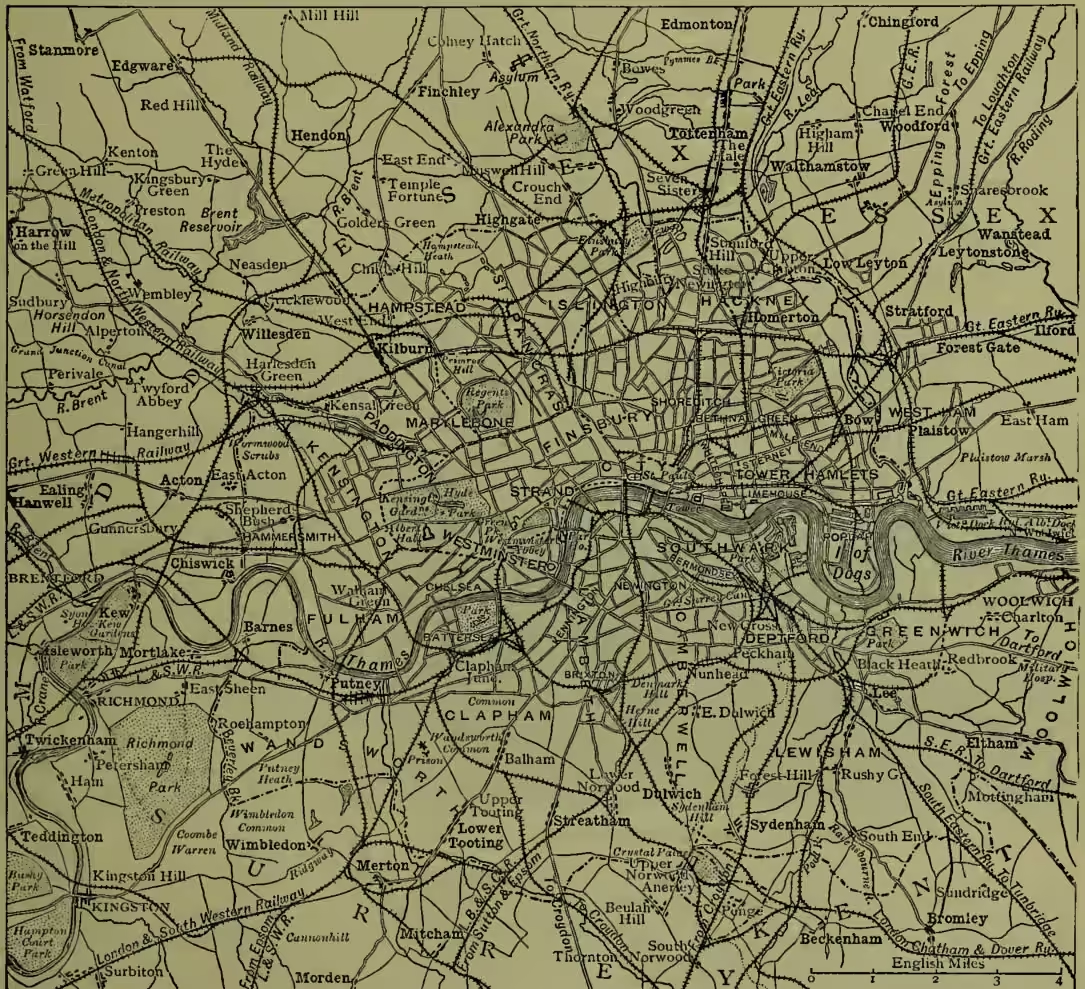
The suburbs form a ring round the city, and the efforts of the medieval rulers were directed—first, to restricting as much as possible their growth; and secondly, to bringing them, when they were settled, under the control of the city. In this policy the Londoners were unsuccessful. The suburbs grew in spite of city and parliament; and by 1222 a continuous street united Westminster with London; another stretched beyond the Tower to Stepney; and a third, flowing out of Bishopsgate, reached northward to Islington. In the same 13th century the city made its final attempt to keep the suburbs under control. A great 'ward without' was formed westward, extending to the Temple and Holborn Bars; and, on the north, part of Moorfields was made a 'ward without' in the jurisdiction of the alderman of Bishopsgate. But, except for the formal addition of Southwark in Surrey, made in 1327, confirmed and defined in 1550, no further extension of the city liberties took place. The estates of the church stopped the way. London was surrounded by manors, of which ecclesiastical dignitaries and monastic bodies were the lords. Foremost among these were the canons of St Paul's and the Bishop of London. Stepney, an immense parish to the eastward, belonged to the bishop, all, that is, except such parts of the precinct of the Tower as were taken out of it. On the west the Abbot of Westminster had the parish of St Margaret, which at first came up to the Fleet, at what we know as Ludgate Circus, and was with difficulty pressed back beyond Temple Bar. The abbot continued to hold the churches in the new ward, and the dean and chapter still present to St Bride's, Fleet Street. On the north, the canons of St Paul's held Cantler's, now Kentish Town, Eald Street, Hoxton, Islington, and St Pancras, while Mora and Wenlocksbnarn were parts of the parish of St Giles, Cripplegate. Other canons, monks, and friars, and the Knights of St John and of the Temple had holdings in Smithfield and Canonbury, at Clerkenwell and in St John's Wood, and in the Temple. All these church estates were in hands which bitterly resented any interference on the part of the city; and when the monastic orders were abolished, their estates were for the most part granted to individuals at least as tenacious of their independence. The canons of St Paul's had already for the most part ceased, owing to the prevalence of a corrupt system of leasing, to own except in name the manors of which they had been the lords. In the more distant parishes similar influences were at work, and except in Westminster, where the abbot and his successor, the dean, held the reins of local government, the parishes of the so-called Metropolitan Area were governed by elected vestries and other such institutions, and the lands were divided and parcelled out in freeholds, some large and a few small, among owners who had little general control or influence.
The precinct of the Tower, eastward of the city wall, was formed partly by aggressions on the
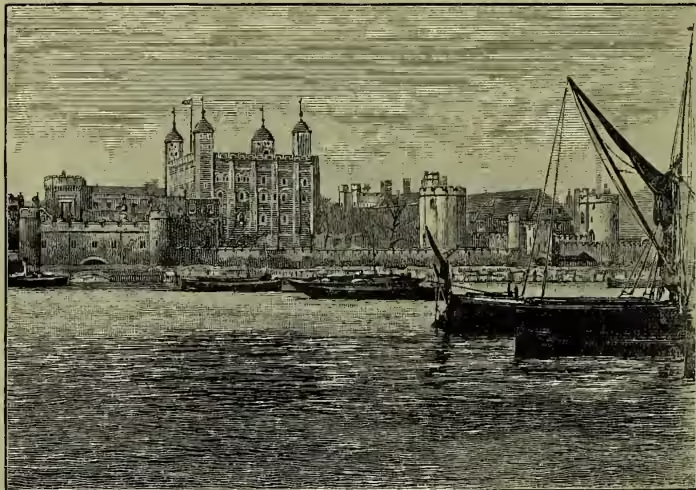
Lady Jane (Grey) Dudley lived, is in good preservation, but is now, for some unknown reason, called the Queen's House. The Beauchamp and Devereux towers seem to have held the most illustrious prisoners; they, with the Bell Tower, in which Fisher, Bishop of Rochester (1534), and Mary, Countess of Lennox (1565), were confined, form the western side of the inner ward, being united by a curtain wall, on which the prisoners walked. Unfortunately, the inscriptions from many different chambers have been brought together in the principal room of the Beauchamp Tower, by which their historical significance has been in some cases wholly lost. Here we see, among others, memorials of the incarceration of the six sons of John Dudley, Duke of Northumberland (beheaded 1553). Of them, John, the eldest, was released and died; Ambrose, the second, became Earl of Warwick, and lived till 1599; Guildford, the third, was beheaded on the same day as his wife, 12th February 1554; Robert, the fourth, is best known as Queen Elizabeth's Earl of Leicester, and died in 1588; and Henry, the youngest, was killed in the French wars in 1558. Other illustrious prisoners were Edward, Earl of Warwick, called the last of the Plantagenets, beheaded 1499, and his sister Margaret, Countess of Salisbury, beheaded 1541; Edward Seymour, Duke of Somerset, beheaded 1552; Sir Thomas More, 1535; Thomas Cromwell, Earl of Essex, 1540; Queen Catharine Howard, 1541; Henry Howard, Earl of Surrey, 1547; Henry Grey, Duke of Suffolk, 1554; Sir Walter Raleigh, beheaded at Westminster in 1618; Thomas Wentworth, Earl of Strafford, 1641; William Laud, Archbishop of Canterbury, 1645; James Scott, Duke of Monmouth and Buccleuch, 1685; James Radcliffe, Earl of Derwentwater, 1716; and the Scots lords implicated in the risings of 1715 and 1745—Kenmure, 1716; Kilmarnock and Balmerino, 1746; and Lovat, 1747. Many of these prisoners were buried in St Peter's Church, which having been burned in 1512 was rebuilt in time to receive the bodies of Queen Anne Boleyn and other victims of the Tudor times. It was 'restored' some years ago in a very thorough manner, every vestige, except some monuments, of the period which witnessed these sad scenes being carefully obliterated. The crown jewels were long kept in the Brick Tower, at the north-eastern corner, but in 1867 were removed to a chamber in the Wakefield Tower. This chamber, in which they are now exhibited, has shared the fate of the chapel, every vestige of its occupation by Henry VI., probably at the very time of his death, having been carefully 'restored' away. The great collection of armour, founded by Henry VIII. in his palace at Greenwich, is on the upper floor of the White Tower. Two or three pieces date from before the time of the Tudors. The ticket-office, by which the visitor enters the fortress, is on the site of a menagerie which dates back to the time of Henry I., whence the saying 'to see the lions,' meaning to visit the Tower. The principal feature of the outer ward is St Thomas's Tower, or the Traitor's Gate, facing the Bloody or Garden Tower, the entrance of the inner ward. The view of the Tower from the westward is much interfered with by the new bridge, but, except for some ugly barracks and the demolition of the palace, has still very much the aspect it bore in the 17th century. citizens, partly by acquisitions from the lord of Stepney, and partly by reclamations from the Thames. Two bastions of the old wall, generally called Roman, and certainly dating back to the reign of Alfred (see above, p. 696), were removed, and the White and Wakefield towers were built on them. They were fenced round by a palisade at first, but by the end of the 12th century the precincts comprised 26 acres, about 12 being covered with buildings. Gundulf, a monk of Bee, designed the White Tower, begun in 1078. The works went on steadily, the chapel of St John in the White Tower being supplemented by the parish or precinct church of St Peter 'ad Vincula' on the Green in the reign of Henry II. The keep is approximately in the centre, and is surrounded by walls and towers forming the inner and outer wards. The towers of the inner ward were those chiefly used for prisoners' lodgings, but a complete royal palace was in the south-eastern corner. Of this palace, from which Queen Anne Boleyn went to her death on the adjoining green, scarcely a vestige remains. The lieutenant's lodgings, where, or in the chief-warder's house next door,
The new bridge just mentioned starts from the boundary between the precincts of the Tower and that of St Katharine's Hospital, an institution founded by Matilda, the queen of Stephen, and refounded in 1273 by Eleanor, queen of Henry III. It still subsists, having been spared at the Reformation, but was removed in 1827 to the Regent's Park, and St Katharine's Dock made on the old site. A little farther east, still on the Thames bank, we come to one of the numerous divisions, known as the Tower Hamlets, into which the original parish of Stepney has been parcelled. This used to be Ratcliffe and Wapping, but has long been known as St George's in the East. Next to it is Limehouse, a name whose original form, Limehurst, sufficiently denotes the old character of the region. Next to Limehouse is Poplar, which includes the Isle of Dogs, a kind of delta formed by the river Lea, which derives its name from its docks. Farther inland are Bethnal Green, a vast district, chiefly covered with factories and with the houses of the lower class of artisans and labourers. Mile End, Old and New Towns, whose names show their situation on the great eastern road made through Aldgate (see above) in the 12th century, which led to an arched bridge, locally known as the Bow, where there had previously been only the dangerous Stratford over the Lea. These parishes, with Whitechapel north of the Tower, form a complete ring round Stepney, where an ancient church, dedicated to St Dunstan, still stands among surroundings very different from those which marked the district when the bishops of London had a palace here, with wide parks, and the noble hunting-grounds of Hackney and Hornsey on the hills beyond; when Edward I. held a parliament in 1299 at the house, near the church, of the mayor, Henry le Waleys; when the good Dean Colet had a country house here, where he was visited by More and Erasmus; and when Bishop Ridley, the martyr, surrendered the manor to Lord Wentworth, the same whose loss of Calais is said to have been the proximate cause of the death of Queen Mary I. Since Wentworth's death the estate has been divided among many owners, and there are few traces of antiquity anywhere. The Bethnal Green Museum of the Science and Art Department is in a style not likely to improve the architectural taste of the neighbourhood, but has housed and exhibited various fine collections of pictures and works of art. Much of Hackney, which adjoins Stepney on the north, has been kept open; an old park of the bishops being now laid out as Finsbury Park, and the commons and fields eastward to the Lea having been rescued from the builder. South of this district, which stands high, are Haggerston and Hoxton, densely populated parishes, comprising the ancient Shore-ditch, and reaching to the city wall. Westward are the two divisions of Finsbury, St Luke's and Clerkenwell. In St Luke's was the 'Artillery Ground,' or place of exercise for volunteer bowmen, from which the modern Artillery Company took its rise. In Clerkenwell, but not strictly speaking of it, is the Carthusian monastery, now a kind of refuge for decayed gentlemen, known as the Charterhouse. Here was formerly a school, in which John Leech was educated as well as Thackeray, who describes the place under the name of the Slaughterhouse. In the Liberty of Saffron Hill was a palace of the bishops of Ely, and their chapel, a beautiful building sold to the Roman Catholics in 1874, still exists in Ely Place. Clerkenwell, the site of the house of the Hospitalers, has still its St John's Gate, with memories of Dr Johnson. Northward and westward, we come to a group of old prebendal manors. Islington has a very ancient history extending back to the time of the Conquest; Stoke Newington with a curious old church and a new one; St Andrew's, Holborn, in which Lord Beaconsfield was baptised, and in the cemetery of which, in Shoe Lane, Chatterton was buried in 1770; Portpool, the original name of the ground now covered by Gray's Inn, whose great ornament was Lord Bacon; and Rugmere, now known as St Giles's and Bloomsbury. The last-named district, in which the British Museum is situated, was brought by the good Lady Rachel Wriothesley to her second husband, William, Lord Russell (beheaded in Lincoln's Inn Fields in 1683), and still belongs to her descendants, the dukes of Bedford. The celebrities of Bloomsbury have been too numerous to mention; but we cannot forget Richard Baxter, who lived in Southampton, now Bloomsbury Square; Charles Dickens, who lived long in Gower Street and in Tavistock Square; and Charles Lamb, who lived in Little Queen Street.
In St George the Martyr, a small parish taken out of Holborn, is Queen Square, called after Queen Anne. Macaulay lived at 50 Great Ormond Street while he was a boy. St Giles's, long a rookery of wretched tenements, has been greatly cleansed and improved of late, but the too famous Seven Dials continue to deserve an evil reputation. Some of the streets and squares of the district were places of repute two centuries ago. Nell Gwynn lived in Wardour Street, the Duke of Monmouth in Soho Square, Dryden in Long Acre and in Gerard Street. The small parish of St Paul, Covent Garden, boasts of a church designed by Inigo Jones, of the greatest vegetable and flower market in London, and of innumerable literary associations. In Bow Street was Will's Coffee-house, where Pepys met Dryden; Turner, the landscape-painter, was born in Maiden Lane; Charles Lamb lived in Russell Court; and Pope, Sheridan, Butler, and Prior are among the names we meet with in the history of the locality.
We now reach the Strand. Beginning at its eastern end, next to Temple Bar, we have the colossal buildings of the New Law Courts (1874-82), of which George E. Street was the original designer; but so thwarted by meddling authorities, that only the best features, such as the noble hall (238 feet long) and the tower, can be considered his. North of the courts is Lincoln's Inn Fields, the largest square in London. Here is situated the College of Surgeons, with its museum, and the museum of Sir John Soane. Close to the Law Courts is the church of St Clement Danes, by Wren, in which a brass tablet marks the seat habitually occupied by Dr Johnson. On the south side are Arundel and Norfolk streets on the old site of Arundel House. Essex Street commemorates the residence of Queen Elizabeth's unfortunate favourite in the Outer Temple. A brook ran through Milford Lane, and in Strand Lane is a bath of Roman origin. Next, to the westward, we come to the charming little church of St Mary, by Gibbs, and to Somerset House, now full of government offices, built by Chambers (1786), after a design of Inigo Jones. Here Anne, queen of James I., resided. The name is derived from the Duke of Somerset (beheaded 1552), who built a house here. The streets on the north side compete with Fleet Street as the headquarters of periodical literature. Before we reach Waterloo Bridge (see BRIDGE) we are in the precinct of the Savoy, conterminous with a manor granted by Henry III. to Peter of Savoy, uncle of Queen Eleanor. Here John of Gaunt resided till the palace was burned by the rioters of 1381. Chaucer, who married a sister of the duke's third wife, was much here. It afterwards became a hospital, of which the chapel, dedicated to St John the Baptist, only remains. In it Gavin Douglas, Bishop of Dunkeld (died 1522), lies buried. Fuller officiated here during the reign of Charles I. The hospital was suppressed in 1703, and the chapel made 'royal' in 1773.
The Thames Embankment (1864-70) borders the Strand from the city round a great bend of the Thames at Charing Cross to Westminster. When we pass the city boundary near the Temple, we are abreast of the building of the London School Board, by Mr Norman Shaw, R.A., next to which, with a short interval, is the river-front of Somerset House, by Chambers, one of the best elevations in London. Gardens beautifully laid out conduct us past the Savoy, the Adelphi Terrace, an Egyptian obelisk bearing the names of Thothmes III. (18th dynasty) and Rameses II. (19th dynasty), and the old gateway which marks the site of Buckingham or York House, where Bacon was born in 1561. Charing Cross station occupies the site of Hungerford Market. The cross in the court toward the Strand is believed to be a copy of the Eleanor Cross erected by Edward I. The statue of Charles I. stands on its exact site. Northumberland Avenue was made in 1874 over the site of the last of the great riverside palaces with which the Strand was formerly lined on the south. Trafalgar Square is on the site of the old King's Mews. Its chief ornament is the church of St Martin 'in the Fields,' by Gibbs (1726). The National Gallery is a poor building (by Wilkins, 1838). The National Portrait Gallery behind it was opened in 1895.
The monumental Corinthian column to Nelson is very conspicuous, with four lions by Landseer at its base. Behind it is a statue of General Gordon by Thornycroft. There are other statues, all poor. For Whitehall, see WESTMINSTER. A statue of George III., by Wyatt, is in Cockspur Street, which leads us past the Haymarket and its great opera-house to Waterloo Place, where is Bell's Guards' Memorial, a very poor figure of Victory in bronze, the Duke of York's (Tuscan red granite) column with statue by Westmacott; and monuments, mostly very bad, to Franklin, Lord Clyde, Lord Lawrence, &c. The clubs in Pall Mall are in many cases justly admired, and, except those most recently built, are in good proportion, especially the Reform, designed by Barry, and the Carlton, by Smirke, and give a stateliness to the street, sadly wanting as a rule in London. At the War Office is part of Schomberg House, occupied by Gainsborough, the painter. When we reach St James's Palace (in Westminster) we turn up St James's Street, noting at the corner a beautiful insurance-office by Mr Norman Shaw. Opposite, on the west side, are several well-proportioned clubs, but some new buildings, covered with ornament, intended apparently to conceal weak designs, go far to spoil the view. Near the top of the ascent are White's, Boodle's, Brooke's, and Arthur's clubs, all celebrated in the social annals of the century, and on the site of Crockford's, the Devonshire. In Bennett and Arlington streets we are reminded of one of the members of the Cabal. Lord Salisbury's obtrusively ugly house looks on the Green Park. In Arlington Street resided another prime-minister, Walpole, and afterwards his son, Horace Walpole.
Piccadilly begins a little to the eastward of Waterloo Place (see above) and its continuation Regent Street, and is called from a kind of teagarden, Peccadillo Hall, which stood where the Criterion is now. The formation of Regent Street, which was to lead from Carlton House (where the York column now stands) to the Regent's Park, which was beautifully laid out on the old Marylebone common, must be ascribed to Nash, to whom must also be assigned the street fronts, often very beautiful, although executed only in stucco. In the Regent's Park are situated the Zoological and Botanic Gardens. In Piccadilly there are still some fine palaces, as Devonshire House, Northampton House, the residence of Lord Rothschild, and Apsley House, but the finest of all, Burlington House, has been altered and added to in a wretched style, and the architect's design can hardly be made out. Here are lodged the Royal Academy, the Royal, the Antiquarian, the Linnean, and several other learned societies. The gardens are covered by the exhibition rooms of the academy, and by the offices and theatre of the university of London, in a very debased style, overloaded with ornament. The only church in Piccadilly is St James's, the parish having been taken out of Westminster in 1684. It was built by Wren, at the expense of Jermyn, Earl of St Albans, who is generally believed to have been the second husband of Queen Henrietta Maria, and who is commemorated in the adjoining Jermyn Street. The exterior is plain, but the interior is the model and criterion of what a Protestant church should be.
Northward and westward is the great parish of St George, Hanover Square, separated from Westminster in 1724, which comprises Mayfair, Grosvenor Square, and Belgravia, extending from Oxford Street on the north to the Thames on the south. It contains many churches, more or less dependent on St George's, but though some of them are very costly, not one calls for separate mention. The mother-church is heavy in design, except the portico. It is by John James. The parish nearly all belongs to the Duke of Westminster, whose ancestor, Sir Richard Grosvenor, married in 1676, Mary Davies, the heiress of two city families, by which these then open fields had been acquired, not without litigation, in the reign of Queen Elizabeth. The whole estate consists of an almost circular portion around Grosvenor Square, extending along Oxford Street from Davies Street to Park Lane, and bounded on the east by the watercourse of the Tyburn; and a southern portion, bounded on the west by the Westbourne, which divides it from Chelsea, and on the east by Grosvenor Place, Vauxhall Bridge Road, and some irregular streets down to St George's Square, which is on a site named in a map of 1723, as 'Mr Weston's garden.' The new churches on this magnificent estate are typical of the other buildings. There is not one which can be named as of good, or even tolerable, design. Belgrave Square and Eaton Place, and the adjacent region are all in stucco. Grosvenor Place is in a French style, very debased. Dorchester House, not on, but bordering the estate in Park Lane, is handsome, having been designed by its owner with the assistance of Vulliamy. In Stanhope Street is Chesterfield House, much pulled about, but still fine, and worthy of its designer, Ware. Grosvenor House has few architectural features, but the picture-gallery in Park Lane is in a fair classical style, and the screen in Grosvenor Street has been admired.
Of St Pancras, large as the parish is, there is very little to be told. It contained, apparently, several of the manors of the canons of St Paul's, and a curious little church, much injured by modern, and indeed recent, restorations, shows Norman features. It is close to the St Pancras terminus of the Midland Railway, and is well worth a visit for the sake of the graveyard adjoining, which, though much curtailed by the railway, still comprises some interesting monuments, those, for example, of the Greys, lords of Portpool, now Gray's Inn; of Walker, the lexicographer; and of Sir John Soane. Many refugees during French and Italian troubles were buried here. In the parish is Kentish Town, the old prebendal manor of 'Cantler's' or Cantelupe's, called after an ancient canon, and now the estate of Lord Camden. Somers Town used to belong to the family of Somers Cocks. The new parish church of St Pancras is a very conspicuous object in the Euston Road. It was built in what was thought to be a Grecian style in 1822, by the Inwoods. Another remarkable building is the Midland terminus with a hotel, by Sir G. G. Scott, one of the largest buildings of the kind.
Tyburn was anciently the name of the parish which we know as St Marylebone. It presents some curious and interesting features. Unlike most parishes it seems never to have been contained in a single manor, but was divided before the dawn of history into two at least, if not three. This division, or inclusion, may have been caused by its remote and lonely situation. A brook ran through it, 'the bourne from which no traveller returns,' its source hidden among the wooded hills of Middlesex; and the little church of St John was in 1400 pulled down because it had been so often broken into and robbed. A new church was built higher up the brook, where there were a few houses, and the place is still known from its new dedication, St Mary 'le Bourne.' The brook was known as the Tyburn, the earlier form of which points to a double stream, and the original church probably stood on a kind of island, a site now covered by the bookseller's shop of Mr Bumpus. The eastern part of the parish formed the manor of Tyburn, and belonged to the abbey of Barking. It was leased out to various people, and in the 15th century was held by Thomas Hobson. Henry VIII. held the manor, and Queen Elizabeth granted it on lease to Forset, who in the succeeding reign bought it. His descendants sold it to John Holles, Duke of Newcastle, for £17,500, and it has ever since descended in his family, Lady Ossington being the present owner. The western part of the parish was the manor of Lilleston, now commemorated in Lisson Grove, and descended much like the eastern half, through leaseholders, who held from the Knights of St John (whence St John's Wood), down to Sir William Portman, whose descendants now own the greater part of it. The western boundary is the Edgware Road. The place of execution for the city of London and the county of Middlesex was at first by the burnside, where in 1330 Roger Mortimer, Earl of March, was hanged. As the suburbs increased and crept towards St Marylebone, the gallows were removed farther west. In 1512 they stood in the adjoining manor of Lilleston, close to the modern Marble Arch, and eventually they were set up for each execution at the foot of Edgware Road. A house, recently rebuilt, the New Inn, is pointed out as the place where the stout beams of the triangular gibbet were kept. At one or other of the places thus indicated, the Holy Maid of Kent (1534), many priests in the reign of Elizabeth, Felton, the assassin of Buckingham (1628), Jack Sheppard (1724), Jonathan Wild (1725), Lord Ferrers (1760), Mrs Brownrigg (1767), and the Rev. W. Dodd (1777) were hanged, with an innumerable company of less notable criminals. The last execution here was that of John Austen (1783). It may be worth while here to note that Tyburnia is not in Tyburn, nor yet in Lilleston, but in Paddington. The number of eminent inhabitants and natives of St Marylebone is very great. Hogarth represented the church, now a parish chapel, in his Rake's Progress. Gibbs, the architect, Gibbon, the historian, Hoyle, who wrote on games, and Charles Wesley, the hymn-writer, may be mentioned as having lived or died in the parish. Besides these, we must not omit the Harley family and their famous collection of MSS. now in the British Museum; Oxford Street is called after Edward Harley, second Earl of Oxford and Mortimer, who married the Holles heiress.
North of St Marylebone is Hampstead (q.v.), with its splendid open heath, some parts of which are as much as 450 feet above the sea. Paddington lies wholly westward of the Edgware Road. It was early divided into two manors, Paddington and Westbourne, the latter named after a little stream the original source of the Serpentine. Both belonged to Westminster Abbey, but the eastern manor having been appropriated to the bishopric of Westminster, with most of the other estates of that short-lived see, went to the see of London, while Westbourne is still the property of the abbey. There is little of interest in either division. The Great Western Railway and its terminus cover a large part of both, obliterating Westbourne Green where Mrs Siddons once lived. A small part of Kensington Gardens is in Westbourne, and in the adjoining manor is a cemetery which belongs to St George's, Hanover Square, and contains the grave of Lawrence Sterne.
Westward of Kensington (q.v.) is Hammersmith, a populous suburb, taken out of Fulham, which reaches down to the Thames, and forms the western extremity of the county. A very interesting church, St Paul's, built here in 1631 by Sir Nicholas Crispe, has recently been pulled down, and a new church of great size, but otherwise unworthy of the site, has been built in its place. It is designed in a mock-Gothic style. In a better style are some nunneries and other institutions of the Roman Catholics.
Fulham boasts of an ancient church and of the so-called 'palace' of the bishops of London. The manor which is, or was, contemninous with the parish, has been the property of the see from time immemorial, and remains the one residential estate of the bishop. The house, which has sometimes been described as the oldest inhabited house in England, surrounds a courtyard. A chapel, consecrated by Bishop (afterward Archbishop) Tait in 1867, is adjoining the house in the grounds. The exterior is unnecessarily plain, but the interior is handsome. The house contains a hall built by Bishop Fletcher (1595), and the arms of Bishop Fitzjames (died 1522) are in the courtyard and in the garden, which lies very low but contains many fine trees and shrubs. The church of Fulham is very plain but contains a few fine monuments. In the churchyard are the graves of eight bishops. Close to them is a tomb which bears the name of Theodore Hook (died 1841), who had a house, now removed, in the village. Of late years the numerous pleasure-grounds and open spaces of Fulham have been covered with second-class houses, and we have but scanty remains of Parson's Green, North End, and other classical localities. Chelsea (q.v.) adjoins Fulham.
Crossing the Thames, we reach that part of Surrey which has been included in the new county. Battersea is chiefly remarkable now for the beautiful park, opened in 1852, close to which was the residence of Henry St John, Viscount Bolingbroke (died 1751). Westward of Battersea is Wandsworth, south of it is Clapham, and beyond that Penge, in which is the Crystal Palace, usually called from the neighbouring Sydenham. All these are covered with streets, interspersed here and there with villas. Kennington, the site of a manor-house of the princes of Wales, Brixton a little farther south, and Norwood, on the summit of the southern line of hills which enclose what is called the London Basin, come next, and the manor of Lambeth faces Westminster. The archbishops at first rented the house from the see of Rochester, on account, no doubt, of its convenient situation. They finally acquired it by exchange in 1196. The domestic parts of the house are modern, but the chapel was built about 1250, the 'Lollards' Tower,' 1440, the gateway, 1490, and the hall, now the library, in 1663. There are many beautiful MSS. and rare printed books in the library. The associations of Lambeth with the greatest men in England are too numerous to be detailed here, but we may remember that Bishop Parker (died 1575) is buried in the chapel, and that this was the scene of More's refusal to accept the king's supremacy. St Mary's parish church is close to the gate and contains monuments of archbishops Bancroft, Tenison, and Secker. Two modern buildings are very conspicuous at Lambeth—Doulton's terracotta factory, south of the palace, and St Thomas's Hospital, which unfortunately faces the Houses of Parliament, having been removed to this site in 1871 to make way for London Bridge station. The architecture is unusually ugly, even in London.
From this point eastward to Southwark (see above) the low peninsula, formerly submerged at every high tide, is occupied with mean streets and lanes, and with great warehouses, stores, and wharves; the only point of interest being that on which Shakespeare's Bankside Theatre the Globe stood. The approaches to Waterloo Bridge probably cover the site. Eastward of Southwark are Bermondsey, where a fine and famous abbey flourished before the Reformation, of which nothing remains, and Rotherhithe, at an abrupt bend of the Thames. Both districts are densely covered with factories and labourers' dwellings. Farther inland and to the southward are Newington, Walworth, the immense parish of Camberwell, with Dulwich College and picture-gallery, and Peckham. All are densely populated, but present few objects of antiquarian or picturesque interest.
Eastward of Camberwell we enter those parishes which are taken from Kent. They comprise Lewisham, a good part of which is still open; Deptford, Greenwich, and Woolwich, which includes some fields on the north side of the Thames. There are many interesting sites in this district. At Deptford was Sayes Court, which John Evelyn lent to Czar Peter; Eltham Palace, with its ancient hall, built by Edward IV.; the Woolwich Academy, for Royal Engineers and Artillery; and Greenwich (q.v.), with its magnificent hospital and its park, and the observatory from which we and most civilised nations reckon longitude.
The commerce of the vast area thus briefly described is in great part carried on in the City; but the best retail shops are in the Strand, Regent Street, and Bond Street. The statistics of the cattle-markets are published at intervals, and show a constantly increasing demand and supply. The tonnage of the port now exceeds 6 millions, and the total trade exceeds 226 millions sterling. The rateable value of the whole county, including the city, amounts to over 30 millions sterling. The annual consumption of food includes 2 million quarters of wheat, 400,000 oxen, 1,500,000 sheep, 8 million head of poultry, 400 million pounds of fish, 500 million oysters, 180 million quarts of beer, 8 million quarts of spirits, and 30 million quarts of wine, besides coal to the amount of 6 million tons.
The following tables show some London statistics:
POP. IN VARIOUS AREAS IN 1891.
| Acres. | Pop. | |
|---|---|---|
| City of London..... | 668 | 37,694 |
| County of London (with City)..... | 75,442 | 232,118 |
| London School Board District..... | " | " |
| Registrar-general's Tables of Mortality.. | 75,334 | 4,211,056 |
| Metropolitan and City Police Districts.. | 441,559 | 5,633,332 |
London within the Registrar-general's district:
(1801) 958,863; (1841) 1,948,417; (1861) 2,083,989;
(1871) 3,254,260; (1881) 3,816,483; (1891) 4,211,056.
Rateable value within Metropolis Management
Act: (1859) £12,045,476; (1869) £16,257,643;
(1879) £23,960,109; (1889) £31,592,387. Miles of
streets: (1801) 470; (1821) 610; (1841) 905; (1861)
1290; (1881) 1740. Houses: (1801) 130,000; (1881)
520,000.
| Imports of Foreign and Colonial Merchandise. |
Produce of United Kingdom exported. |
Foreign and Colonial Produce exported. |
|
|---|---|---|---|
| 1885.... | £132,699,036 | £50,517,252 | £34,845,773 |
| 1886.... | 128,008,767 | 46,125,495 | 34,455,430 |
| 1887.... | 129,430,751 | 46,023,152 | 35,339,715 |
| 1888.... | 138,183,465 | 50,211,258 | 37,572,768 |
| 1895.... | 145,047,445 | 44,613,355 | 35,057,528 |
The customs revenue was: (1865) £10,942,913;
(1885) £10,584,956; (1895) £9,479,788 (as against
£3,030,405 at Liverpool). The total foreign trade
of London is over a fourth of that of the United
Kingdom, and is to that of Liverpool as £225,000,000
is to £187,000,000. For some industries London is
more important than any other town in the
kingdom. In 1891 there were 83,448 dressmakers,
milliners, &c., in London, 52,346 tailors, 35,009
printers, and 31,867 cabinetmakers.
The death-rate of London in 1855 was 24.3 per
1000; in 1881-90 it was 21.4; it is now little over
17. In London in 1891, 65 per cent. of the popula-
tion were London born, and there were 59,390
persons of Scottish birth, and 66,465 of Irish birth.
Of 95,053 foreigners, 26,920 were German, 12,034
Russian, 14,708 Polish, 10,366 French, 5138 Italian,
4903 American (U.S.), 4289 Dutch, 3041 Austrian,
2244 Spanish, 2044 Belgian, 1432 Swedish, 1011
Norwegian, 827 Danish.
See Stow's Survey (1599); Maitland's History (1756);
Newcourt's Repertorium (2 vols. 1708); Cunningham's
Handbook (1849; new ed. by Wheatley, 3 vols. 1891);
Sharpe's London and the Kingdom (1894); Paul's
Vanishing London (1896); Thorne's Environ (2 vols.
1877); Walford's Greater London (2 vols. 1885);
Baedeker's Handbook (1889); Hutton's Literary Land-
marks (4th ed. 1888); Cassell's Old and New London
(6 vols. 1887); Loftie's London (1890); the larger (1892)
and smaller (1893) works by W. Besant; and many local
histories. See also the following articles in this work:
| Banking. | Greenwich. | Obelisk. |
| Bridge. | Guild. | Parliament. |
| British Museum. | Hampstead. | Police. |
| Charterhouse. | Hospitals. | Royal Academy. |
| Chelsea. | Immigration. | Royal Society. |
| Christ's Hospital. | Kensington. | Sydenham. |
| Club. | Kew. | Temple Bar. |
| Covent Garden. | King's College. | Thames. |
| Deptford. | Mint. | Theatre. |
| Dock. | National Gallery. | Water-supply. |
| Fire. | Newgate. | Westminster. |
| Fleet Prison. | Newspapers. | Woolwich. |