Lucigen, one of the most powerful artificial lamps, and specially well adapted for lighting large spaces, whether open or covered. The light, which is produced by burning creasote-oil, is brilliant and diffused, and does not cast black shadows like the electric light, as the flame gives a broad glow resembling very much the effect of the sun. The construction of the lamp is exceedingly simple. The tank or oil-reservoir is a plain circular drum, to the top of which the burner is fixed. The burner-tube, E, extends to the bottom of the drum, passing through an outer tube F, which is pierced with holes through which the oil is strained, and passes down into the small well, L, in the bottom of the tank. The compressed air enters the drum at H, and forces the oil up the tube, E, to the oil-cone I.
The heated air from the coil, C, enters the annular space between the oil-cone and burner, where the air and oil become amalgamated and escape in the form of a spray or vapour which is immediately inflammable. There are various forms of the
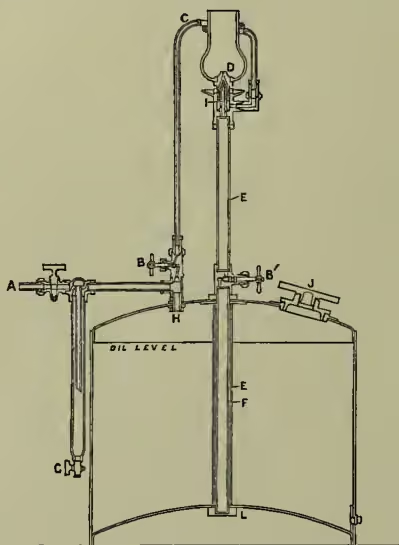
Lucigen, which was first used in 1885; but for a universal lamp the vertical type worked by compressed air may be taken as the best, which, with about 18 lb. pressure at the burner, gives the most regular and effective light.