Lycurgus

Chambers's Encyclopaedia, Volume 6: Humber to Malta, p. 751–752
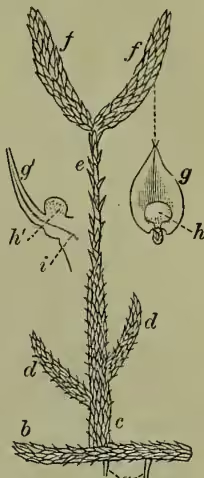
A detailed botanical illustration of a club-moss (Lycopodium clavatum). The main drawing shows a vertical stem with several pairs of small, lanceolate leaves. At the top, there are two spore-bearing branches (labeled 'f'). A single spore (labeled 'g') is shown in a section of a leaf. A sporangium (labeled 'h') is shown in a section of a leaf. A vein of a spiral vessel (labeled 'i') is shown in a section of a leaf. The stem is shown with roots (labeled 'a') and a creeping stem (labeled 'b'). The upright stem (labeled 'c') has vegetative branches (labeled 'd') and a stalk bearing the sporangiferous branches (labeled 'e').
Club-moss (Lycopodium clavatum):
a, roots; b, creeping stem; c, upright stem; d, vegetative branches; e, stalk bearing the sporangiferous branches. f, f, spore-bearing leaf; g, same in section; h, sporangium; i, vein of spiral vessels.

Lycurgus, the lawgiver of Sparta, is usually dated about 820 B.C. He was uncle of the young king Charilaos, and governed the state wisely during his nephew's infancy, then travelled over Crete, Ionia, and Egypt, and on his return, finding his country in complete anarchy, made a new division of property, and remodelled the whole constitution, military and civil. Next he bound the citizens by oath not to change his laws until he came back, and then left Sparta to be no more seen. His memory was honoured as that of a god with a temple and yearly sacrifices.

Source scan(s): p. 0766, p. 0767