Mackerel (Scomber), a genus of acanthopterous fishes of the family Scomberidae, which also includes the Tunny, Bonito, and Sucking Fishes. Members of the 'mackerel' family are pelagic forms of very extensive distribution. They are gregarious and predaceous, and are extremely active, the form of their bodies being eminently adapted for rapid gliding movements. Their muscles are richly supplied with blood and with nerves, and the temperature of their bodies is several degrees higher than in other fishes. The genus Scomber, the mackerels proper, comprises seven species, distributed in almost all temperate and tropical seas, except off the American shores of the South Atlantic. The Common Mackerel (S. Scomber) is found as far south as the Canary Islands, and from Greenland to Cape Cod in Massachusetts. It is abundant off the British coast, is found in the Mediterranean, but is scarce in the Baltic. It is a very beautiful fish of elegant spindle-like shape. Its colour is a lustrous dark blue above, with wavy blackish transverse streaks and silvery below. The tail is crescent-shaped, and has a slight ridge or keel on each side. The snout is rather long, pointed, and compressed.
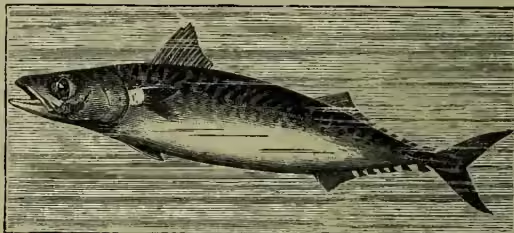
The mackerel is usually from 14 to 16 inches long, and about 2 lb. in weight, but it may attain a size of over 18 inches. Mackerels move about in shoals, approaching the coast at certain seasons either before or after spawning, or for purposes of feeding, following shoals of herrings, sprats, or pilchards, on which they prey. Their migrations are probably largely influenced by temperature. Early in the year they move from the deeper parts of the Atlantic towards the British coast. In May and June they are found off the Scilly Isles, whence some go up St George's Channel, but most proceed along the English Channel. They are very constant in the rate at which they travel during their migrations. The mode of capture varies with local circumstances. In spring and autumn drift-nets only are used; in summer, when the fish are near the shore, seine-nets are likewise employed. When the shoals are much broken up, hand-lines are used baited with various substances, such as a slip from another mackerel, a piece of a cuttle-fish, a thin rind of pork, worms, or indeed any glistening substance, such as a strip of coloured cloth moving quickly through the water. Hand-line fishing may be prosecuted at all hours of the day and night, but it is most successful in the morning and evening, and a smart breeze, termed a 'mackerel breeze,' is most favourable to its success. As food, the mackerel is very highly esteemed, but it taints very rapidly and loses flavour when kept. Owing to the rapidity of decomposition in hot weather, and the consequent injurious results to consumers, mackerel were allowed in 1698 to be sold in London either before or after divine service on Sundays, an enactment that appears not to have been repealed. The introduction of steamboats as 'carriers' instead of sailing-vessels has proved highly beneficial to the mackerel industry and to the general public. In the beginning of 1890 a first consignment of cured mackerel was sent from Cape Town to Princetown, Massachusetts. Off the south coast of England mackerel seem to spawn about May or June. Sars states that eggs are deposited some leagues from the shore and at the very surface of the waves, where large numbers of these fish may be met with engaged in spawning. The eggs float on the surface. In suitable circumstances the young grow rapidly.
Another species, the Spanish or Coly Mackerel (S. colias), is found in Europe in the Mediterranean, rarely on the south coast of England, and occurs from Nova Scotia to Cape Hatteras. It attains a weight of 4 or 5 lb., and unlike the common mackerel possesses an air-bladder. The Scad (q.v.) is sometimes called Horse Mackerel; the Mackerel Midge is a small Rockling (q.v.).