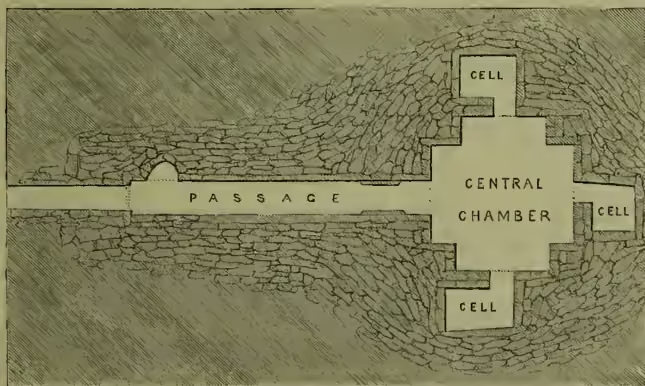
Maeshowe, a chambered mound in the Mainland of Orkney, 9 miles WNW. of Kirkwall and 1 mile E. of the great stone circle of Stennis. A grassy truncated cone, 36 feet high and 92 feet in diameter, it is surrounded, at a distance of 90 feet from its base, by a trench 40 feet wide, and still in places 8 feet deep. On the west side is a passage, 54 feet long, to feet wide, and to feet high, with (about midway) a unique doorway. This passage leads to a central chamber, measuring by feet; converging to a vaulted roof, originally 20 feet high; and built, like the passage, of undressed slabs and blocks of native stone. On each of the other three sides of the chamber, at a height of 3 feet from the floor, there is a square opening to a cell or 'sepulchral loculus,' 3 feet high, feet wide, and to 7 feet long. Maeshowe was explored in 1861 by Mr James Farrer, M.P., when it was found to have been ransacked at least once before—in the winter probably of 1152–53 by Norwegians, followers of Earl Rognvald, and pilgrims to Jerusalem. Their Runic inscriptions, comprising upwards of 900 letters, thickly cover the walls of the central chamber, and consist mainly of such inscriptions as 'Her- mund Hardaxe carved these runes.' There are carvings besides of eight crosses, a 'worm-knot,' and a nondescript animal. Mere idle scribblings, the runes afford no clue to the origin of the tumulus itself, which Dr Anderson assigns unhesitatingly to the 'Age of Stone,' whilst Fergusson ascribes its erection to Northmen and to a date so recent as 970.
See the article CAIRN; Farrer, Notes on the Runic Inscriptions (1862); Proc. Soc. Ant. Scot. (1867); James Fergusson, Rude Stone Monuments (1872); and Joseph Anderson, Scotland in Pagan Times (1886).