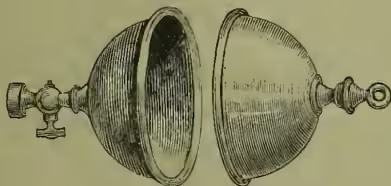
Magdeburg Hemispheres are two hollow hemispheres, generally made of copper or brass, with their edges accurately fitted to each other, and one of them furnished with a stopcock. When the edges are rubbed over with grease, pressed tightly together, and the globe thus formed exhausted of air through the cock, the hemispheres, which fell asunder before exhaustion, are now pressed together with immense force—e.g. if they are one foot in diameter, they will, after exhaustion, be pressed together with a force of nearly a ton. This experiment was first performed by Otto von Guericke (q.v.), burgomaster of Magdeburg, in 1650, at the imperial diet at Ratisbon, to the astonishment of the Emperor Ferdinand III. and his princes and nobles.