Magnetism (magnēs or lithos magnētēs, 'the loadstone,' probably first found at Magnesia in Lydia). Magnets are natural (Loadstone, q.v.) or artificial, permanent (steel masses magnetised by the action of other magnets or of an electric current) or temporary (soft iron masses magnetised by magnets, or the so-called electro-magnets, soft iron masses round which a current is passing).
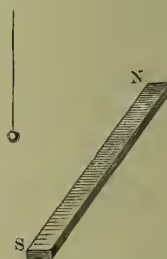
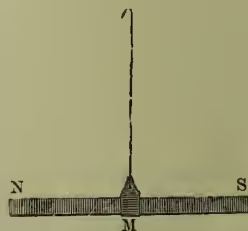
Polarity of the Magnet.—When a small soft iron, nickel, or cobalt ball is suspended by a thread, and a magnet (fig. 1) is passed along in front of it from one end to the other, the ball is powerfully attracted towards the ends, but not at all by the middle of the magnet. The points of the magnet towards which the attractive power becomes greatest are called its poles. By causing a small magnetic needle moving horizontally to vibrate in front of the different parts of a magnet placed vertically, and counting the number of vibrations, the rate of variation of the attractive power may be exactly found. When the poles of one magnet are made to act on those of another a striking dissimilarity between the poles is brought to light. To show this, let us suspend a magnet, NS, fig. 2, by a band of paper, M, hanging from a cocoon thread (a thread without torsion); or let us pivot it, or lay it on a float on water. When the magnet is left to itself it takes up a fixed position, one end keeping north, and the other south. The north pole cannot, except in unstable equilibrium, be made to stand as a south pole, or vice versa; for, when the magnet is disturbed, both poles return to their original positions. Here, then, is a striking dissimilarity in the poles, by means of which we are enabled to distinguish them as north pole and south pole. When thus suspended, let us now try the effect of another magnet upon it, and we shall find that the pole of the suspended magnet which is attracted by one of the poles of the second magnet is repelled by the other, and vice versa; and where the one pole attracts, the other repels. If, now, the second magnet be hung like the first, it will be found that the pole which attracted the north pole of the first magnet is a south pole, and that the pole which repelled it is a north pole. We thus learn that each magnet has two poles, the one a north, and the other a south pole, alike in their power of attracting soft iron, but differing in their action on the poles of another magnet, like poles repelling, and unlike poles attracting each other.
The attractions and repulsions are found in a bar-magnet to follow the same laws of distribution as would have been obeyed by the forces due to two equal isolated discs, the one attracting, the other repelling, and situated at points a little short of the extreme ends of the bar; and the places where these imaginary discs of imaginary magnetic matter would be are called the poles of the magnet. This conception of imaginary magnetic matter greatly facilitates many calculations, and is largely applied. It is as if the one kind of pole consisted of positive, the other of negative matter; and the north pole of a magnet is, in accordance with this order of ideas, conventionally termed the positive pole.
No Isolated Poles.—If we try to cut a bar-magnet so as to isolate the poles, we find that each half has developed a new pole at the broken end, and each half has become a separate magnet whose poles are equal to one another, and to the poles of the original magnet. We can therefore never have one kind of magnetism without having it associated in the same magnet with an equal amount of the opposite magnetism.
The Earth a Magnet.—The fact of the freely suspended magnet taking up a fixed position has led to the theory (Gilbert, q.v., in 1600) that the earth itself is a huge magnet, having its north and south magnetic poles in the neighbourhood of the poles of the axis of rotation, and that the magnetic needle or suspended magnet turns to these as it does to those of a neighbouring magnet. All the manifestations of terrestrial magnetism (q.v.) give decided confirmation of this theory. It is on this view that the French call the north-seeking pole of the magnet the south pole (pôle austral), and the south-seeking the north pole (pôle boréal); for, if the earth be taken as the standard, its north magnetic pole must attract the south pole of other magnets, and vice versa. In England and Germany the north pole of a magnet is the one which, when freely suspended, points to the north, and no reference is made to its relation to the magnetism of the earth.
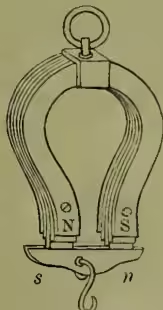
Form of Magnets.—Artificial permanent magnets are either bar-magnets or horseshoe-magnets. When powerful permanent magnets are to be made, several thin magnetised bars are placed side by side with their poles lying in the same direction. Such a collection of magnets is called a magnetic magazine or battery, and is more powerful than a solid bar of the same weight and size, because thin bars can be more strongly and regularly magnetised than thick ones. Fig. 3 is a horseshoe magnetic magazine. The central lamina protrudes slightly beyond the other, and it is to it that the armature is attached, the whole action of the magnet being concentrated on the projection. The magnetic needle is a small single permanent magnet nicely balanced on a fine point. See COMPASS.
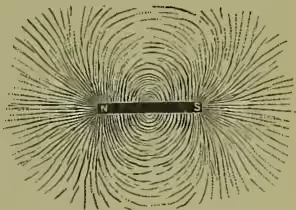
The Magnetic Field.—The region surrounding a magnet (even, to a diminishing extent, to an infinite distance) is in a peculiar condition. If a magnet be laid under a piece of glass and soft iron filings be sprinkled on the glass, each filing will assume a particular direction; and the whole congeries will map out the lines of the directions in which small magnets will be made to point by the play of the magnetic forces existing around the magnet, in the 'magnetic field' of that magnet. These directions are the Lines of Force in the magnetic field filling all space; and an example of them is given in fig. 4, which shows the arrangement of the filings above a bar-magnet, laid parallel to the glass. In a horseshoe magnet the strongest part of the field external to the magnet is that lying between the poles; the lines of force are there crowded together.
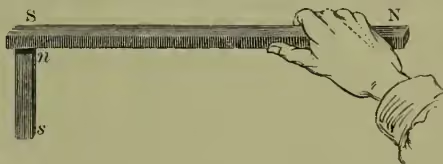
Magnetic Induction.—These lines of force external to the magnet are also Lines of Induction. In the direction of the lines of induction a magnetic separation tends to be set up; the soft iron filings are each converted, while in the neighbourhood of the magnet, into temporary magnets, each with a north and a south pole; the one pole is repelled, the other attracted; on the whole each filing is swivelled round into the direction of the local line of force. Similarly, a bar of soft iron becomes, while in contact with a magnet, as in fig. 5, or to a less extent when in its neighbourhood, itself a temporary magnet; and it may in its turn magnetise and support other bars, so that a chain of soft iron bars may, up to a limiting weight, be supported on a magnet. Steel bars are slower than soft iron in taking up a magnetic condition, and the harder their temper the slower they are in doing so; but, unlike soft iron, they do not readily lose what they have acquired; they become permanent magnets, while soft iron retains magnetism only precariously and easily loses it when mechanically disturbed. Specially soft iron may lose the whole when struck; ordinary wrought-iron will generally retain traces of residual magnetism, the amount of which depends on the previous magnetic history of the particular bar. The characteristically magnetic substances are iron, nickel, and cobalt; but many others, even liquids (such as solutions of salts of iron) and gases (such as ozone), are attracted by the magnet.
Diamagnetism.—Most substances are (in the form of spheres) feebly repelled by magnets, and bars of them lie across the lines of induction in a non-uniform magnetic field. These substances are said to be diamagnetic—e.g. bismuth.
Magnetisation by the Earth.—The inductive action of terrestrial magnetism is a striking proof of the truth of the theory already referred to, that the earth itself is a magnet. When a steel rod is held in a position parallel to the Dipping-needle (q.v.) it becomes in the course of time, and the sooner if struck with a hammer, permanently magnetic. A bar of soft iron held in the same position is more powerfully but only temporarily affected. We may understand from this how the tools in workshops are generally magnetic. Whenever large masses of iron are stationary for any length of time they are sure to give evidence of magnetisation, and it is to the inductive action of the earth's poles acting through ages that the magnetism of the loadstone is probably to be attributed.
Preservation and Power of Magnets.—Even steel magnets, freshly magnetised, sometimes gradually fall off in strength, till they reach a point at which their strength remains constant. This is called the point of saturation. If a magnet has not been raised to this point it may lose nothing after magnetisation. We may ascertain whether a magnet is at saturation by magnetising it with a more powerful magnet, and seeing whether it retains more magnetism than before. The saturation-point depends on the material of the magnet itself. When a magnet is above saturation it is soon reduced to it by repeatedly drawing away the armature from it. After reaching this point magnets will keep the same strength for years together, if not subjected to rough usage. It is favourable for the preservation of magnets that they be provided with an armature or keeper. The power of a horseshoe-magnet is usually tested by the weight its armature can bear without breaking away from the magnet. Small magnets are much stronger for their size than large ones. The reason of this may be thus explained. Two magnets of the same size and power, acting separately, support twice the weight that one of them does; but if the two be joined, so as to form one magnet, they do not sustain the double, for the two magnets, being in close proximity, act inductively on each other. The north pole of the one tends to repel the adjacent magnetism of the contiguous north pole of the other, and to form by induction a south pole in its place; the magnets thus weaken one another. Similarly, several magnets made up into a battery have not a force proportionate to their number. Large magnets, in the same way, may be considered as made up of several laminae, whose mutual interference renders the action of the whole very much less than the sum of the powers of each. The best method of ascertaining the strength of bar-magnets is to cause a magnetic needle to oscillate at a given distance from one of their poles, the axis of the needle and the pole of the magnet being in the magnetic meridian. These oscillations observe the law of pendulum motion, so that the force tending to bring the needle to rest is proportionate to the square of the number of oscillations in a stated time.
Action of Magnets on each other.—Coulomb discovered, by the oscillation of the magnetic needle in the presence of magnets in the way just described, that when magnets are so placed that two adjoining poles may act on each other without the interference of the opposite poles—i.e. when the magnets are large compared with the distance between their centres—the attractive or repulsive force between two magnetic poles varies inversely as the square of the distance between them. Gauss proved from this theoretically, and exhibited experimentally, that when the distance between the centres of two magnets is large compared with the size of the magnets—i.e. when the action of both poles comes into play—the action of two magnets on each other varies inversely as the cube of the distance between them. This variation in the strength of the field may be shown either by the oscillation experiments above referred to, or by direct observation of deflections produced at different distances. The action on a magnet in a uniform magnetic field is that of a couple, like that of the hands on a copying-press. There is rotation, but no translation, unless the field falls off in strength from the position of the one pole to that of the other.
Effect of Heat on Magnets.—When a magnet is heated to redness it loses permanently every trace of magnetism; iron, also, at a red heat, ceases to be attracted by the magnet. At temperatures below red heat the magnet parts with some of its power, the loss increasing with the temperature. The temperatures at which other substances affected by the magnet lose their magnetism differ from that of iron. Cobalt remains magnetic at the highest temperatures, and nickel loses this property at 662° F.


Electric Relations of Magnetism.—Every electric circuit is a closed loop of some form or other. Every such loop bearing a current has round it a magnetic field; and such a single loop is equivalent to a thin disc, or shell of any form, cut out of a large bar-magnet, and has a south and a north aspect. The lines of induction pass, say, from the north face outwards, filling all space, and return to the south face, threading the loop, so that each line of induction is a closed curve. The lines of induction immediately surrounding the wire are, if the circuit be large enough, circular in form. If wire bearing a current be coiled into a helix or solenoid (left-handed, fig. 6; right-handed, fig. 7), the helix acts in respect to bodies external to it exactly in all respects as a bar-magnet would do: the strength of the equivalent magnet being in proportion to the strength of the current passing. The magnetic field surrounding a current-bearing loop or helix is called an Electro-magnetic Field; and it is identical with the field which might be produced by a sufficiently magnetised mass of the same contour: the difference being that, since currents may be made very strong, 'electro-magnetic' fields can be made more intense than any magnetic fields obtainable from steel magnets. These phenomena have led up to Ampère's theory of magnetism.
Ampère's Theory of Magnetism.—Ampère considers that every particle of a magnet has closed
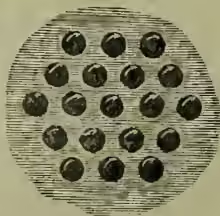
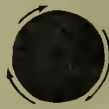
currents circulating about it in the same direction. A section of a magnet according to this theory is shown in fig. 8. All the separate currents in the various particles may, however, be considered to be equivalent to one strong current circulating round the whole (fig. 9). Before magnetisation the molecules lie in different directions, so that the effect of the currents is lost, and the effect of induction is to twist the molecules round so as to bring the currents to run in the same direction. The perfection of magnetisation would be to render all the various currents parallel to each other. Soft iron, in consequence of its offering less resistance to such a disposition, becomes more powerfully magnetic under induction than steel, in which considerable resistance to this displacement of the molecules exists, and which, when this deformation has once been produced, retains it to a considerable extent, this being the cause of permanent magnetism. This displacement of the molecules upon induction is often accompanied by a tick, or by a mechanical twist or an alteration in length and thickness.
Currents may also, it is probable, be induced by a magnetic field in the several molecules of a substance non-magnetic or not; and, as these are so directed as to oppose the magnetic field, we will, if we postulate the absence of resistance to them, arrive in non-magnetic substances at a state of things in which the stresses in the magnetic field and those in the substance acted upon by induction are opposed; and this will give rise to the phenomena, and may provide an explanation, of diamagnetism, which is, so far as is known, a property of bodies only found manifested within a magnetic field.
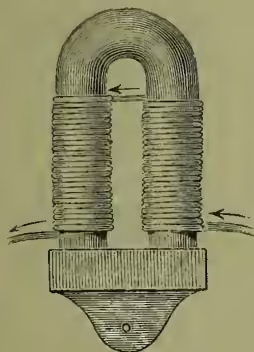
Magnetic Induction inside a Helix.—The interior of a current-bearing helix is a very powerful magnetic field, the most powerful part of the whole electro-magnetic field of the helix, since all the lines of induction are concentrated within it. Soft iron there becomes, instantly on the passage of the current, a powerful temporary magnet, or 'electro-magnet,' as it is called, which falls off in power instantly on the current being stopped; steel becomes permanently magnetised. Fig. 10 shows how the wires may be arranged to magnetise a horseshoe-bar.
The current of the helix, acting on the individual currents within the molecules, places them parallel to itself, and the result is that the soft iron comes to act as a magnet, stronger than any steel magnet. So long as the process of setting the molecules in position is far from being completed—i.e. so long as the iron is not 'saturated'—the strength of the magnetism induced in the core is approximately in proportion to the strength of the current and the number of turns in the coil. Another result is that on introducing a soft iron core into a current-bearing helix the lines of induction, which are due to the induced concert of the soft iron molecular currents, are added to those of the inducing field, so that the whole field is greatly strengthened.
Magnetic Attractions and Repulsions of Currents.
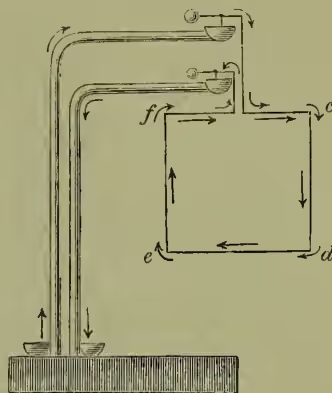
—The stresses in the magnetic field are such as to make all lines of induction from various sources coincide as far as possible in direction; and hence circuits tend to place themselves, as far as possible, coincident with one another in respect of form and parallelism of current.* It is not difficult to show that this tendency results in movements the same as those which would be produced if linear currents in the same direction (parallel, convergent, or divergent) mutually attracted one another, and currents in opposite directions repelled one another. When a circuit is in part flexible, the flexible part being a wire or even merely a line of discharge through air, it tends either to expand or to contract in area, so that it may come, as near as may be, to meet these conditions; and the result is that similarly-directed currents or parts of the same current move into the closest possible proximity to one another. This is illustrated by fig. 11, in which the course of the current is shown by arrows; the movable part of the circuit, poised on mercury cups, will rotate in a magnetic field so as to tend to make the direction of its own lines of induction coincide with the direction of the lines of induction of the magnetic or electro-magnetic field, and thus to make its own contour embrace as many as possible of the lines of induction of the field, if their general trend coincide with its own, or as few as possible if they be opposed; and, consequently, if a wire in which a current passes downwards be placed vertically near cd, the lines of induction round that wire and those round cd coincide in general direction, and cd appears to be attracted by the wire; while if the current pass upwards cd is repelled, and ef attracted. Place, now, the wire below and parallel to de. If the current passes in the direction d to e no change takes place, as the attraction cannot show itself; but if the current moves from e to d the whole turns round till d stands where e was, and both currents run the same way. If the wire be placed at right angles to dc, the rectangle turns round and comes to rest when both currents are parallel and in the same direction.
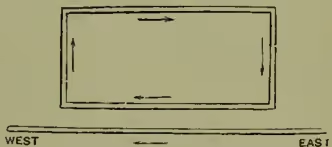
According to Ampère's theory, the earth, being a magnet, has currents in it which are equivalent to currents circulating about it; these must be from east to west, the north pole of the earth being, in our way of speaking, a south pole. A magnet, then, will not come to rest till its own lower currents place themselves parallel to and in the direction of the earth's currents. This is shown in fig. 12, where a section of a rectangular bar-magnet is is represented in its position of rest with reference to the earth-current. The upper current, being farther away from the earth-current, is less affected by it, and it is the lower current that determines the position. A magnetic needle, therefore, turns towards the north to allow the currents moving below it to place themselves parallel to the earth's current. This also is shown by the current-bearing rectangle in fig. 11, which comes to rest in stable equilibrium, in the absence of any external current, when and lie east and west.
The Measurement of Magnetic Data.—This has largely had its terminology evolved with reference to the equivalence of magnetic forces and phenomena to those which would be evinced if 'magnetism' were a kind of matter, positively or negatively attracting and resident in the poles. A pole of unit strength is one which attracts or repels another equal pole, situated at a distance of one centimetre, with a force of one dyne. The magnetic moment of a magnet is the strength of either pole multiplied by the distance between the two poles. This can be measured directly. The intensity of magnetisation of a bar-magnet is the magnetic moment divided by its volume. A magnetic field of unit strength or intensity at any particular point is a field in which at that point a unit pole would be pulled upon or repelled with a force of one dyne; and conversely, the intensity of a uniform magnetic field may be measured by finding the mechanical couple acting on a magnetic needle, freely suspended in it. The intensity of induced magnetisation produced by putting a long bar of a magnetisable substance in a uniform magnetic field of unit strength measures the magnetic susceptibility of that substance. The force within the substance of an induced magnet, due both to the inducing field and to the surrounding magnetised substance, when the inducing field is unity, measures the coefficient of magnetic induction or the magnetic permeability of the substance. The strength of a magnetic disc or shell is its magnetic moment per unit of area, if this be uniform.
Magnetic Measurement of Electric Data.—Given a magnetic shell of given outline and strength, its action upon a magnetic needle placed within its field can be observed; and conversely, from its outline and its deflecting action its strength can be calculated. An electric current of the same contour can have its intensity so regulated as to produce the same magnetic effect as the magnetic shell did upon the needle in one position; and if in one, then in every position; and the intensity of that current is said to be, in magnetic measure, numerically the same as the magnetic strength of the equivalent magnetic shell. This is the basis of a system of electric units, called magnetic or electro-magnetic units of electric quantities; and convenient multiples and submultiples of these—arrived at by substituting for the centimetre, the gramme, and the second, as the units of length, mass, and time, 1,000,000,000 cm., the ampère, the part of a gramme and the second as these fundamental units—are in use as the practical units for electrical measurement. These are the ampère, the unit of current-intensity; the ohm, that of resistance (= the resistance of about 106.2 cm. pure mercury column, 1 sq. mm. in transverse section: defined as that of 106 cm. by the Paris International Electrical Congress); the volt, that of potential difference or 'electromotive force' (= approximately that of a Daniell cell, in which the liquids are a saturated solution of nitrate of copper and dilute sulphuric acid, 1 acid to 22 water); the coulomb, that of electric quantity; the farad, that of capacity; and the quadrant, that of self-induction.
Self-induction.—When a current is suddenly started in a coil of wire, the ultimate result is to set up a magnetic field. But, while this is being set up, energy is being absorbed by the field, and the current falls short of its full intensity. Similarly, when the current ceases this energy is restored, and the current seems piled up as if it had momentum of its own like water in a hydraulic ram. The stronger the magnetic field that will be produced—the more lines of induction will thread the coil—the more marked is this effect; and this exaggeration is brought about by multiplying the turns in the coil (keeping down the resistance, if necessary, by increasing the thickness of the wire used), or by inserting a core of soft iron, or both.
Induction of Currents in Magnetic Field.—Lay two circuits in one another's neighbourhood. The sudden production or increase of current in the one will produce a brief current in the other in such a sense that there is mechanical repulsion between the induced current and the originating one; the cessation or diminution of the primary current induces, in the opposite sense, a brief current in the secondary circuit. These are phenomena of the magnetic field of the primary circuit; and the primary circuit can be replaced by a magnet or electro-magnet, whose approach or strengthening induces brief currents in one sense, and whose recession or weakening induces brief currents in the opposite sense. No current passes in the secondary coil so long as the primary current or magnet remains constant or stationary. For the ways in which this production of a secondary current is utilised, see DYNAMO, INDUCTION. If we try to move a good conductor—a copper disc or a knife—in a strong magnetic field the motion is resisted or damped; the production of the induced currents generated by motion in the field absorbs energy.
Rotatory Features of Magnetism.—As a simple case, consider the field in the immediate neighbourhood of a linear current. The lines of magnetic force run in circles round the wire; a magnet pole tends to be driven in such a sense that, if it be positive or north-seeking, it will travel round an advancing current in the same sense in which the point of a corkscrew travels round the axis of the advancing corkscrew. If a magnet were flexible it would form a coil round the current; and conversely, a flexible current-bearing wire tends to coil round a strong bar-magnet, and currents parallel to bar-magnets tend to rotate round the magnetic axis of the magnet.
Nature of the Magnetic Field.—All the phenomena of the magnetic field are explicable as due to whirlpool currents of electricity in closed vortex-rings, the axes of which are the magnetic lines of induction. The reaction of tendencies to the formation of these vortex-rings from different sources results in the production of local variations of stress in the ether which result in attractive and repellent movements between currents or magnets, or between currents and magnets, or in the production of currents, or of magnetic induction; and the resultant forces are along the axes of the whirls which tend to shorten themselves longitudinally and to spread out laterally. The electric displacements in the whirls are therefore at right angles to the lines of magnetic force. With other dispositions of the magnetic field we have other forms of the lines of force; but they are always closed curves which mark the axes of vortex motions or shears, and which lie wholly in air, or partly in air and partly in metal or other substance.
Electro-magnetic Propagation.—When a disturbance is set up in one place which leads to the formation of a magnetic field, the change from the original condition of the ether to the complex condition which is known as 'magnetic field' is marked by a magnetic or electro-magnetic propagation of the disturbance; and the theoretical velocity of this propagation has been shown to be about 300,000 kilometres per second, which is practically exactly the same as the speed of the propagation of light. In a linear current the direction of the current is the direction of propagation; the disturbance is propagated in the ether, not in the conductor; and the magnetic and electric displace- ments are at right angles both to the direction of propagation and to one another. Without a linear conductor to guide the propagation the disturbance is propagated equally in all directions; and Clerk-Maxwell advanced the proposition that light is a phenomenon of this order, an electro-magnetic phenomenon involving vortical stresses, rather than the mere vibration of an elastic ether. This proposition has been strikingly confirmed by the researches of Hertz in 1888. He found that by producing waves of electro-magnetic propagation of periodic disturbances he could reproduce with long waves, which he found to travel at the predicted rate, the phenomena of reflection at the surface of a conductor, refraction, polarisation, interference, &c., which are manifested by those short and frequent ether-waves which give rise to the phenomena of light and radiant heat; and his results have shown that the plane of magnetic disturbance, at right angles to that of electric disturbance, is the analogue of the plane of polarisation, which must be at right angles to the plane of vibration. By Hertz's researches the science of light has been made a part of the general science of electro-magnetism.
See DECLINATION NEEDLE, DIAMAGNETISM, DIPPING-NEEDLE, DYNAMO-ELECTRIC MACHINES. For literature, see ELECTRICITY; and refer to Sir William Thomson's Reprint of Papers on Electrostatics and Magnetism (1872); Von Helmholtz's Wissenschaftliche Abhandlungen (vol. i. 1882); and O. J. Lodge, Modern Views of Electricity (1889). For instruments, &c., refer to W. E. Ayton's Practical Electricity (1886) and Jamieson's Magnetism and Electricity (1890).