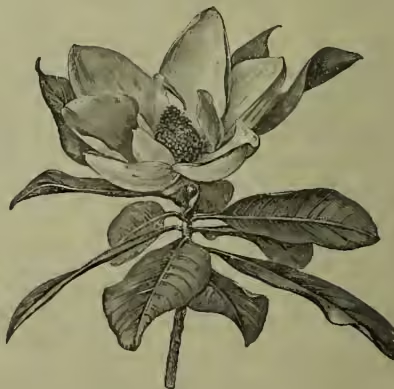
Magnolia, a genus of beautiful trees of the natural order Magnoliaceæ, having a calyx of three sepals, a corolla of six to twelve petals, and carpels in spikes arranged in cones, and opening at the dorsal suture. They are natives chiefly of North America, the Himalaya Mountains, China, and Japan. The flowers are large and solitary; the leaves generally large, in some species evergreen, in others deciduous. The wood is in general soft, spongy, and of little value. M. grandiflora, sometimes called the Laurel-leaved Magnolia, has white flowers of great size. It is an evergreen tree about 20 feet high, with magnificent laurel-like leaves, found in the lower districts from North Carolina to the Gulf of Mexico. It succeeds well as an ornamental tree in the south of England, but in Scotland requires a wall and some protection in winter. M. tripetala is found on the Alleghany Mountains, and extends as far north as lat. 43°. From the radiated manner in which its leaves are disposed at the extremities of the branches it has received the name of Umbrella Tree. It has very large white flowers. It is one of the species most commonly cultivated in Britain, but in Scotland it requires a wall. M. acuminata inhabits the same districts, and is a lofty tree with greenish-yellow flowers. It endures the climate of Britain well, but its flowers are not so much admired as those of some of its congeners. M. glauca, a native of Pennsylvania, Virginia, and the Carolinas, is known by the names of White Bay, Beaverwood, and Swamp Sassafras. It is a tree or shrub of 15 to 20 feet in height, with very beautiful and fragrant white flowers. The Yulan, or Chinese Magnolia (M. Yulan or conspicua), has been much cultivated in China for more than twelve hundred years on account of its beautiful and fragrant white flowers, which it produces in great profusion. It is one of the finest ornamental trees, and succeeds well in the south of England. It is a deciduous tree, and the flowers expand before the development of the leaves. M. excelsa, one of the finest species known, is a predominant tree in some parts of the Himalaya Mountains, at an elevation of 7000 to 8000 feet, the mountains, when it is in blossom, appearing as if sprinkled with snow. M. Campbellii, another native of the same region, produces great rose-coloured flowers, and is described by Hooker as the most superb of the genus. The bark and fruit of all magnolias possess tonic bitter properties, and the bark of some of the species, particularly that of M. glauca, is used in domestic medicine in the marshy districts of North America in cases of rheumatism and fever. Michelia and Manglietia are closely allied genera. The natural order Magnoliaceæ is closely allied to Ranunculaceæ, differing chiefly in the arborescent habit, and in the large stipules which envelop the young leaves before they open, but soon fall off. The leaves are simple. Aromatic properties are prevalent. To this order belong the Tulip Tree, Star Anise, and Winter's Bark.